Showing posts with label solar. Show all posts

Thursday, July 2, 2020

Urú!

Well, I think I will delay my supposed vacation from blogging just a bit and will be posting this blog post, hopefully.
Meanwhile, we were supposed to get back to work partially with things going gradually in the fight with COVID-19. Suddenly, though, things started getting out of hands here and the number of hits is increasing by day as I'm typing these words in what seems to be a second wave. So, Phase I, which was supposed to be ending by June 21st, is extended further to some unknown time till this moment. Who knows, maybe till the time of posting this, Phase II would in effect (and probably I'll be heading back to work).
Anyway, I was planning to post about a series of shots, which I'm going to call The King Series, but I think I will delay that for now in favor of the shots I've shot on June 21st for the solar eclipse; My FIRST ever solar eclipse shooting!
However, I have to notify you in advance that this would be a rather short post (or maybe I should say a boring post) because shooting the eclipse was kind of "monotonous". Or in other words, no big deal about it; Nothing special!

Urú!

Sigma DG 70-300mm.
Just before I start, Urú actually means "eclipse" in Irish; Just so you know. Now, I really wished that I would have taken these shots within the framework of a landscape, but this was not possible (of course). Thus, I had to satisfy myself with what I can do at the moment. I Just picked my Sigma 70-300mm lens fitted with B+W 403 UV filter and Kenko's IR Cut filter, and my modified EOS 7D and headed out. I had an idea of using my Rokinon 800mm f/8 Mirror Lens, but abandoned the idea when I remembered the hurdles and hardships involving its focusing (manual) and also no filter would fit that (except for the solar filter maybe), but I really wanted to shoot in ultraviolet here to experience what the outcome would be. Not a big deal though, for sure, but still, it was an experiment to be done!
Rokinon 800mm Mirror Lens,
a.k.a. Barrel lens.
The solar eclipse started around 7:20 a.m. local time, so I was there with my tripod. The other unpleasant part about this eclipse is that it was partial only and not annular. Anyway, I guess I don't have the right to complain here since it's my first time to shoot a solar eclipse.

Triple Eclipse

Kenko's infrared cut filter,
to stop the infrared leakage in
the ultraviolet pass filter.
Now, the ultraviolet and IR cut filter did a good job in blocking the sun, in addition to the high f-number (but this one I was fluctuating between f/11-f/22) and the high shutter speed (settled down later to 8000-1s). However, the first few shots were bright (too bright) as can be seen from Triple Eclipse. Also, this brightness showed the inner reflection problems (common when you stack filters on a lens), and for this we see here a triple image for the eclipse; One real image and inner reflections in between the filters and the lens. Can serve an artistic purpose but definitely not always.

Stages

As I've stated already, the shoot was a bit boring really: Shoot a series in burst mode, adjust the camera tilt, shoot again. The thing kept on and on. I was hoping though that I would get some details from the sun or its halo when I process the ultraviolet images but I think I did need an extra zoom here (I was shooting at 300mm of course). I wanted to use a teleconverter to shoot at 600mm but then I thought, well, it's my first time; I better shoot with what I'm sure that would work. Adding a teleconverter would reduce the amount of light significantly and adding an ultraviolet filter is not quite a friendly thing, since UV wavelengths are quite sensitive to the glass and are drastically reduced. All in all, it was a good idea to reduce the amount of glass through which the UV must pass. Anyway, the good thing after all is shooting different stages of the eclipse where the moon gradually covered more and more of the sun disk. So, I decided to merge some of these images all together in some artistic way and so it was Stages. Of course, this is not the real path of the sun in the sky; Things were harder in reality as I was following the sun at 300mm. The event started to get closer and closer to the zenith point and things started to get harder for me to look (I was covering my head and the camera's back with a towel). However, at the end, I've decided a video, just so I might do something with it. And I did!


Note: The music comes from Free Music Archive website, and titled Magic Hour by Three Chain Links - Hope I got it all right!

The original video was almost 8 minutes long. Around the end, I got a signal on LiveView warning me about sensor heating, and that's when the video ended as I had to switch the camera off, of course. Anyway, shooting was getting harder at that point as I said as the camera got almost pointing to the zenith.
The problem with the video is that it was not easy to deal with and correct the color shift. I had to process the video several times to make it smaller in size to be dealt with and correct the color using "traditional" approaches (I've edited the video in Photoshop to correct the color in fact), and used OpenShot Video Editor to speed up the video. For some reason this one kept on crashing when I wanted to add the audio track so I had to close it down and head to the traditional Windows Movie Maker to add the audio. Such a mess. This said, I'm not really planning to venture into the world of video yet. Maybe never. Still, this is not the first time I do shoot a video with such filters and correct the colors, I just wish that correcting the White Balance for videos was easier than it is, just like the case with RAW files.

Finale


Well, after this little post about the past solar eclipse, I'm thinking seriously about giving myself a bit of a vacation from blogging for the time being, even though there is indeed some "good" material to post and discuss as I've mentioned before; The King Series, which sadly seems to have been abruptly stopped at the moment. Meanwhile, and for this short vacation from blogging (which I think would be around 2-3 weeks), there is much thinking to be done, and try. Just a side note, I've downloaded GIMP lately and I'm tinkering with it to see how I would adapt to this editor.
In case you don't know what GIMP is, it is a free opensource editor. And like how RawTherapee is somewhat a mimic for Adobe's Lightroom, GIMP is the mimic for Photoshop.
My initial trial with it leaves so much to be desired though it has some sparkle about it and things that got me interested to try out, but first things first and there are some essentials that I need to get around with, like how to edit a RAW file and changing the workspace color (it's dark gray which is not suitable for judging colors). I'm digging still through this and for sure I would need to be going through a lot of Help files and topics.
Beside all this technical mess, there are also some issues I'm working on but maybe it's not a good idea to talk about them right now as I'm actually unaware of the "end" of these issues and whether they are going to lead where I want it to be or not, but it is something that I better work on slow for now, and when the time comes, I'll talk about it in this blog, maybe.
And as with the ongoing crisis and home quarantine, which is more or less active despite the gradual opening and going back to normalcy, I've realized the fact that the hardest thing about isolation is not being isolate or alone at all, but hardships lie in being forced to be with others. I believe this is exactly the real problem with jails and imprisonment; Not confinement itself, but being with others and bearing with them, specially if a person does not get along with much of them.
Despite the lengthy period of time spent at home and not going to work, despite all of that, I still feel the need to get a vacation as if I'm not ready yet to get back to work. As I'm typing these words it has been confirmed that I should go back for one week at least starting from July 5th to supervise some cleaning and disinfection work, and probably check on some devices. For such a little task under such circumstances, I still do feel not ready for the whole thing as if I didn't take a vacation for months. Which is true in some sense because the months in which I've stopped going to work were mostly spent at home coping and fighting against mood swings… severe mood swings. Maybe this whole thing is a signal that I need to find something, change jobs or resign, or anything. An idea that I had since long time but never been able to step it up further because, simply, there is not much to do out there for people like me. On the other hand, there are even more pressing matters that I deem more important than work and its situation which do require more attention from my side, and yet, they are just afloat without any real vision nor a solution in the near future. These matters are more or less related to the fact of how am I supposed to enjoy life for real, away from the network of mood swings and depression, and re-discovering what love is, in a time when I'm approaching 40 already… if love still exists, that is.

Thursday, November 21, 2019

Ave…

The weather is getting colder here, as well as my heart along the way I presume. It would have been such good news and feeling, if not for the passing of a dear online friend that suffered from a long battle against diabetes. Though we never met really, but we still shared all the jokes and laughter together and she was quite fond of my photos. She dreamed that one day we might meet up in Ireland and even do some photography in front of her. She made me feel as if my photos from Ireland made her re-discover her homeland; As if she was not Irish already, living her final days in the US.

Rest In Peace, Paula Doak


Mearcair

Last week the news were out about a transit of Mercury over the disk of the sun. Not a rare event but it definitely is not the average event that would happen every year. I think the next transit for Mercury of this sort might take place in 2032 or sometime around that if I'm not mistaken, and I'm not sure even if it would still be visible in the sky here. Rarely even more than Mercury, are Venus transits. I think the next transit won't be happening in my life time at all!
Anyway, the adventure was set on Tuesday. I had a very limited time to prepare for the shoot as the transit would occur only at about 3:30 p.m. local time, and then in about one hour the sunset would officially start. To gain some time, I've actually prepared my gear the day before and made everything ready, so all I had to do is pick up the gear and head to the roof of my house. I still had some fears back then that some objects would block the view as the sun goes down in the sky but luckily none of that happened. So, in a nutshell, my gear was composed of:
  • My modified Canon EOS 7D.
  • Solar filter.
  • Rokinon 800mm Mirror Lens (fixed at f/8).
  • Flexible cable (will explain why below).
  • Cable remote.
  • Tripod of course, with ball head for easy and quick movement.
I had to refer back to my old tripod which I didn't use quite a while mainly because it extends quite high compared to my other most-used tripod, without needing to raise the central column or the neck.

The gear I used and you can see the cable around the mirror lens,
while the clips hold the solar filter over the lens front.
The shot was out of focus because the flies were really, really, really annoying.
Yes, that much annoying that I couldn't focus properly with my phone.


I was reluctant to use my old mirror lens with its cumbersome control mechanism; Just a complete manual lens with a primitive telescopic design crammed in a small volume. However, knowing that Mercury will be such a small dot over the sun disk, I've realized (and I've done my own research as well) that I do need a very long focal length, and here I had two choices. Either:
  1. Use my Sigma 70-300mm with teleconverters, OR,
  2. Use my Rokinon 800mm Mirror Lens.
Rokinon 800mm Mirror Lens f/8
Comparing the two, the scale tilts towards the Mirror Lens further. Because using teleconverters would reduce the light quality further (beside using a solar filter here) and this might not be such a good idea and the overall size of the whole lens/teleconverter combination would be too long and I'm sure it would give me some hard time in movement (specially with my external telephoto lens sleeve which is not quite as flexible as a regular sleeve on a real telephoto lens). Adding one teleconverter to my Sigma lens at 300mm would extend the focal length to 600mm. Adding another one would make this jump to 1200mm. Juicy! However, my previous experiences in shooting the sun with such a long focal length were quite cumbersome specially when it comes to moving tiny amounts of degrees to follow the sun (remember: the more you zoom in, the faster the celestial body will virtually move). So, imagine here that I'm jumping to 800mm with a single lens only and without much light quality loss; As simple as that.
Now, we come to the story of the cable. Since the focusing with such long focal length and cumbersome mechanism would prove to be a challenge, I got myself these multi-purpose bending cables or wires long time ago solely for this purpose; To wrap them around the focusing ring of the mirror lens and use it as a level to move the focusing ring gently. It didn't stop the shake though but it was quite useful nevertheless.

Mercury, after processing the image (cropped).
The lower right line is just some dirt.


Anyway, my main aim was to shoot a series of shots of Mercury crossing the sun disk but unfortunately after one hour of shooting or so, I just got plenty of images with the position of Mercury almost not moving. After being attacked by flies and sweating waterfalls I had to get inside and stop the whole thing (at that point it was past 4 p.m., and still didn't have lunch then!). So, technically, despite the many many images I've shot, I didn't quite get a serial sequence after all. Probably one of the mistakes that I've committed here is that I've focus on the sun (by checking the edges of the circle on LiveView of course) thinking that because of the great distance between Earth and the sun, Mercury would virtually be in focus as well. This seems to be not the case here though! When I've edited the images, Mercury was not quite that sharp dot on the disk of the sun, but more like a blot of ink!

100% Crop of one of the images. Mercury is the small black dot,
which I think it could have been more in focus. In some images, Mercury
completely disappears.
(click to enlarge)

What amazed though is the presence of dirt and other artifacts. I thought first that those are only on the solar filter from the outside but it turned out to be they are sensor artifacts. This is despite cleaning the gear (lens and camera) the day before and making sure all are clean (and using the loupe to check the sensor specifically). I'm not sure how this got in, but definitely I need to check and clean it later. Didn't have time to do so yet.
At this point, my little "silly" adventure with Mercury transit was over and I'm still checking the images Ivé shot (counted more than 2400 images) to see if I can do anything artistic about them! We'll see.

Finale

The departure of a friend, an online friend, is not in any way less drastic than a real physical friend's departure; Whether met or not. This departure was sudden to me, because she was supposed to be coping well with her new condition after amputating one of her legs because of some blood problems. Such a drastic and sudden change of events.
All these feelings actually are pushing me to write emotionally from the first moment I've heard the news, and typing an eulogy on her feed on Facebook. Now, I feel the urge and the necessity to really focus to write one poem at least for her sake.
All these ideas seem to clash now in my head though. I do have other tasks and other ideas of photography that I want to work on. One might consider typing or writing a poem is easy but that's not really the case at all. It needs dedication and time, and foremost, an immersion into your own feelings. Now my feelings are there hovering in the air as well as my words, but I have to turn my mind into a lens to focus these into proper and rhyming words on paper (or monitor that is). Goodbye Paula. May we see each other one more time, in peace…


Thursday, July 14, 2016

Post-Ramadhan…

Ramadhan has passed, and so did Eid (The Feast), and now I'm back to my normal pace. Well, almost. If you can call my life normal anyway.
As much as it was idle, I had the chance to do some experiments during Ramadhan, and the majority of my work with photography was actually visiting old photos and doing effects or re-working panoramas I've done in the past (mainly from Malta). All this experimenting did actually trigger me to place an order, which I will explain later.

An Ghrian

An Ghrian, the sun, in Irish. I did try to take shots for the sun before (and almost got my sensor fried too!). However, this time it's a bit different, with my converted Canon EOS 7D and an ultraviolet-pass filter. Though I did some trials using my Rokinon mirror lens which I didn't use much, but most of my trials were done with my Sigma 70-300mm plus two teleconverters (yielding a total of 1200mm in focal length). Not only controlling the Sigma lens is relatively easily in terms of focusing (a must-be manual), but also most of my filters (ND, IR, and UV) are circular filters that fit the Sigma lens only (with a step-down ring). As for Rokinon's mirror lens, and despite the great zooming that could be achieved, the fact that filters can hardly be used here made it a dangerous tool and hard to control.

The sun shot with a stack of 4 filters.
Story about it here.

In the process of capturing better images for the sun (and the moon), I came into the swirl of the world of filters and not only for lenses, but also for telescopes and eyepieces, as I was looking for ways to get the desired look (scientifically) and checking probability for finding what I need in other categories; but without the need to get a telescope either.

Taken in UV filter.
The set can be found
in my stream.
In the process of learning more about the world of filters in relation to shooting the sun and astrophotography in general, I've encountered the sad fact that my B+W Black 403 UV Pass filter is not a pure UV Pass filter, but it does leak some great amount of IR. Hence, probably many images I've taken before using this filter specifically were actually formed by IR beams and not by UV spectrum specifically. Nevertheless, some of these were good, and weather in IR or UV, I was able to show some surface features for the sun, even though the usual filter used for such detail is the H-α filter (another filter on my wishlist). After researching a bit further for some way to enhance the performance of my UV-pass filter, I've found out that the only way to do this is by attaching a hot-mirror filter or NIR-cut filter (Near InfraRed). I'll talk about them a bit later, as it seems I couldn't get exactly what I wanted.
Beside the mess, I'm considering seriously to get some 30.5mm filters for the rear of my mirror lens, but that should be on hold for some time now since more important issues must be dealt with.

1200mm, f/128, 0.8s, ISO100.
Using UV-pass filter.
The dot on the sun is Venus.
June 17th, 2016.

Re-Work

During Ramadhan, the majority of work was actually re-working or editing my old panoramas and applying some techniques or effects on them (e.g. watercolor effect). The majority of this work is just to post these images on Instagram later on though. However, I was able to mingle a bit with some older panoramas to discover some new projections that I've never done before to them.

Qalaoid
Gruama
In fact, my work also included some old shots from 2013, like Gruama, which was shot using my then-new infrared-pass filter. It was just a re-process in some different way since I was not experienced back then with such filters (and it was taken with a regular camera). Back then I didn't appreciate the effect much but now I realize that my B+W infrared pass filter with threshold of about 650nm is in fact pretty useful for artistic uses. Increasing the threshold for infrared filters will approach photography more into the realm of monochrome rather than being colored infrared with the typical vivid and pleasant strange color cast. Kodak's gel filter which I usually use with my fisheye lenses has a threshold of 1000nm, and thus chances for producing vivid colors even with my converted camera is next to null; shots are always monochromatic, in between red and blue tints, as can be seen in Dawwar tal Qaddis and Planeta InfraĠużeppi.

Planeta InfraĠużeppi

Dawwar tal Qaddis

Toys

 Now to the fun part: new order placed and excitation in the air! Though I wished that I could expand the list of my items this time but all is placed in the wishlist waiting. I have a budget I'm trying not to exceed, and yet I'm trying to educate myself further in terms of filters and some aspects of astrophotography.

Source: B&H.
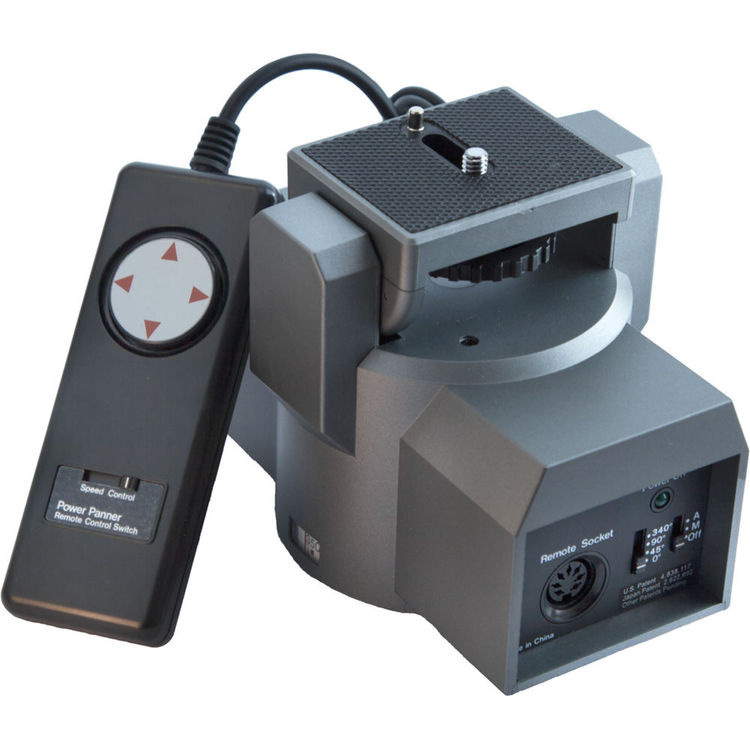
As I'm limited in terms of the budget, I've tried to limit myself to the very essential items, like this one: CamRanger MP-360 Motorized Pan/Tilt Tripod Head. This tripod head must be one of the MOST wanted items in my list since I'm having hard time controlling my lens when it is zoomed in (specially when it comes to shooting the sun or the moon). Tripod heads available for me now are just impractical, since at large magnification values for objects like the sun or the moon, the object would look to travel faster than it would appear to the naked eye, and I would have to adjust the knobs for the tripod head after each shot to follow up. This head should and is supposed to solve such problem quite easily by controlling the orientation by a cable remote.

Source: B&H.
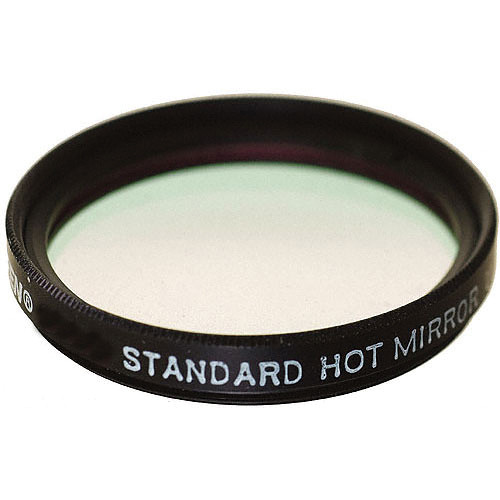
One of the major items and one of which I've been hesitant to order is the Tiffen 58mm Standard Hot Mirror Filter. The idea was primary about using this filter to aid my UV-pass filter and stop the IR leakage in it. However, checking the transmission curves provided, things would seem shaky with this filter because it does block spectrum in the range of UV as well. Roaming the net around, I've learned more and I've experienced more on how to read transmission charts, but unfortunately, no perfect match for my need was found. Few filters were found with quite narrow band passage allowance in the UV, but the corresponding websites looked weird a bit and I couldn't even place an order! Anyway, if this filter didn't work well with my UV-pass filter, I'm planning to use it normally and directly with my lenses, since it helps on clearing the image and increase its sharpness as I read in some articles; so in essence, it has a clearing factor just like what UVC (Haze, or UV-cut) filters do, but in a different region of the spectrum. However, this is not the end of the story with filter, as the lens itself play a major part in UV Photography, because modern lenses are usually multi-coated for UV protection, and seems older lenses are more appropriate for the task!

Kylemore Abbey

Coming to mention UV-cut filters, I've noticed some bluish streak in the panorama done for Kylemore Abbey in 2014. Even though the panorama is tone-mapped from HDR, yet such bluish haze (in the mountains) might not be removed with HDR technique and would require UV-cut filter indeed. For this reason, I've started to look for gel (or polyster or resin) UV filter to be used specifically with my fisheye lenses. Ironically, I barely used my circular 58mm UV-cut filter!

Source: B&H
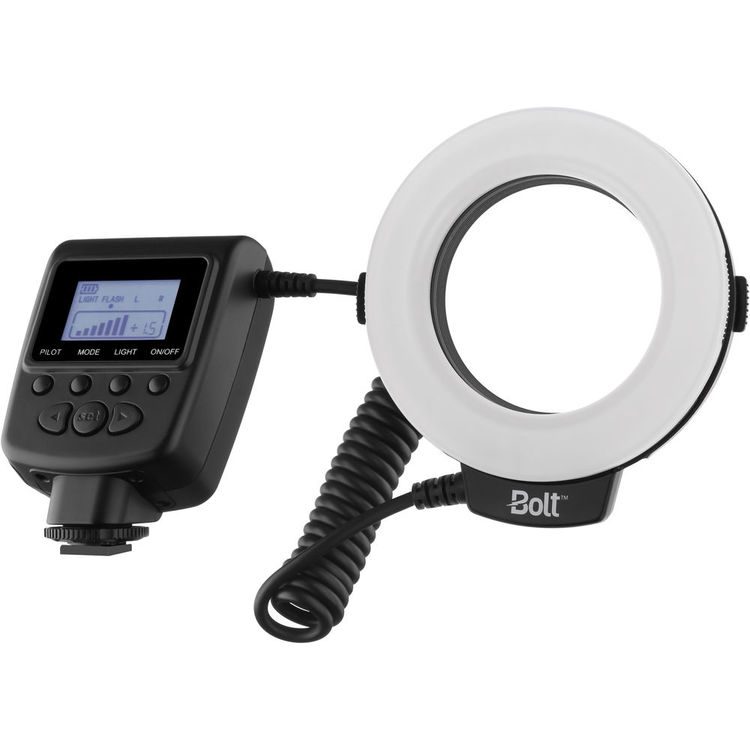
Another critical item which I've been postponing its purchase is the ring flash for macro photography. Since I don't delve deeper on a professional level with macro photography, I've thought that such professional ring flashes like Canon's are way too expensive for my simple use. Thus, I've decided to head to something more simple and cheap for occasional usage: Bolt VM-110 LED Macro Ring Light. It comes with various adapters for various diameters, and it uses LED instead of a flash tube. Moreover, this ring flash is universal and doesn't depend on TTL system, thus it works with any DSLR almost as the description reads. Some people would strongly recommend using TTL systems but I'm quite used by now on using manual modes in regular speedlites. Thus, handling this item should not be a problem supposedly.

Beside these major items, I've ordered some cheap infrared polyester filters and other stuff which I might talk about later. Also on the way but from another resource, some Baader filter sheet (or solar filter) to be cut and shaped freely for shooting the sun, and a book about Sumerians (been my fascination for some time). I can somehow consider this to be my own birthday gift to myself, but a bit early.

Finale

Up till this moment, my life is undergoing a storm, despite the calm appearance from the outside. Let's not delve into these matters of the heart for now. All I can say for now is I'm urging these new toys to arrive, as soon as possible, to get me started playing around. I need to put my worries onto something; the sooner the better…


Thursday, January 9, 2014

Sonnenaktivität

Here we are; a new year. I won't be talking about resolutions here as, in fact, the new year thing is not widely separated and the concept of New Year's resolutions is just something weird for most of the people here - needless to say that we grow up without really considering it something special that a solar year passed and a new one began.
I can't say my beginnings of this year were good, but I really couldn't care lesser about my bad luck, or the troublesome conflicts with other people around me, specifically at work. This, by now, became like a daily dish for me.
One of my great sorrows for the past week is that I wasn't able to go out at night during the long "weekend" which consisted of 4 days and shoot at night. Mainly because not much scenes were available, and some of the locations that I've used to visit for some solitude and silences, were bugged by annoying people and their trash. Luckily, I did some of my homework the week before and did shoot something at night.

Blaue Nacht

From the early beginning of that night, it was a helpless endeavor trying to find out something to do and not to sleep that early in a such winter night. My first pick was a location that I used to visit years back, and specifically at such time of the year (and even did a panorama there deep in low tide time). This time, however, the situation had changed. People (specifically the annoying type) were still roaming the place. I tried my best to stay away from the rest and do my own business.

Ausstrahl
Rokinon 8mm fisheye, f/11, HDR.

I have to say that the main reason for visiting old location is some inspiring kick that got to me when I viewed some old images (specially those I've made into 3D anaglyph images) of a broken shade on the beach. Back then, I didn't have the fisheye lenses that I do have now, specially the Rokinon 8mm. Thus, I've decided to re-discover the area and this shade specifically with my Rokinon because, simply, the geometrical patterns were inspiring as they are.
As I settled down in the place, over the soft sand, I was faced with two main problems: a) setting up the tripod on a soft ground, and b) the flare from the harsh lights of the restaurant at my back. In the final image, Ausstrahl you can still see some traces of the flare even after the crop. One of the problems with fisheye lenses like Rokinon, with a large field of view, it is the hardship to use a flag to block other light sources that cause the flare; simply because there is a big chance that the flag would get into the frame, and when moved out of the frame it does not technically block anything!
On the soft sands it took me some time to settle and to take some test shots with ISO12800 to judge my composition. I've decided then to go with long exposure brackets; something that became a favorite activity at night exposures. Can't remember the exact timing but it ranged from about 8 minutes down to around 30 seconds. Almost at the end of the exposures, some guy was peeking from the top of the concrete wall behind me and started to make comments. His comments weren't bad or vulgar, but they were simply nosy. Thus, when I felt the situation being like that, I didn't stay longer and picked my stuff and left the place.

Altar
Rokinon 8mm fisheye, f/8, 4m, ISO100.

Leaving the first location, I still had the urge to work a bit more, thus I've visited Soog Sharg dock place where I made some shots several times previously. This time, it was relatively quite (as the time was nearing dawn by then). Even though I did take several shots with different times thinking of bracketing and merging into HDR when I finish, but at the end I only picked the first shot that took me 4 minutes. The rest was a play in the RAW editor (DxO in this case) to fix the shadows and highlights as much as possible, along with the distortion but not to the extreme flattened look. That night, however, wasn't the last activity for me in 2013!

Pajero

As I've mentioned before, I've got a new car just before the end of 2013. A Pajero. I really like driving it and it was a great help with the rains that hammered over Kuwait this week. I'm grateful.

Pajero 2014

The day I picked to shoot my new car was cloudy and prior to some light rains back then, but with HDR rendering I was able to show details in the clouds above. For such an elevated car, it was hard to pick up a proper angle to shoot form a lower level, unlike my previous car, Seat.
I've taken several shots as well from various angles. However, no need to put them here as they are just regular ones. The main interest for me now is to do a panorama from inside like I did with Seat. I've managed to check the rear and I've almost settled with my mental process on how to setup the gear inside - but I do need a proper place to work (for some long time) and it should have proper light level. Let's not forget that I must wash the car prior to my work!
There is one old panorama taken from inside of Seat, which I've done in the parking lot of my work place, but now with my sickness of this place, I've neglected the idea of heading there and shoot a panorama.

Sonne

In the past 2 weeks I've picked up a new hobby. Shooting at the sun. Well, it can be classified as astrophotography, but the case with me is that I'm not completely within the reach of astrophotography; but my main interest is the sun, and the moon of course.
This main interest was sparked (again) in fact when I was surfing B&H website to find what was new for me back then, the mirror lenses. With some little research and study, it seems that those lenses are in fact just small telescopes to be attached to the camera (with the help of some adapters too). This even sparked in me the desire to, maybe one day, get my own telescope and try some astrophotography - but we would need REAL good locations for such hobby, and the urban areas where I live and roam are, of course, not suitable for such task.

Sonne I
Red arrows point to noise bits from the system itself.
Blue arrows point to features on the sun itself.

My first trial to shoot at the sun was with my relatively-new Sigma 70-300mm. As I used to do with the moon, with my Tamron back then, I've attached two x2 teleconverters to raise the focal length to 1200mm. Using the two teleconverters can be awkward in normal conditions because the light quality becomes lower, but with the sun, we would still need some filters to block the harsh light, and here comes the welding glass (green) to do the role.
The welding glass provides around 11.7 stops which was enough to look at the sun thru the LiveView LCD at the back. They say, usually, if it is safe for your eyes, then it is safe for your camera when it comes to shooting at the sun, and this is what I've done in fact. Focusing, however, was a bit troublesome; typical for such a long focal length and a shaky system. I think I do need a collar to hold the lenses to the tripod like how it is done with typical large telephoto lenses.

Sonne II

I did another trial few days later but this time the harsh spots from the system itself did vanish, and I'm not sure why! Maybe it has something to do with the focus itself. When focusing at a subject like this I usually zoom the LiveView to the edge of the sun disk and try to make it out as sharp as possible visually (which is not always a good solution). With two teleconverters (and f-number exceeding f/2.8 in multitudes!), the AF function is simply idle. Just to note here that the image were corrected for colors later of course. In Sonne II, the spots (or flare?) are more obvious than in Sonne I. The best has yet to come though...

Sonne III

My third trial with the sun was done differently. I've used the IR filter instead of the welding glass. The thing about the IR filter is that I can't technically measure the number of stops it reduces, because mainly it is intended to block visible spectrum and pass the IR band of the spectrum - this is the main goal for producing it, and using it! Thus, with this uncertainty in my mind, I kept some ND filters at hand just in case I do need to reduce the light even further. Just to notice, my IR filter thread is 58mm and my Sigma's thread is 62mm, thus I had to use a step-down adapter between the two which causes a bit of vignetting at the edges, but here it's not really important.

Sonne III
Original IR shot.
The light level, however, was easily controlled then by the shutter speed and the aperture (which was kept at maximum) and reducing the ISO too (back to 100!). All that was done as I was watching the LiveView. Not so surprising, focusing using the IR filter was much easier and I could achieve a relatively sharper edge focus. This is understandable since the welding glass is bulky and it technically hangs in front of the lens, while is IR filter is screwed in. What I'm not sure of though, does the IR radiation has any part in any of that? Meaning, does the IR radiation come into focus and NOT the harsh disk of the sun itself? Logic says that I've been focusing with the help of the IR band since I'm using an IR filter - but who knows! However, with Sonne III I was even luckier to find several spots at the center of the sun. Adding to that, the original IR shot did have some "halo" around the disk, unlike the dull image done with the welding glass. Seems to me that it is all a good practice for now before, one day, getting my hand on a mirror lens or even a telescope.

The f-Problem
One of the problems that accompany using a teleconverter is the fact that not all information might be recorded in the EXIF of the image file, or even communicated with the camera itself. In my case, my Bower x2 teleconverter would communicate such information, but the Vivitar x2 teleconverter does not communicate any of such information with the camera. Thus, the camera would show f/22 for example, but in reality the f-number is supposedly larger than f/22; after all, the f-number is a ratio.
When shooting at the sun with my two x2 teleconverters, the recorded f-number was f/64. I thought, if someone would try to track the information of the shot to try and do something similar, the consequences might be not "pleasant". Also, I have to think about the future use if I want to mention such information with my images, like in this blog for example, and definitely such information would be misleading. All in all, there must be some accuracy in the information represented with the images. Sigma's maximum f-number is f/22, and it is recorded as f/64 when using the two x2 teleconverter, and this value comes from the Bower teleconverter alone.
Hitting mathematics, let's see what does that mean. That is, having f/64 with two x2 teleconverters and the lens zoomed to 300mm. First of all, let's get the diameter of the aperture here without teleconverters:

N=f/D;
Where N is the f-number, f is the focal length, and D is the diameter. Simple algebra, and we get the equation of the diameter as:

D=f/N;
Thus, in normal conditions with 300mm focal length and maximum f-number of f/22 (as in the Sigma 70-300mm lens), the diameter should be: 300/22 = 13.636mm. 
Now, the teleconverters are just magnifiers and do not have any aperture control. In return, then, the diameter doesn't change with the addition of teleconverters, but the focal length does. With two x2 converters, the focal length is theoretically expanded to 1200mm! (300 x2 x2). Now, if we supposed that the f-number is indeed f/64, and the diameter of the aperture is not changed, what would the focal length be in that case? Again, simple algebra would give the equation as: f=ND. Meaning, the focal length is: 64x13.636 =872.727mm. A wrong answer of course.
Using the above equations again to find the correct f-number, it would be: 1200/13.636 = 88. It is worthy to note that in the specs of such teleconverters, it is mentioned already that they double the f-number, but the problem here lies a bit in the mathematics involved, because f-numbers are not based on the rule of stops of 2n, but rather on 2n/2. I find the method of finding the diameter is more "direct" if I can call it so!
This item of info, though simple, I believe it would play some role in critical times when calculating the required exposure becomes essential and finding the correct f-number would be a must at such times, along with other uses.

Finale

Gaston Bachelard
The Aesthetics of The Image
Ghada Al-Imam, PhD.
Husain Ali, PhD.
The Philosophy of Art
A New Vision
My arsenal of books is about to finish, but that's going slowly for the time being. Two interesting books (somewhat) are on the list for now. The first is a discussion of Gaston Bachelard's (1884-1962) philosophy. In fact, despite the title of the book, I thought it would be a direct impact on the matter of the arts, but it turned out to be a highly deep and sophisticated discussion for various themes, and generally for the relation between science and art. I had to stop when I reached around quarter of the book or even lesser than that because, simply, I could not comprehend a single word from the text. Thus, I've just decided to put it aside for later and start reading the second book on the list. The second book, The Philosophy of Art, is more clear in its aspects about art and the philosophy related to it. I've just began reading it though and I need to see what comes next; at least the talk is clearer and I'm able to follow the ideas so far. I'm not expected though some tips about how to criticize a work of art or the likeness of that, but at least I might develop my own sense and evaluation of art in order to see future work with a philosophical eye, and not simply with the visual attraction.

Aside from the cultural venue, I've been suffering a lot of downs with no ups. Mom's condition is not getting any better (though stable), and in my work place things are getting on my nerves more and more. In fact, my work right now is the last thing I do care about. The mediocre, if not poor, treatment from the administrative people in my work place makes me question the value of my dignity and respect relative to those people. It's not the first time to think of seriously leaving that work place and be on my own doing my own job and the things I like - but it is better to be with moonlighting; that is working with a stable job and a side job until the situation becomes concrete on the side job. I didn't start this yet even and makes me wonder what to do next. What angers me the most is to realize that I've spent 6 years in this college to get a scientific degree, to be controlled then by a bunch of monkeys that barely know how to do algebra and simply got no considerations for our simplest rights.

The situation is vague. I'm simply living each day to its extent and trying hard not to think of tomorrow. It's hard to neglect that because of the hammered mind, an expectation for a new trouble arises with every morning I turn my opened for the daylight. My heart is tired.