It is one weird week from the very beginning. With relative ease and being busy in the same time. Our week starts on Sunday (it was Saturday before 2007 I think), and some surprises started off with this day. Well, only on this day so far!
That day started off with a catastrophe when I figured out that my backpack (with some books that I didn't read yet) went missing. After searching in the car in a REALLY crazy manner, my office keys that were missing for two weeks showed up! Then, I've tried to organize my thoughts and finally reached a conclusion: my backpack could be in the seminar room since I've attended a critique session there last Thursday! And it was as I thought; I've got my backpack back (say it 10 times fast) and most importantly, my keys as well!
Another surprise was waiting for me on Flickr, when a new record (for me) was set, for number of visitors, number of likes on one image, and number of comments as well. All of that was mainly because of one image taken the night before!
Critique:
Last Thursday we had a meeting for sorting out our images with my teacher, Mr Bahaa, and another honorary member of the group that I always hear of his name but never saw him till that meeting came up: Ahmad Dashti, PhD. He teaches in the college of Arts under Kuwait University, in the department of Mass Communication. So I've heard.
The event was useful for me, not only in figuring out the strength in my images, but I was already trying to analyze and figure out the characters of the the leader and our guest as they were criticizing my, and others, images.
The image that made it all clear to me was an old image taken from Shuwaikh area beach (and the same day a TV crew came on filming); Dimensionality.
Personally, I do have my own interpretation for this image and why I thought of it and why I made it in the first place, but I preferred not to open the discussion further with the critics but I kept recording notes on the side. Funny thing though, a friend who probably doesn't know this image was mine defended the image and said "The image has an appealing contrast!" This response proved to me a point that I had in my mind for some time (and will mention below).
The image is mainly to be categorized as part of minimalism, but apparently my critics were not into the venue because they were criticizing for a completely another purpose, and probably didn't even notice the red buoys floating to the vanishing point. However, I'm not saying they are wrong of course, but I had my mind and points made up:
That day started off with a catastrophe when I figured out that my backpack (with some books that I didn't read yet) went missing. After searching in the car in a REALLY crazy manner, my office keys that were missing for two weeks showed up! Then, I've tried to organize my thoughts and finally reached a conclusion: my backpack could be in the seminar room since I've attended a critique session there last Thursday! And it was as I thought; I've got my backpack back (say it 10 times fast) and most importantly, my keys as well!
Another surprise was waiting for me on Flickr, when a new record (for me) was set, for number of visitors, number of likes on one image, and number of comments as well. All of that was mainly because of one image taken the night before!
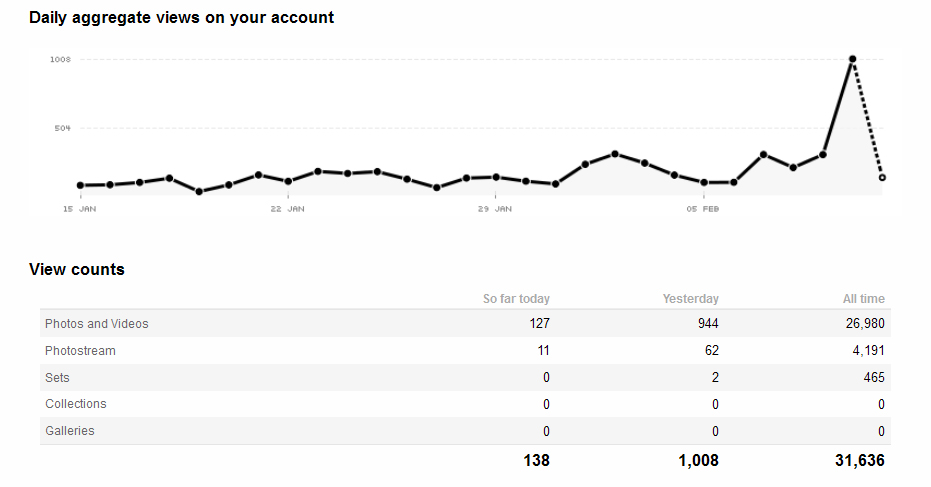 |
| Statistics from Flickr on Monday |
Critique:
Last Thursday we had a meeting for sorting out our images with my teacher, Mr Bahaa, and another honorary member of the group that I always hear of his name but never saw him till that meeting came up: Ahmad Dashti, PhD. He teaches in the college of Arts under Kuwait University, in the department of Mass Communication. So I've heard.
The event was useful for me, not only in figuring out the strength in my images, but I was already trying to analyze and figure out the characters of the the leader and our guest as they were criticizing my, and others, images.
 |
| Dimensionality Canon EF 50mm, f/16, 60-1sec, ISO 100. |
Personally, I do have my own interpretation for this image and why I thought of it and why I made it in the first place, but I preferred not to open the discussion further with the critics but I kept recording notes on the side. Funny thing though, a friend who probably doesn't know this image was mine defended the image and said "The image has an appealing contrast!" This response proved to me a point that I had in my mind for some time (and will mention below).
The image is mainly to be categorized as part of minimalism, but apparently my critics were not into the venue because they were criticizing for a completely another purpose, and probably didn't even notice the red buoys floating to the vanishing point. However, I'm not saying they are wrong of course, but I had my mind and points made up:
 |
| Himmelsweg Rokinon 8mm, f/22, 2 minutes, ISO 100. |
- Apparently, the critics were criticizing from the contests point of view and not the regular criticism.
- Accordingly, minimalism is not probably a right theme for contests. Presumably, most judges in such contests would prefer complicated (technically speaking) images, or images that were taken in some kind of hard work.
- Panoramas are a point of weakness for critics; they can't judge it and halt on its steps. However, my teacher pointed out some details that are better to be removed.
- From my friend's comment about Dimensionality (even though he didn't take it), I realized that you can still have fans for an image whatsoever the critics might say! It's up to you: do you want to satisfy some critics to be, probably, authenticated as a good photographer? Or to be a popular photographer? The choice is yours after all!
- It was obvious that my critics were judging from their own experience and their own style in approaching photography, specifically PhD. Dashti. In his comments about Himmelsweg, he mentioned that all what is special about this image is the sky and not much significance about the rest - and he continued to say that he is more of a humanitarian, meaning that he likes to add a human-related topic into a scene to give it a life (either a person or something related). My teacher, however, knows that I don't deal with and hate portraits and picturing people and my sole interest is in architecture and nature. His comment, however, made me realize that he is under the impression and influence of his own style and experience - similarly, I do realize that I work according to my own experience and influence (and style).
These ideas and points would serve me better in the future when I present images for critique and for sorting out for any expo that the group would think of enrolling in - but I'll keep on working with photography for the self-satisfaction and emotions' sake. One of the reasons that I don't like to enroll in contests is the fact that I'd prefer to work on my own pace and photography for me is a tool to de-stress myself, and contests are a bit like pressure gauges blowing off steams. Not my atmosphere. However, I'm into contests for the group's sake alone.
Glanz an Mitternacht:
The weather was nice that night. Not so cold, and not hot of course like those unbearable summer nights. I know that people in the northern hemisphere usually look forward for summer, but here, winter is like our spring season. Despite my tired body and the inadequate sleeping pattern for night time photography, I've decided to just head out as soon as I can after midnight to be safe away from people. My aim was a spot that I've visited in summer and in which people were active all night long (till the morning).
 |
| A scene I don't like Tamron 70-300mm @154mm, f/13, 7 min, ISO 100. |
 |
| Glowing Beach Canon EF 15mm fisheye, f/22, 10 min, ISO 100. |
As I was taking A scene I don't Like, I was wandering around waiting for the shutter time to finish and then I've noticed some nice view and reflection on the water on the other side facing the location that I was aiming at. What attracted me here is the colors of the last three lights to the left which resembled Kuwait's flag. However, after settling my tripod and working out with different lenses, my attention changed from simply catching the lights, to catching the shore with reflections. The lights alone are not interesting enough and I would repeat A scene I don't Like again! To my surprise, Glowing Beach was responsible for my new record on Flickr with 102 people adding it to their favorites so far.
I have to admit though that the image is processed, just like any long exposures. The main look was achieved simply by twitching the white balance because Tungsten WB on camera was not enough, thus I had to decrease the color temperature more and add a bit of magenta with the Tint slider.
My choice of lens was scrambled in the beginning but then I've realized that my best choice was the 15mm Canon fisheye lens even though with my cropped sensor it does not give a strong curvy horizon like Rokinon 8mm does. If I was to use Rokinon's, then lot of elements would be added to the scene that I don't like, and the reflections and objects would seem really far away - beside the hardships with metering the scene with this manual lens. My best compromise (I guess) between the EF-S 18-55mm and the Rokinon 8mm, is to be the Canon 15mm I believe. Wider than 18mm, but not so wide to include everything like the 8mm!
 |
| Light Maestro Canon EF 50mm, f/22, ISO 100. HDR |
The method here was HDR made out of long exposures. Can't remember the times exactly but the range is from few seconds, to around a minute or a bit more. The process for building the image was as follows:
- High f-number to encompass large depth of field (and the focus is set on the third pillar of light from the front).
- Few seconds exposure to get some details for the core of the light pillars.
- When merged into HDR, the tone-mapping was done in Photoshop and mainly by using Exposure adjustment layers to lower and raise the exposure in certain areas - mainly, lowering the exposure in the light pillars core and raising it a bit in the towers' shades. Also, in this phase, the "White Balance" was fixed by means of Photo Filter adjustment layer.
I have some plans though to go out to the area in some other night soon hopefully. I just hope I will get some scenes worthy of shooting in such tranquil nights. Night brings surprises indeed...
Rokinon's Triumph!
With winter, comes the clouds season. With clouds come many ideas, namely grand views encompassing large skies against the relatively small Earth, and ideas related to long expsoures (like Himmelsweg mentioned above). I had some plans to combine them both, and the best lens to do this was the Rokinon 8mm fisheye lens. One problem raises though: How would you do long exposures with such a lens with no filter holders?
 |
| Through My Window Rokinon 8mm fisheye, f/22, 7 min, ISO 100. |
At certain times, like those minutes before sunrise or just after sunsets, using Rokinon fisheye lens for long exposures seems a plausible idea indeed; it is dark enough to have a long exposure (of course with some clouds scattered), just as was the case in Through My Window which was shot right after the sunset. Some white balance fix followed later though to enhance the color of the sky.
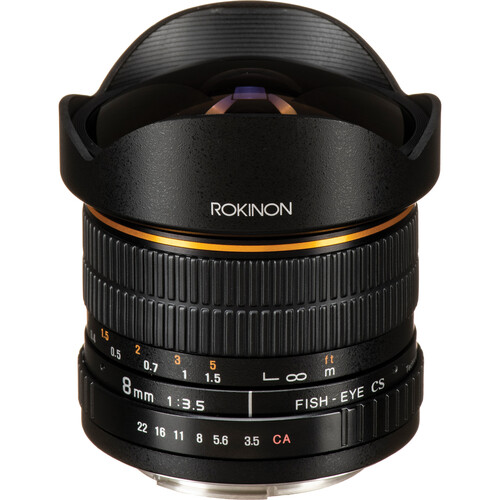 |
| source: B&H |
However, does that mean our long exposures with this lens is limited to night time? This can't be! Unfortunately, my search for solutions was to no avail. I was hoping to find at least some kind of filter carrier or holder to be fixed at the back of such lens; but my search was also in vane.
At close inspection, however, I've noticed that the rear side of the lens had many grooves, and because of the fact that the lens is completely manual, I thought there might be no danger in sticking gel filters at its back with some kind of adhesive. Anyway, I've forgot the idea of using an adhesive because it is not fast enough to handle and probably impractical after all when it comes to using several gels upon each other.
 |
| A groove that got my attention |
One groove, however, that really got my attention. It was deep unlike the others and it has some space underneath; naturally it was a target for my thoughts. It was time to work.
After cutting many pieces and trying some models from the ND gel filters that I've already got since two years ago maybe, I've settled down with a square shaped cut. I've tried circular cuts but there were impractical to fit, and I've tried as well some square pieces with side length of 3cm but they were large to be fit into the groove (probably good for sticking them with some adhesive though, that's another idea!). Finally, I've cut some pieces with side length of 2~2.1cm and they seem to work perfectly even when stacked over each other. The only requirement here is, I'd need something sharp to push the edges into the groove, plus some extra utensils that I will explain later.
 |
| The rear side with ND filter slide fitted. |
As I had different ND filters of different stops, I had to make some special marks to note the number of stops for each slice I've cut. Thus, I've decided to simply add some punctures for the number of stops on one of the corners for each slide. These are added simply with a needle or compass (not the one used for directions!).
In the beginning I had some problem fitting these slides into the groove by the corners, but then I've simply developed a method of simply pressing the center and then pushing the corners with a blunt object into the groove (maybe I should make a video of that?).
I've kept the ND slides into one envelope (unlike those I kept for the 15mm fisheye lens, where each stop is kept in separate envelope). In a primary test, the filters worked well as I've set the metering to spot and pointed the lens onto some light fixture indoors - the ND filters worked as intended and they slowed the shutter speed according to the specified number of stops. Good sign!
The first somehow real test was to take place in the early morning next day when I headed to work as early as possible to catch some glimpse of the low light level before the sun becomes stronger in the horizon. After some trials with different point of views and angles I think I've reached a conclusion that the method works fine with tiny inconsistency in exposure measurements and I think this comes because of the nature of the wide angle lens which gathers light from a wide view; wider than usual, thus even a spot-metering method can be tricky. But, all in all, the exposures done for the test images like Rokinon's Triumph! and before were pinned down correctly a bit more or a bit less.
Some test images were fuzzy or foggy-like and this made me concerned about the cleanness of the slides. I think this fuzziness was a product of my fingerprints on the slides as I was handling them. Also, as I was trying to work fast to fit the slides into the rear end of the lens, I've realized the fact that in all of my gear, I don't really have a sharp object to push the corners into the groove! Thus, I've decided to take a small manicure set that I've had in 2011 when I went to Hajj - It was distributed by the caravan's organizers to help us in our journey in various ways!
Finale:
It was a busy and a tiresome week, and now I've almost finished reading my new book (which had been ordered since 2011!), but I have to say it is somehow an easy read; not much of new stuff to digest. Maybe I'm a little bit disappointed but it's nice to look at the photos in the book. They help on getting inspired.
As for the group, I'm responsible for contests (and how ironic is that!) and frankly I don't know much about it and what to do. There is a famous photography contest of Austria, and I really don't know how to proceed with it; all what I did is scan the leaflet that was given to me and publish it via Flickr. Am I going to be responsible for the entries? I don't know, yet.
We are busy now preparing for many events - the national day, and Mawahb 3 expo next March. I'm not sure where would I fall in this, but I've been asked already to supervise the printing process, hence I've been collecting information about color management issues lately.
The sea is wide and it feels like swinging among its tides. There had been some heart issues lately, but not the hygienic type. Feels alive, but sick in the same time. When does all of this just end?
In the beginning I had some problem fitting these slides into the groove by the corners, but then I've simply developed a method of simply pressing the center and then pushing the corners with a blunt object into the groove (maybe I should make a video of that?).
 |
| The lens and the ND slides. |
 |
| Rokinon's Triumph! Rokinon 8mm fisheye, f/22, 1 min, ISO 100. |
The first somehow real test was to take place in the early morning next day when I headed to work as early as possible to catch some glimpse of the low light level before the sun becomes stronger in the horizon. After some trials with different point of views and angles I think I've reached a conclusion that the method works fine with tiny inconsistency in exposure measurements and I think this comes because of the nature of the wide angle lens which gathers light from a wide view; wider than usual, thus even a spot-metering method can be tricky. But, all in all, the exposures done for the test images like Rokinon's Triumph! and before were pinned down correctly a bit more or a bit less.
Some test images were fuzzy or foggy-like and this made me concerned about the cleanness of the slides. I think this fuzziness was a product of my fingerprints on the slides as I was handling them. Also, as I was trying to work fast to fit the slides into the rear end of the lens, I've realized the fact that in all of my gear, I don't really have a sharp object to push the corners into the groove! Thus, I've decided to take a small manicure set that I've had in 2011 when I went to Hajj - It was distributed by the caravan's organizers to help us in our journey in various ways!
Finale:
 |
| Source: Amazon |
As for the group, I'm responsible for contests (and how ironic is that!) and frankly I don't know much about it and what to do. There is a famous photography contest of Austria, and I really don't know how to proceed with it; all what I did is scan the leaflet that was given to me and publish it via Flickr. Am I going to be responsible for the entries? I don't know, yet.
We are busy now preparing for many events - the national day, and Mawahb 3 expo next March. I'm not sure where would I fall in this, but I've been asked already to supervise the printing process, hence I've been collecting information about color management issues lately.
The sea is wide and it feels like swinging among its tides. There had been some heart issues lately, but not the hygienic type. Feels alive, but sick in the same time. When does all of this just end?


