Showing posts with label 7d. Show all posts

Thursday, December 12, 2019

Djinn…

Officially winter! We already got some rains here and I'm trying to enjoy as much as I can out of it because I know in some months from now, it will be so damn dry and "cooking".
Anyway, I didn't post anything here for about 2 weeks (or 3? I didn't count!) for some... legitimate reasons I'd say: A new panorama!

Djinn

Just before I get into the story, I'd like to explain the word Djinn to those who don't know it or never heard of it. Djinn (Arabic: جِن) according to the Islamic literature and belief, are creatures created even before the creation of Adam and Eve and they inhabit and dwell Earth and even space. They are created of fire and unseen by humans (except to few, saying that from experience). So, in some sense they are equivalent to what the Westerners would call Demons. Also, they can be either good or bad, they have different faiths and beliefs, as well as living in tribes and social classes of their own, just like humans.
So, I hope this introduction fascinated you a bit to read on, as I think the technical stuff coming along this post might be a bit boring! Since I didn't touch my panorama gear for quite some time now (mainly because I didn't travel nor I'm part of any group that does activities here and there). Thus, I had to look for alternatives; Ideas, mainly to be done in my periphery: Car, home, work... etc. It took the idea some time to "cook" in my head and I was kind of slow and sluggish in preparing my gear (typical), and the target was one of the rooms in my house where typically guests use, in case we get to have any sleeping over.
Now, the keywords for the work or the general idea revolves around: Magic, black, dark aspect or darkness, and maybe a touch of some horror and fear? Since I don't have models (as usual) I had to think about it thoroughly because the task is not easy here as the idea started to take shape in my head. I will be shooting myself, in various locations within the room, while it is dark and definitely needs a somewhat longer exposure (not good for stable poses!). Anyway, things (unwillingly) went on two trials and for this reason I didn't post last week, because the plan was to have this material ready by then but, unfortunately, the first trial failed drastically and I had to re-do the whole work in a different manner and a different setting.

جِنْ (Djinn)
Click to enlarge


Voigtländer Color Skopar 20mm f/3.5
Lumicon H-Alpha (Night Sky) filter.
Try #1: The first try was done  with my modified Canon EOS 7D and Voigtländer 20mm lens, fitted with the Night Sky filter (i.e. H-alpha filter) which is, partially, an infrared filter actually, allowing a band of Reds. I've tested this filter against my B+W 092 Infrared (threshold: 650nm~690nm) filter and compared the results (in-camera, using Custom WB). Comparing the blue tones specifically, I've decided to go with the Night Sky filter instead, this is beside providing a tiny bit of shorter exposure time. Working with 20mm instead of my usual Canon EF 15mm fisheye lens meant, of course, shooting more slides or angles, and that means forgetting about doing any HDR work here because the load would be simply RIDICULOUS. Now, using 20mm introduced another problem here is the need to change the usual orientation while shooting. So, instead of starting at 0o for the tilt, I've actually used -15o instead. This is just to include the whole stool with my body in the separate shots that I would need to do later to merge with the panorama while stitching (having myself in two shots to be stitched together is next to impossible; It must be one shot including my whole body). Another problem is the misalignment of many slides, and the empty spaces that added to the chaos (the computer was unable to connect these slides nor I was able to do so manually because of the featureless spaces). After 2 weeks, or so, of working on stitching this panorama, I've realized that this thing is beyond repair and I must re-do the whole thing, and probably drop out some of my requirements for this panorama, like using an infrared filter, and just shoot in the usual manner.

Canon EF 15mm f/2.8 fisheye
Try #2: So, after the failed attempt, I've switched back to my 15mm lens and this time I thought of some trick to compensate for these empty spaces; I've simply stuck some electric tape on various sections of the wall just to aid the computer later on to stitch these images - and just to show you my luck, the idea did work really but the tape was some bad quality and almost fell down, so I had to work fast! Anyway, testing the White Balance before the shoot, I've realized that this is almost equivalent to infrared shooting with my modified Canon EOS 7D, because the room is dark and the major light source is to be from the candles (which issue infrared of course). I banged my head at that moment; How come I didn't think of this before instead of all the hassle with my first trial?! Of course there should be remnants of the visible spectrum but that was not a problem specially after calibrating the white balance in-camera. The scene already turned to be an infrared-like. With this, it was like shooting a normal panorama and I had the power to do bracketing for HDR merging and tone-mapping, which I did. *sigh* Just like the old days!

Process: Processing the images was typical: Load the files, run Photomatix to merge the brackets, and then start with the stitch. It was essential here to calibrate the white balace in-camera before the shoot, otherwise the HDR merging and adjusting the colors would have turned to be a "wedding party of wild elephants" - Sorry, the best I could find to express my thoughts here.
However, while merging the bracketed images to create HDR slides as usual, I've made a mistake which I didn't discover until I tried to stitch the panorama for the first time. The mistake was enabling the Remove Ghosting with Detection level set to High. I'm not sure what I was thinking but in a nutshell, the computer created a movement where there were none in fact, and that PRODUCED ghosting! So, the situation was like the old advice of turning off the image stabilization on your lens when your camera is actually stable on a tripod because that would trick the lens and creates a movement. This is exactly what happened, but digitally this time. So, I had to re-merge the bracketed image in Photomatix again and this time putting the detection level on Normal. I've activated this option in the first place just "in case," specially that we have candles here and there might be moving shadows that would make the stitching harder a bit.
That was concerning the merging process but there was still a side work that had to be done and that is preparing those slides of me (specially those involving my reflection in the mirror) but no need to go on with this - it was just a simple masking process. But all had to be done in HDR mode of course with HDR slides.

Effects of using High detection level for ghosting removal on Photomatix.
Click to enlarge


One slide with tape cuts.
Click to enlarge
Stitching: As for the stitching process, it was typical to try to stitch the HDR slides first right away, but as usual, it failed. I remember in old times, this didn't happen much. Anyway, what can I say here; The image was indeed dark and I've intended for it to be so. Thus, I followed the typical procedure of tone-mapping the HDR slides using Photomatix again, and trying to get the best details from each slide. Of course the process is automated; I just pick the darkest slide possible to work with and save the settings then apply that to all. From these tone-mapped images I would create a model, and base the stitching of the HDR slides on this model. Lot of details here, but anyway the thing was not out of troubles, as usual. The tape trick did work to some extent but still needed some help or let's say a "push" from my side so I had to add some manual control points to match between the slides. Actually this problem happens all the time with or without sharp details between the slides for various reasons. All these tapes on the wall would be cloned out of course when the panorama is stitched completely. The final stitched panorama still had some stitching errors which I couldn't fix before stitching so working on that in Photoshop was inevitable. The thing is that I have to do these fixes every single time I create a new projection out of the same panorama; So, it will be such a slow process after all.

Finale

Well, this was the "short" story of this panorama, and I'm still having some more ideas at the back of my head, cooking and waiting to be served when I get the power and time. Beside that though, I'm still working on other projections of this same panorama here. I didn't want to put all the eggs in one basket so I might post about these in 2 weeks time from now; If they are ready though.
Now, it is time to think about some other panorama to do, beside the other ideas at the back of my head of course. The past few weeks were kind of hard, mentally. I was literally waiting for weekends just to sleep as much as I can (and even skipping my socializing with the family around some games like I used to every weekend). I'm trying to re-discover myself here, in some ways, but seems the process is taking longer than I participated. There is a talk about change in the horizon, things going to be better, the hardships years are over... yet I don't really see any of that in the horizon from my side. The travel that I've participated for 4 or 5 years now is still an idea that I could not make a reality. Would it be soon? We'll see. I'm planning for a little vacation by the first week of the new year, but I'm still not sure if I would be able to because I need to make sure that I won't be needed in my workplace. Boy, I'm going to sleep for real, and who knows, I might head out to shoot at night like I used to in the past years…

Thursday, June 1, 2017

Colorado…

Well, Ramadan is here and boy ain't I happy to have a leave off work during this month! Despite my usual troublesome sleeping pattern during this month, yet I feel refreshed at some level and I'm eager to work with my camera more often than before (specially with me doing my experiments near my room). With May project with the group, which is about colors, I've started to re-kindle an old passion for high-speed. The work is still going on as I'm typing this, as there are a number of issues I need to fix still and some more ideas in hope I can try later.

Colorado

The May project was a priority, so I spent some time thinking about what can be done in that venue. It is easier said than done, as colors are everywhere but it's hard to get some concrete and unique work of art involving colors. In the beginning, I was trying to follow my typical steps in creating an idea: Find a deep emotion inside myself, and cast that particular feeling on the subject at hand, be it color, shadows, or whatever. However this step seemed hard and technically I was so mentally confused that I couldn't realize my own feelings or how to organize my thoughts! Thus, I had to shoot for mere fun and I started mumbling with my props and gear to find something colorful.

Colorado I
Canon EF 100mm macro, f/29,
250-1sec, ISO100.
After playing around with some props and accessories, I decided to use the refraction power of water to create some colorful abstracts by using colored Popsicle sticks placed in a separate glass jar behind the glass of water. Later on, however, I've decided to add corn syrup into the water during the shot (putting the camera on timer while pouring already). This was just to add some action to the scene instead of plain silent colors. There was no need to high-speed mode as 1/250 of a second for the shutter speed was enough to kill the ambient light, but the greater hardship was in having a proper framing for the shot since I was working inside my room and could barely have a proper distance to stay away from the set with my 100mm lens, while using 50mm lens would require me to get closer beyond the nearest possible point of focusing.

Colorado II
Canon EF 100mm macro, f/29,
250-1sec, ISO100
Distributing the light was not so hard to do but it was rather hard to adjust (as I usually work in manual mode). I've used 2 white boards on the sides to reflect off the light and later on I've placed a shade on the top of the set to reflect any astray light from below and reflect it back (and it did a great job!). While shooting, there was always something going off which made the power sometimes excessive or too low without even touching any flash settings. Not sure what is causing this but the first culprit in my mind right now is the fact that I was working in LiveView mode. Some professionals always warn against using LiveView mode for serious shooting. However, with my back problems, I find myself often forced to work that way!

Colorado III
Canon EF 100mm macro, f/32,
250-1sec, ISO100
After shooting Colorado I I decided to increase the amount of action and pour even more corn syrup to fill the frame (while some were already accumulating at the bottom of the glass) which created such a mess as seen in Colorado II, but oh well, I guess this is much better than having much plain space as in Colorado I. There was one last shot I needed to try, and here, I've replaced the colored sticks with colored pencils and filled the glass with corn syrup instead of water as I loved the looks of the bubbles in the bottle of the syrup. To add something to the scene, I've placed a small cut from a branch of some plant I've found here (no animals were killed to try this!). At this level, I wanted to step further and try the risks of using f/32 with this lens which I've experienced some weird behavior before at this aperture value. However, after several shots I did get something stable as seen in Colorado III, and even created a 3D Anaglyph out of this scene. Now, I'm creating the habit of documenting the set every time I finish one experiment. I guess it is a good practice?

The set used for Colorado I and Colorado II. A reflector was placed on top during the shoot.

The set used to shoot Colorado III.
I used 2 small candles on the sides in hope to excite the fluid and produce more bubbles inside the syrup but that wasn't useful!

Cherry Boom

I thought I was over with the Colorado experiment above, but then I thought why not implement high-speed onto the project, specially that I'm trying to work in a space near my room (even though no proper table for me yet, as you can see from the sets above). Implementing the idea of colors here emerge from the concept of the color circle and complimentary colors. Thus, I simply googled "Cherry Red Color" and I got the code #a61f34, and starting from there I got the complimentary color which is some degree of cyan. I picked cherry specifically because it was available, and because of its distinctive red color and tiny branch which typically stems out of it. I could have gone with grapes but I think grapes do not have a distinctive shape or color (and the red variety would be typically larger than I need them to be). Thus, the choice for cherries seemed legit!

Final look for the set of the project.

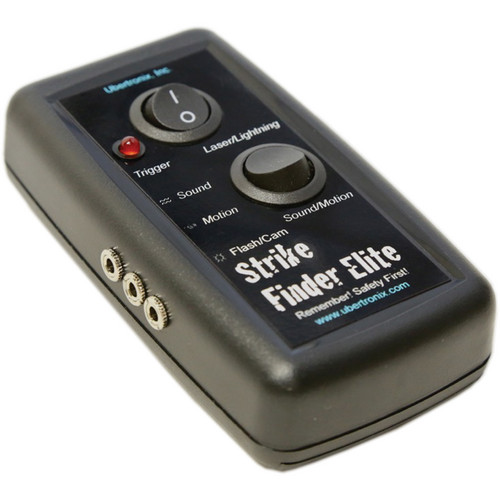
Ubertronix Strike Finder Elite.
Source: B&H
I used watercolors here to color the water and later I've added a bit of milk to kill the transparency of the water a bit. As seen in the set above, I've used here only 2 speedlites (580EX II) and didn't want to use my third speedlite (430EX II). I used here also my UV filter over the lens front just to protect the front from water droplets. I should have protected the flash heads as well with plastic bags but I skipped that actually. The big hurdle was to get my old Ubertronix trigger to work, specifically with a laser-gate. Without detailing the troubles, at the end the laser-gate method proved useless to me because of the shutter lag and the cumbersome laser pointer I was using. Thus, for the rest of the experiment, I went on doing a manual job, holding the cable remote in one hand and dropping the cherry with the other.

Cherry Boom I
Canon EF 100mm Macro, f/9, 3200-1sec, ISO200.

It was apparent from the beginning that I'm having a problem and probably should have used a larger bowl of some sort since the white edge of the plastic dish was hard to remove. Some problems did not show up till later on as I was inspecting the images like Cherry Boom I. Beside the shallow depth at f/9 (which was not enough), it seems that 1/3200 of a second was not enough for the shutter to freeze the water movement! However, during the experiment, I've raised the speed a bit more without really knowing the final outcome that I will be getting later on. Good luck? Maybe!

Cherry Boom II
Canon EF 100mm Macro, f/9, 4000-1sec, ISO200.

The speed of 1/4000 seemed just enough to freeze such a fall! In total, out of 20+ shots, I got merely 2 useful shots and one or two shots for splashes without the cherry(ies) which I simply liked for their shapes but I don't think they would be useful as stock images or printed and displayed. As for Cherry Boom II, the cherry here fell upside down and my brain being in love with illusions, I've decided to rotate the image 180o and thus the water came up and the cherry down, but standing up. What annoys me about Cherry Boom II is, like the other shots, the white space from the plastic dish edge which cannot be removed or substituted. I continued the work further in the next day and going manual too with 1/5000 shutter speed, and changing the camera tilt little bit (and pouring some water into the dish) to hide the white edge as much as possible. Again, out of 20+ shots, I've one suitable shot here.

Cherry Boom III
Canon EF 100mm Macro, f/20,
5000-1sec, ISO320.
Beside enhancing the looks, I went on enhancing the depth of field as well pushing it to f/20 (to have greater chance of having the cherry sharp wherever it falls), but that of course called for an increase in ISO, as I didn't want to use my third speedlite still. Water splashes now are more stable and live! In Cherry Boom III, seeing that the two cherries fell on their side, I've decided to rotate the image 90o clockwise to add a surreal feel to it.
In all of these shots of high speed, there was always a problem with the noise level when processing the images, despite the ISO being relatively low. With my Canon EOS 7D, I'd say that the ISO is somewhat easier to handle up until ISO 800 or around that, but in these images the processing was cumbersome and I do have my doubts about being accepted for exhibitions with the group (if they pass the aesthetic critique). However, some stock websites did already accept these images without a problem and they are up for sale!
Finishing from this cherry project I did proceed to another one, involving high-speed shooting as well, but I will keep that for a future post, as I'm still trying to work on it further.

Finale

After kindling my passion again for high-speed photography (adding to that the lack of locations and ideas for panoramas), and after the failure of my trigger, I've emailed the company asking about the reasons for such time lag and after some discussion, it seems that the reason is my shutter and not the trigger itself. I was advised to connect the trigger to the flash instead of the camera but in my working conditions this is not possible, as working with triggered flashes means opening the shutter in a dark environment while the flash becomes the only source of light. However, reading about some aspects of my camera, it seems that I do have also to adjust some of my photo-shooting habits to reduce the time lag in shutter release (depending on LiveView being one!).
Though I'm on leave without traveling but seems I do have a busy schedule here (beside taking care of Mom), but I feel some satisfaction that I didn't feel in a long time now since I could work with my camera and really think of something to do with it, without feeling exhausted like everyday after coming back from work through the traffic jam. Meanwhile, the idea of traveling is still ticking and tickling my mind, despite the fear of the hassles that I might have to face outside because of all the madness going in the world today, specially for a guy like me from the Middle East.
In the meantime, August is getting closer, my birthday that is, and I'm preparing to have some big order (well, not so big, but a bit big maybe?) of some gear and maybe some books. I would have to place the order before August I presume since there are some items that are considered "special order" (i.e. need time to be prepared and dispatched). This is to be a gift to myself, since no one around give such gifts except of perfumes! On my mind is a 4th speedlite (and probably another 580EX II if available still) and maybe some filters. I feel so excited that I want to place the order right away in the coming few days, but my financial situation and the course of Ramadan makes me hold it back and wait. Thus, I might be placing my order by the end of June or so! I need to miss my camera so much to work with it with passion…

Stock photography by Taher AlShemaly at Alamy

Thursday, March 10, 2016

Diaspora…

Saying "Exhausted" is not enough to fulfill the description of the current situation. At some point, I thought I would need some dose of adrenaline, and some Prozac at other times, just to get me through the past 2 weeks.
Rolling over many ideas, I kept my gear and camera scattered around the place, and that would require one day indeed to be collected back again. Some ideas were simple, but I was hoping to get through the project with something acceptable.

Spotting Red

Many props and items have been purchased or improvised trying to establish some ideas for some photos. I have to say that this project, The Color Red, was beneficial at some point for making my mind run wild and made me connect to my world; trying to express feelings by using the power of still life and setups. Something I rarely do in fact.

Broken Love (I)
The first thing to do was to repeat the rose and ice heart experiment according to recommendations given by the leader of the group. The new instructions involve removing the random petals and including the rose into the ice mold. That proved to be challenging somewhat, since the rose went afloat and froze just like that. Breaking the ice mold (resembling a broken heart) caused the rose itself to "break!" You can see that clearly in Broken Love (I). The rose being afloat was not a good "view," so to say. Thus, there was a third (and a final) trial.

Frozen (I)
Frozen (II)
The last trial involved doing layers of ice to stabilize the rose inside the mold. This was done in two days of time by pouring a layer of water and wait for it to freeze, then pour another layer and wait for it to freeze and so on till the pan or cast is filled (almost). I had to compromise here with the idea of freezing a boiling water (to make a transparent ice) as I did in the previous 2 trials. However, the shape and the translucence of the mold was even better that way! I liked it shape so I snapped several shots as it is without breaking it first as can be seen in Frozen (I,II). I had to break the mold then to mimic the main idea in mind…

Murder

Breaking the mold was a challenge by itself. This is because the ice was formed into layers and not frozen all as once piece. This made cracking the ice out of uniformity and was hard to be done in a soft and easy way like the previous trials. Had to hammer so hard and then collect the scattered blocks into one position trying to make a heart shape (somewhat!). At this point I've removed the plastic piece underneath the block (which I used to give some reflections); this would help keep the blocks stable and not easy to slide off the table. I cropped the final image in somewhat panoramic format to give more direction for the water (blood) coming out of the heart.

Murder (II)

A friend of mine then suggested to change the colors (in fact he was pointing out to doing the experiment all over again), making the heart red if possible. Hence, I thought of using the typical channel swap method which is usually used in infrared photography, where the Red and Blue channels of the image are swapped. However, upon inspection by the leader of the group, Murder was favored more (probably for its calm atmosphere). According to him, this can go into contests as well. I'm happy that I've finally made something!

愛 (love)

The "Red" project didn't stop at that point still though. I kept on trying to do more ideas. Many ideas proved problematic, and more problematic even was to spend valuable time trying to achieve them instead of skipping to other ideas on the queue. Painting strawberries, for example, was one of those ideas which I've abandoned for good (but came back later in another form as will be shown). The next idea on the line was simple: a mother and daughter writing the word "love" in Chinese. I chose that word specifically for its duality: it is the word for "love" and it has a radical for "heart" used in it. You can see above that the word "heart" is painted in red. Well, my writing wasn't that good specially that the brush used is not calligraphic in nature (Chinese calligraphy uses special kind of brushes and special types of inks). Anyway, I used the help of my sister and her daughter to show their hands with the brushes as seen above. Setting the speedlites was a hurdle, as I was trying to depend on camera settings and light setting as much as possible to approximate the scene to a high-key. I've reflected 2 speedlites on the sides off large white surfaces (papers or so) while a third speedlite was held in one hand with a "bulb" diffuser. Lot of work had to be done in Photoshop though, to fix the colors and contrast and also flip my niece's hand to make it a left hand (but the edit was a fail and the I uploaded the original as it is to stock sites). The image anyway did not pass the sorting process, but it was accepted in a number of stock sites.

Artificial Nature
I stopped for a while from the project Red, and chose to work with something else. I thought I was over with it back then but I got struck with some idea, but it involved editing more than just mere photography. However, the concept is the same one I was thinking about with strawberries before, and in fact I was looking for strawberries first, but then I realized working with apples is more appealing because of the larger size. The idea about the food consumption in our modern world and how it is "edited" with genetics. Without going into the details of the make of such "design" but opinions were mixed between a pro and a con about this edit. Personally, I do feel there is something missing but I can't put my finger on it yet.
The funny thing about this shoot though is the improvised "cube" or "tent" for lighting. Three large white surfaces (or hard papers, or whatever) were placed as a background and on two sides, while placing 2 halves of a car shade on the top and at bottom. Using only two 580EX II speedlites and each one of them is pointing to the opposite side, the lighting was good enough and almost similar to that of a cube or a tent usually used for product photography. The idea is to bounce the light from one surface to another just like the beams inside the microwave would do. That way, the scene is supposed to be lighted from all directions.

Side Dishes

In between those "red" photos, there were some older ideas were put on queue to be done. Specifically, some ideas related to the marbles' images I've done before. As suggested by a friend, an image of an eye reflected into the glass marble would be a better idea. For this idea, I was going to use my brother to sit behind the marble, but a better idea and more stable one was to use my laptop as a background.

They Are Watching…
The drawback here was the inability to fit the eye image to be completely full screen, and because of that some white lines appear on its sides. I've simply loaded the image into Photoshop and put the window on full screen. I had to use some extra stack on the top of the keyboard and then put the marble on top of the that stack, upon an acrylic sheet I usually use for reflections. This was essential as the keyboard was getting into the final image and this was undesirable.
In the beginning I was trying to fit the marble or the whole scene into the frame but then I realized a crop is inevitable.In fact, adding more space to the image and cropping later would give more flexibility in terms of design and placement for the marble and its reflection. In the editing phase, despite cleaning that sheet, I had to work for long time on cleaning the area below the marble.

They Are Watching (II)…
As I was working I had this idea of doing an inversion into an inversion. That is, inverting the eye image, and then inverting the image while processing it in Photoshop. When that was done, I've rotated the image for 180 degrees upside down. Why? Not sure. But it looked more pleasant that way. However, the overall look still not so appealing, probably because of the blue and black combination. The eye reflection here is also weak and somewhat lost despite the simplicity of the image. I'm eager to show the first to be sorted, but not the second! I'm sure the second would not have any chances.


Another side dish was served to me on Wednesday is when I got the news for the arrival of my second camera (finally!). It is another EOS 7D which I purchased from a friend and then sent it to LifePixel for conversion to a full-spectrum; That is, supposedly capturing infrared and ultraviolet spectra. Just as a simple test, I've tried this selfie while standing next to a glass door allowing the sun to come in, and also using the on-camera flash to quicken the shutter speed a bit (at ISO400). Interestingly, as I was working on LiveView (essential for focusing precisely), with the absence of clear IR sources (e.g. sun, flash), the scene would be as it is in normal images (i.e. the shot is not reddish). My initial position was in front of a mirror with CFL lamp on top, and since such lamps do not issue any significant IR radiation (and has a coating inside that blocks UV), the image in the LiveView was plain normal. The IR influence did not appear in a clear way until I moved near the glass door. More ventures need to be explored in that field, specifically when it comes to panoramas. The selfie you see here is plain and direct from camera RAW without any modification (except for resizing of course).

Finale

Many things are going and racing through my mind, which makes me more serious about having a vacation away from my camera a bit. However, having a vacation from my camera doesn't mean not, supposedly, stopping the experiments. I do have special concerns as I plan to jump further with my panorama processing, and I'm thinking seriously of putting my relatively-new Voigtländer 20mm f/3.5 lens into work with panoramas, and my initial checking tells that I wouldn't have to re-calibrate my VR-Head for this new combination of camera-lens. It needs time for further testing and inspecting and check that no parallax-error or minimal parallax-error is achieved with this lens without re-calibrating the whole set. If re-calibrating is required, I might give up the idea. The reason for going after this, is my belief that the optics quality is better with this lens more than my common and usual Canon EF 15mm lens. Another testing series should check for the amount of chromatic aberrations. In my previous shots like 愛 (love), which was shot with the 20mm Voigtländer at f/18, the aberrations were somewhat visible on close inspection. However, the final say is to be told only by direct comparison between the two lenses taking shots for the same scene under the same circumstances. On the other hand, I need to look after possibilities of doing HDR shots with my newly-converted camera, as well as shooting panoramas as I do with my normal camera.
I'm not sure when I would carry all these plans, because I'm thinking of resting for a while for real and try to organize my life all over again. Well, I think I'm failing at this already but I might do something at least. Heck, just thinking of my gear which I need to pack back into the proper places I get a shiver down my spine! It is not only the camera that is giving me some stressful times, but everything else around me seems to be doing so. I can almost swear that if I was a brick, I could have been cracked or smashed already for such amount of mental stress. Anyway, who cares… and I'm trying not to care, the best to my capability…


Thursday, April 11, 2013

Grace...

Mom is finally back home right now, but that doesn't mean the end of the story. In fact, I think the struggle had just began now to elevate her spirit and make her cope what life throws at her, specially with boring hours of dialysis.
We are hoping now that the dialysis process is a temporary procedure until Creatinine is reduced to some level. All we can do for now is to pray for her and, of course, be on her side as much as possible. The other challenge from our side is to cope with life's schedules and rush with an added responsibility like this. We've been managing for the past 3 weeks by having leaving from work and changing shifts among family members, but at a certain point, I believe Mom has to be alone at home, probably with the maid only to help her out.

One of the greatest challenges for me right now is to try and work on with my camera after being mostly idle in the past weeks. Not completely idle, but I was aiming at various things without thinking just to try out my camera and not stop using it. Mainly I was aiming at geometrical shapes in flowers, specially those sent to Mom in the hospital. I won't bother you with the technical details here, but most of the images here were taken with 50mm lens plus some extension tube(s) beside using one or two speedlites (580EXII and 430EXII).

Blooming Alone

Sanfte Aufbau

Zentrum Aufbau

The Dark Side of Beauty

Introvert Petals

Lumini

Vortex

Floral Fractal

Mother's Heart

Die Sanfte Ringe
New Toys:

With the rush of the events lately I've ordered some new toys for my camera that I've barely touched or experienced something with. I hope in the coming days I will do this accordingly.

Source: B&H
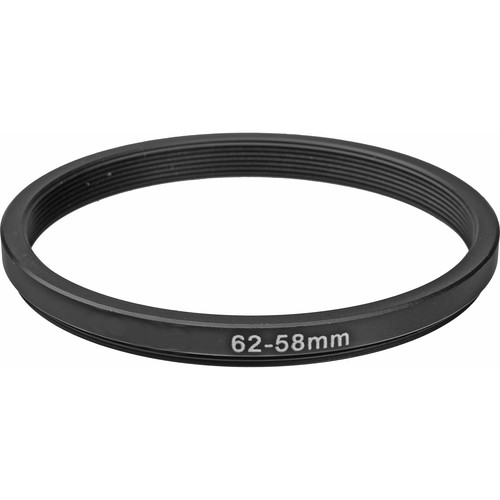
One of the simplest "toys" here is a step down ring which is aimed at fitting filters on lenses with different diameters. My ring here is a step down from 62mm to 58mm (62-58mm) which I got specifically for my Tamron lens (70-300mm). Most of the lenses that I'm using have a diameter of 58mm and hence most of my filters (polarizer and IR for example) are ordered accordingly to this diameter. In order to make these filters somehow complete and fit all, this step down ring can do the job. The only problem here is that it sometimes gets stuck in between or stuck into the filter read itself. Typical problem (and I'm planning to get special wrenches to detach filters from lenses).

Source: B&H
The other toy is an eyepiece from Polaroid which acts as an extension at a right angle. It is supposed to be quite useful for shooting at waist level but I didn't test it for long. One of the hardships in this piece is how to fit it into my camera. It comes with plenty of adapters for various cameras (specially EOS cameras) but unfortunately, there is no direct adapter for EOS 7D camera and I had to make several tests. I could hardly fit one of the adapters into my 7D and I'm not sure it is quite useful for shooting at waist level but probably more useful to shoot on sides (i.e. to be on the side of the camera and look into the eyepiece). I will leave this for time to sort out its benefits.

Source: B&H
Maybe the most important toy for me right now (and didn't try it yet!) is the Ubertronix Strike Finder trigger. Some years back I got a cumbersome circuit to trigger the flashes by sound (and needed the PC cable to connect it to the flash but never got this cable). This trigger now is all-in-one type: sound, motion, laser and lightning. The difference here though is the fact that it is a camera trigger (and it comes with N3 cable to be connected in the place of the cable remote into the camera). Without trying it all seems good, but with one thing: the short cables and sensors. I want to try this as soon as possible but yet I didn't formulate any ideas on how to do so. The trigger box contains a jack port saying "flash/camera" thus I do believe I can connect it to flashes (speedlites) by special cables too and it's not limited to cameras only. Among other models, this brand was the only one probably to support Canon EOS 7D. In a twist of options, it has the Laser gate, i.e. triggering the camera with the change in Laser reception as I understand it while other brands depend on infrared gate which triggers the camera only when an object crosses in between a transmitter and a receptor. I'm not sure though how I'm going to use the trigger for Laser but according to the instructions it works as well for infrared just that way, as well as for lightning photography. Too bad the lightning season is over right now!

Thoughts:

In the passing weeks, with Mom's sickness and up till this moment, I had some weird urge in geometrical wisdom and started to read whatever comes my way from Wikipedia; specially the schläfli symbol. There were many stuff that were complicated of course and my mind couldn't digest but reading about simple stuff could spark some imagination. Reading about mathematics and geometry can never be in vain - it is up to you of course!
I'm trying in the meantime to look at the problem with Mom's health as a test for something; probably to change my attitude toward the world, probably to test my capabilities of challenging the world with increasing responsibilities and yet keeping up with my own projects and photography. Mom cared for us as a mother would do, and her memories still race in my mind at the moment; memories of some time when I was 10 years old or less and how she used to dress me for school. Despite the health problem is upon her, but it is our test, her children. Probably God wants to see how we do care for her and I'm lying my hope in succeeding in this test. After all, I arrived to the realization of the fact that at some time, at some moment in time, there should be that point of departure between her and me as it is the case always with every living thing. My only prayers go to make this point in time just far away; far enough in time to make me stronger to bear it. I've realized as well the fact that just wishing to depart life before her so I wouldn't have to see her leave me alone in this world is a mere selfish thought. Mothers can't bear the departure of their kids from her sight - it is me who has to bear it all instead...


Thursday, February 21, 2013

Maschinen Auf...

What a busy week. It is good to be busy sometimes; it makes you forget stuff you don't want to remember, mostly. The trend of such busy week is still going on and might go on for the next week as well because some group members are going to Dubai in the coming weekend and some responsibilities are flung at me. It would be my first time to organize and be responsible for a field trip to some distant area.
It seems as if this week is spreading seeds of reputation and a renowned name. I'm getting personal invitations and simple requests for occasions related to photography. I wouldn't say I'm on the road of being famous, but it does give a portion of confidence that I needed for some time. Say, would I be reading my horoscopes daily if I do have some support on my back? I wonder...

Blooming Me!
As Mawahb-3 expo is approaching closer and closer, the management of the group realizes that not many fine photos are available, if there is any, for a large number of members in the group. For this reason, my teacher and the leader of the group thought of giving a workshop (workshopS in fact, see Andaluz below) concentrating on geometrical shapes in flowers and their beauty. Personally, I'm not a flowers person but since the topic bears some resemblance and sense of an abstract work, I've decided to join in.

Silhouette in The Heart's Rose
Canon EF 100mm macro, f/16, 500-1sec, ISO 200.

After some advices and a short lecture by my teacher, the work started. He prepared a rose under a monolight with some gobo, but I picked my own rose or flower (which according to my teacher was the most expensive of them) and started  to work on it on my own. What attracted me to this flower specifically is the stems in the middle (sorry, don't know the scientific name for those!). Frankly, I don't know why or how did I forget the ISO on 200, but anyway it worked just fine with the pulses of the speedlite.

Harmonie
Canon EF 100mm macro,
f/16, 800-1sec, ISO 200.
My 580EX II speedlite was connected with TTL cord to the camera and attached with honeycomb grid giving 16o range. One of the hardest parts of all was to fix the flower on some stable ground and up high close to the camera's level, and the only way to do this was to put the flower into the handle of the small bag which carries my speedlites and filters! After that, I was free to move the speedlite around the flower and testing the results. Even though my teacher doesn't recommend using the LiveView feature to do the metering and focusing, I do find this way is really useful and I can almost never imagine myself without it now. With LiveView you can move a cursor to the desired location to do the focusing, and this is much more easier than depending on zones or points in the viewfinder. Metering, however, can be a bit tricky with the rectangular cursor across the display and also the possibility of leaking light rays from the viewfinder that can put the exposure reading off track, but still it can be useful to take readings from various areas in the scene without moving or tilting the camera - that is for comparing the differences in stops and so on.

Die Glänzende Finger
Canon EF 100mm macro, f/4, 400-1sec, ISO 200.

As I've mentioned before that I was moving the speedlite (and changing the depth as well) which yielded some interesting results. It did feel like working in a studio full of diffusers and reflectors but in a macro level! Images like Silhouette in The Heart's Rose for example was achieved by using the petals as reflectors for the speedlite pulse and hence creating a silhouette out of the stems in the middle of the bloom. On the other hand, Harmonie was achieved by using the petals behind the stems as diffusers which also painted the stems in red giving something in between ethereal and a romantic look. Well, some people pointed out it is scary as well! Just worth a mention here that Harmonie is originally in landscape orientation but I felt it's more appealing to make it in portrait position.
Even though we were supposed to exchange flowers and work on each for some time, but the time was limited, and personally after shooting Harmonie I thought I did achieve my purpose for this session already.

Award:

Award to BPF
Canon EF 50mm, f/4,
1600-1sec, ISO 200.
Just one image but it has to be mentioned here for it did take some deal of experimenting with speedlites. Last week I've received an award dedicated to BPF group (the group I'm member of) since I was the representative of the group and the middle man between the group and Kuwait University's Cultural Festival last January.
What I really loved here is the wooden texture and its touch (yes, its touch). I wanted to show an image focusing on the group's name (upper white line) while showing fine details for the rest of the shield. After experimenting which consumed a great deal of time, I've held my 580EX II speedlite with a snoot on top of the shield pointing downward, while controlling via wireless a 430EX II speedlite in front of the shield but pointing away from the shield with  reflector in front of it to spread some light on the shield. I guess I achieved the desired look little bit though I wished it to be brighter over the logo and the group's name.

Christmas in Ahmadi!
With the beginning of the last weekend, a friend in the group suggested that we head out to Ahmadi, a town or city down south with around 30 minutes of driving from my place. Ahmadi is known to be a home for many foreigners and citizens who are related to the oil industry. I dare say even that it is a town created and established by oil companies alone!

Stern von Licht
Canon EF 50mm, f/1.4, 125-1sec, ISO 100.
It Snows in Ahmadi!
Canon EF 50mm, f/1.4,
125-1sec, ISO 100.
We don't really celebrate Christmas in here (not officially), but Ahmadi was lighted up with decorations made of light patterns in shape of miniatures for the celebrations of the national day (mainly February 25th and 26th). It was one heck of a night and an absolutely fantastic spot for night photography. If only I could head there on my own I might have tried my luck often there. We had our share though from the annoying people and hooligans but around 1 p.m. it became relatively quiet.
We spent around 2 hours taking shots and experimenting on only one road, and we were leaving the place we noticed prettier scenes even but it was time to leave specially after getting a pin penetrating my shoe and sticking to my foot! This incident was the end of our journey that night and we had to leave. I didn't go to the doctor to get any injection (tetanus?) but my foot feels just fine right now and as I'm typing these words, the pain is almost gone and I don't limp as I used to when I first got the injury. Well... just in case you care anyway!

Star Spangled Kuwait
Canon EF 50mm, f/1.4, 25-1sec, ISO100.
Candy Clock
Rokinon 8mm, f/3.5, ISO 100.
HDR
One of the significant features in Ahmadi's general design is the light miniatures in every roundabout you go around. I think it works so good as a land mark! Other areas in Kuwait would resemble just one big maze for their roundabouts within the area.
One of these roundabouts did fascinate me the most though; it was one with a small clock tower which carried lighting tubes and lights were going on and off like a running fluid. A long exposure for this clock tower didn't give much beauty for the lighting conditions there, thus I've decided to go on to the roundabout itself and do some HDR shooting right in front of it. There was a total of 6 images taken in a range of -6EV up to +2EV. Despite the usage of a tripod that was flattened almost to the ground level (and I had to clone out a portion of the leg out of the image), yet the image on 100% zoom seems to be shaken and because of the long exposures taken here, the merged HDR had lot of noise specially after tone-mapping, and some portions looked shaky as if the camera was shaken. I don't remember any staggering wind that night despite the cold weather! The final result is, after all, an image that looks like a sweet candy in small size, but not suitable for printing as I believe.
Too bad I won't be able to go out there this weekend because my friend is going to Dubai with the rest and I have yet also to process some images from that night that I haven't touched because of the events that followed after that night!

Andaluz:
It was place that I could spend my week taking photos inside without being bored. The ideas in that place are just, simply, abundant and there is a chance in every moment, in every corner. That place was called The Arab Organizations Headquarter (AOH).

A La Luz
Rokinon 8mm, f/8, 10-1sec, ISO 100.

As part of the efforts by our leader to increase the amount of publishable works from members of the group, as I've stated before, more activities are on the run, including a trip to Dubai this weekend. For him, it was easy to gain access to the AOH, as he said. "I just needed to do a phone call," he stated! This is the good thing about our group - not only we're trying to do the best we can, but also we are under the leadership of a renowned photographer that got access to many places I wouldn't even dream of.
As soon as I heard about the plans, I've prepared my VR-head and made it ready for panoramas. As soon as I got into the place, my mind was completely boggled for all the fine crafts and the handmade wooden decorations along side with the Andalusian style of architecture. It was indeed a dream! However, because of the time limit and the practicality needed (along side with cautions and precautions for walking around such a paradise!) I couldn't just walk and do panoramas wherever I settled with my tripod. Thus I've just wandered off to take some shots from various locations.

Anti Gravitatis
Canon EF 50mm, f/1.4, 320-1sec, ISO 400.

One of the first locations to be visited was the reading hall or library. Once I got in there, my teacher told me to be careful for the high contrast around the elliptical stairway because there is a light fixture on top (in shape of a chandelier). I was looking for such structure because I was thinking of some sort of a shot for some long time now - an abstract shot with an 8mm fisheye lens from the ground level of the stairs. First, I've used the tripod but it was not so flat and the framing was not appealing much, thus I had to use my hand and lay completely on my back and take few shots, most of them are shaky. I was planning for HDR merging because of the high contrast but A La Luz was made from a single shot while the others were shaken and unclear. This experiment sparked some ideas for improvising something or making something already to handle such low-level shots.
When I wandered into other rooms, I've found a fountain with some faucets that were somehow a good target for a long exposure. However, I've found out that however stops I add to the shutter speed (with the help of ND filters), the water's outlook does not change drastically despite the speed of the water, thus I've concluded that the turbulence in the water waves or currents (including changing directions) is essential to long exposures done for the water to show some dynamic attitude for the image. Otherwise, The long exposure image would look just like Anti Gravitatis which was taken as a test shot from the very beginning. And by the way, when Anti Gravitatis was taken and then viewed on monitor back home, the image was not in portrait position as it was taken originally (this is because I turned the rotation option in my Canon EOS 7D). However, I liked its look and how the water is like flying in the air!

That One
Canon EF 50mm + 12mm tube, f/1.4,
25-1sec, ISO 400.
Enlightened Curves
Canon EF 50mm, f/1.4,
100-1sec, ISO 400.
After settling in a place above the reading hall (seems to be a cafeteria or a reception area) and doing a panorama there (see below), and after having a break with a cup of coffee and a chitchat with my teacher, I've resumed shooting at some details of the miniatures and the fine wooden work like That One and Enlightened Curves. These two images specifically were supervised by my teacher. In That One, I've decided to use the 12mm extension tube along with 50mm lens to reduce the minimum focusing distance and I was surprised for the magnificent isolation of that piece of the rail. I can almost say that even in regular circumstances and under f/1.4 this would be hard to achieve in such a way. Anyway, the image was good as my teacher said but it does not have that touch of light that makes it special, and he's right. So, he guided me to my second shot, the Enlightened Curves. In a hurry there were some long exposures for a fountain outside as night befell us already, but the framing was done in such a haste and apparently, the final results could not be adjusted properly. They might be a subject for some work later on though!

Panorama and QTVR

The day I've received the news about going to AOH, I've realized it is a significant chance for a panorama, and the first thing I would grab was my VR-head. Even though I didn't see the place before but my friends who had been there before assured me that it is an architectural gem and a good spot for panoramas.
When I got there, I started to wander around and in fact I've found 2 suitable places for panoramas just at the reception place inside! But if I was to start to work on panoramas in every location I'd get to see, I would not give a chance for single shots. Thus, I continued to wander around taking photos until I arrived at a place just above the library (and can be reached from different entries) which was, as I believe, the cafeteria. Such a vast place with Andalusian designs in marble and wood; it was an architectural heaven!

Tiempos Andaluzas

The wooden decorations were intriguing indeed. I still need to test my lenses against these structures but unfortunately, I had to leave, naturally!
When I started to settle down in this spot, I've started to take general readings from my lightmeter in incident mode. I was going in a circle around the tripod and camera set and pointing the lightmeter towards the camera as I was circling the tripod and measuring the light at different angles. It is the first time I apply this, since I usually prefer shooting my panoramas in Av (aperture priority) mode, which specifies the shutter speed automatically for me. Now, I'm working in a completely (M)anual mode, and I need a starting point for bracketing my exposures for the HDR technique. After completing a full circle around the tripod, the average reading was around 61/3EV, corresponding to something around 1 second at f/8. By the way, f/8 is one of my own personal favorite f-numbers when doing panoramas because I can easily gauge the depth manually on the focusing ring of the Canon EF 15mm fisheye lens, and next comes f/16. Thus, bracketing the shutter speed for HDR in the range of -2EV to +2EV would be something like: 4-1, 1, 4 seconds respectively.
In this panorama, the zenith (topmost) shot was not hard; the ceiling had enough details to be stitched easily within the rest of the slides. The nadir, as usual, was a big problem.
I didn't bring extra tools with me to take the nadir (and I was standing on some tiles with decorations) thus I had to improvise something. I've tilted the set a bit (and almost fell to the ground!) but back at home when stitching, this method proved problematic and not suitable enough; probably my shot was far away from being flat. However, I had to render the QTVR putting my logo after all, after a long fight with the stitcher!


for a larger version, you can download it here


The Hanging Andalusian
One of mistakes that I've done while doing this panorama is picking such a location between two distinctive features, making the flat version of the panorama having two focal points, or two points of interest for the viewer: the fountain, and the wooden decor. However, I was afraid that if I situated myself behind the fountain I would lose some details from the decoration itself. Hence, I've decided to work on a vertical panorama in which both features are aligned vertically. It still might be competing for interest that way, but usually in vertical images the eyes would scan the view from top to bottom!
Yet there is more to work on with this panorama, and more points of view that might be intriguing still. All of that, beside working with other images taken from Ahmadi last week, and from AOH as well. All of that and more to come probably after Saturday's trip to a reservation down south. I'm not the kind of person who shoots for wild life but it is something I have to take care for with other members.

Finale:
Here I am again, busy all over again with projects and barely have the time to think of my personal life. Can be good and bad in the same time. The heart is swinging in the current time; it says something, and the mind says something else - isn't it always like that?
I've been thinking a bit about Geltani and trying to complete some aspects about it but with such a fuss of projects and the pressure with the group I couldn't really collect my thoughts about some aspects. And still the problem of ambiguity in between words of similar letters and different meanings persists. I've collected my leaflets on which I usually write down my thoughts about the Geltani conlang, and brought them all back home with me so I would stay, hopefully, calm and meditate into them and think of something. On the other hand, the chart of sounds for Geltani is still not complete, and the syllabary system for writing foreign words is not thought of yet. I'm surely lagging behind with my ideas and achievements - it does sound like a time for a vacation to work more, rather than a vacation to rest...