Showing posts with label canon. Show all posts

Thursday, April 16, 2020

Strobogenic III…

Keeping myself busy here by typing some blog posts. I got some ideas for my Arabic blog which I didn't post into for quite a while. Suddenly, I'm filled with ideas and busy typing stuff for this blog and that blog, as well as doing some photos (or, trying to). All that with a heck of sleeping pattern. Anyway, the good thing is that I do have some stories to tell here, about experiments and shots that I've worked with a month or two ago before even the quarantine and home stay issues! These shots or experiments are actually a continuation for my experiments with the stroboscopic flash a while ago, when I did several selfies using this mode, as well as some "impressionistic" work with some roses, which I've posted about a while ago.

Fluffy

As I've just mentioned, this is a continuation for my work with the stroboscopic flash, and this time I've picked a very traditional item (for me) to work with: Feathers.
I kind of have a long history with feathers. I do like working with them in various situations: Macro, abstract, Still Life; And now, Motion.
This session was done on two parts actually. The first part was somewhat a failure because the speedlites were pointing directly to the set, where I kept a glass jar filled with water. Despite placing a paper to diffuse the light, but the distance between the speedlite and the paper was almost null and to have some good diffusion a space is needed between the material and the light source, so I had to shoot it again using a different method. In the second attempt, I did place some white boards to bounce the light from the speedlites and then onto the jar, but still the reflections were kind of harsh. Thus, the majority of the work here needed a heavy load of Photoshop work to enhance the reflections to some degree, beside the other adjustments of course.

The first setting before using white boards.
Just by luck, 4 feathers dropped down forming two Xs!
Hope this is not a bad omen!
In my previous attempts with stroboscopic shooting, I didn't get the chance to have a black background. This time, though, I do. And now I can say with utmost degree of assurance, that a black background for such shots is a MUST! This black background plays a grand role in enhancing the saturation of the colors and helps to show the movement much clearer. There might be some details in the black background but that's OK; These can fixed in Photoshop most of the time.
Red Chaos
Before I head to the bulk of my work here, I just need to talk a bit about Red Chaos because this image belongs to the first attempt, and not along the rest of my work in the second attempt. However, the image itself was not created until later in time, when I finished (mostly) working with all the shots that I've shot in the second attempt. After working with the second attempt, I did get this idea to examine the possibilities further with the images that I've taken in the first attempt; Because I didn't see any chance when I examined the images the first time, besides the hideous reflections on the glass. Red Chaos, however, is composed of various images overlapped together; A technique that I've been using a lot lately on various occasions and in old and new images. This technique is also one of the major tricks that I've used with the second attempt collection here (and these triggered me to think back at the failed attempt in the very beginning).
Raining Feathers
By the second attempt, I've decided to add more feathers of various colors instead of working with red feathers only as I've planned first (as apparent in Red Chaos). I have to say, Raining Feathers is one of my favorites despite the off-center alignment here as dropping the feathers was a random action and controlling the point of falling down cannot be set precisely. I realized, doing these experiments, that throwing off feathers is not an easy task at all! Also, the drier the hands, the better. The water at this level turned reddish because of the dye on one of the feathers that I've left from the previous attempt, but that was fine with me; The colorful, the merrier.
The Falling Red
Back with the red feathers, I did many drops and shots, all stroboscopic, and honestly, I didn't find much of the results amusing. In The Falling Red, I do like the movement of the feathers here, with movements like a dancer on stage, but the problem is that the tip of the trail at the bottom was not perfectly on the top of the jar, but behind it. I thought of fixing it but I decided not to lose much time on it and work on other shots. Probably Rest In Peace is the one with some acceptable result here, and it is worth noting that I've fixed the basic feather already on the jar (i.e. it didn't just land like that on its own).
Rest In Peace
At this level, I've shot a lot (and needless to say how much power I've used for the speedlites!), and I've realized that despite the movement, as recorded by the stroboscopic flashes, the shots were somewhat idle in some sense. Something was telling me that they needed some action; Some movement of some sort. I could have slowed down the shutter speed maybe to add some motion blur, but I've preferred something stable. So, it occurred to me to add some movement manually, without changing the shutter speed and see what happens. Sometimes, stroboscopic flashes do have an effect like the high-speed flashes in terms of freezing the motion. The final result was "creating" two images.
Eruption

Red Escape
The motion was easily recorded by dipping the tip of the feathers into the water in the jar and hitting them hard to make a splash, which was created successfully but without any presence for these feathers in the image in fact! So, it was time to be inventive as usual and compose images together. Adding to that, only one image for the splashing water was to my liking, while the rest didn't seem interesting much, so in the two images here, Eruption and Red Escape, the splashing water is essentially the same image put with these two, but got edited in different ways depending on the position of the feathers in the two images. In all of these images, and specifically in the second attempt of shooting these stroboscopic images with feathers after using a white board to bounce the light off, I had to edit the image and work on these white areas on the glass jar caused by the light reflections from the white board. I've tried to fix those in reality (i.e. by changing the shooting conditions) but that was almost impossible with the setting I'm using because diffusing light do require some space, and even though I'm bouncing the light off white boards, the boards themselves are not distant from the speedlites to give the chance to the light to spread. Actually all this work with the second attempt images made me realize that I could maybe do something about the images in the first attempt, and this is how Red Chaos (above) was created.

Methodology:
In my final work with the camera and speedlites, I've noticed the tendency within myself to take it easy and to just try and compose things by editing in Photoshop and such, like the previous shots for example; Eruption and Red Escape, as well as more that will come in future posts, hopefully.
This really made me think: Was I too hard on myself trying to do everything in-camera and with little processing? Or was I on the right track and I'm going astray right now? I don't really know the exact answer and probably there is no right or wrong here, but what I think of myself is that I was highly affected by the nature of my photographic life in the past few years, specifically when I was a member in a photography group, when there was much focus on doing "authentic" work with little editing because, naturally, these are the regulations usually for photography contests. However, when I see other people online do their photographic work, specially when it comes to commercial and product photography, those artists don't see any shame in editing their work to represent what they are working on. Many photographers out there do edit their work in composites to create some surreal images and deliver that WOW effect to the viewers. It is editing, but an estimated and carefully planned one, and not just a random one. Not everything can be fixed in Photoshop.

Now, to be specific about the stroboscopic photography, I've started to make sense of it all indeed. On many websites that I've encountered online, it might be stated that such type of photography is subject to trial and error. This is true to some extent but not completely as there is a window of calculated guess at work here, starting from the formula providede in the speedlite's manual:
Frequency = Number of flashes ÷ Shutter Speed;
(f = N/t)

From this formula, I can start, indeed, planning for the shot just as I plan for a regular shot based on the aperture I want to pick for the scene. The starting point here though would be either the number of flashes I need, or the shutter speed (or time). Mostly it would be the latter depending on the situation, and probably it is the most flexible factor here.
As for the number of flashes, I usually fluctuate between 5 and 10, and this is the simply the number of replications you want to see of your subject in the image. Condensing an image with so many replications of any object as it moves is not a good idea on most occasions actually and find a number between 5 and 10 is quite suitable for most situations.
Now, depending on these 2 factors, the shutter speed and the number of flashes (replications) required, the frequency is yielded using the formula above; But lo and behold! Sometimes the frequency exceeds the limit (199Hz for Canon's speedlites) or even simply that the batteries or speedlites power is not enough to support the operation, and here raises up the important of having a dark room or place to work; Because with this, you have the flexibility to increase your shutter speed as you like, and since the shutter speed is in reciprocal relation to the frequency, that means the more shutter speed you add (slow down, increase time of exposure), the lower the frequency would be - this said in case of fixing the number of flashes or replications.
And believe it or not, the frequency of the stroboscope is better be down and not high! This is because, the higher the frequency you use, the closer the beats of the flashes would be and the closer the replications of the moving object would be. If you care about showing details in your work for that moving object, then it would be wise to add some distance between replicas of the moving object in the scene or photo. By definition, the frequency is the number of beats per second (that's why we divide N by t), so the higher the frequency, the beats per second are going to be more, meaning more replicas in such a short period of time which essentially reduces the distance between these replicas in the image. To summarize all of that:
Number of flashes (N): Number of replications
Shutter Speed (t): The total time of the exposure
Frequency (f): The distance between replicas

Of course, all of this talk does not include the power of the speedlite(s). The more speedlites, the better, of course. Sometimes, one might find oneself forced to change the whole stroboscopic settings to meet the power requirements, specially if the speedlite(s) is/are running on batteries alone without any external assistance.
So, these are my thoughts about how to build up the initial settings and idea for working with the stroboscopic flash. Adding to that the very first remark I've mentioned above, that one must also think and include composing a number of images altogether if required and if it is not critical (e.g. for photo contests which usually require authentic work rather than composite photos). I hope the information here is useful for dear reader.

Finale

Well, at the end, I think I will be preparing these images here to be uploaded to the stocks since I didn't upload any images for a long time. There is a number of images too related to chess, which I might post about here later. I worked with chess for a long time and I think I will put it all aside for the time being and start something else.
In times like these I'm really not sure how I feel. I do feel relaxed at one point for staying home, but in the same feel upset because I cannot move around as I like as well (specifically for shopping and getting snacks and some necessities). But beside all these mundane everyday matters, I'm trying to focus on the bigger picture and what about to be coming next. Great uncertainty lie here and I can't figure out any heads or tails out of it. This even had me re-think, again and again, about my career possibilities beyond my current job. Is there anything I can do during this time to have some cash on the side? Moonlighting? Preparing myself to leave my stable job? This said, I have to say that things are fine so far with my work since I've already had my salary for March without going to work, but would that continue? I don't know, like I don't know many other things about the situation here. I'm supposed to go back to work by April 26th, but even that date, might be pushed forward further if things didn't calm down.
Many things, and ideas, are chasing through my mind and I really need to work with my camera further to help me calm my brain down. Also, I do have some plans to play some games. I'm enjoying this home-stay thing because this is what I do already before all this had started, but some annoyances are inevitable. Oh how I wish to have a walk in some lavish garden right now, and rest in a shady gazebo…

Thursday, March 5, 2020

Strobogenic II…

Things are going so fast that it feels like I didn't post here for a month or so. Because of the nCoV-19 pandemic, people are going crazy here. My workplace decided to give everyone 2 weeks off until things calm down. Thus, more time to work with my camera hopefully, until March 15th. Probably because of that, it does feel like ages since I've posted here and actually time is kind of passing slowly. However, I'm not complaining; I'm counting my blessings here and thank goodness for the fact that I don't have to drive in that daily mess!
Anyway, I've been working with my camera and doing many things with some old photos trying new editing techniques but I'll save that for later. For this week's post, I just want to focus on my work with the stroboscopic lighting which I've established by my last post (or before?).

Strobogenic II
In continuation for my work with the stroboscopic light, and after doing a number of selfies which I've posted about last time (before my RP post), I've kept on working on a little experiment, with roses this time. Initially, this was not my idea; I was thinking of a real model (I mean, someone posing for me in general not a paid model), but that didn't happen unfortunately (still seeking that goal though!). Nevertheless, it was a good experiment somehow from which I've learned from some mistakes (or "misfortunes" if I can call them so).
Grungy Passion
The idea was simple, throw a rose and record that in a stroboscopic manner. However, I've read online in some texts about the topic that the background should be black. For me, I've neglected this particular point simply because I don't have a black background, but I thought working in a dark room would somehow solve the problem. Also, doing my calculations in relation to the shutter speed, the frequency, and the number of flashes, I've realized practically that I do need a dark room to lengthen the exposure freely; Lengthening the exposure here does not really have to extend in terms of seconds or anything. It can still be parts of a second but still considered "slow" in terms of motion (does that make any sense?). Speaking about something in the order of 1/30 of a second and up to a second and beyond.
Side note: Using a shutter of 1/30s with the maximum frequency of 199Hz on the speedlite yields about 6 strikes of flash, which means the motion can be recorded on the sensor with such shutter speed and frequency on 6 moments during this exposure time. Notice that I'm not talking here about anything related to the power of the speedlite. In fact, at some point and under some settings, the speedlite options would limit the number of strikes that can be set in the configuration menu, and this is in relation to the expected power consumption and some issues related to the protection of the speedlite from overheating. Trust me, the heat is a serious issue even with such small units. For this reason, using multiple speedlites with each dialed to relatively low power is a good choice to overcome these limitations.
Receptive
Thus, with a shutter speed of 1/30s it would be better to work in a dark room as much as possible to avoid unwanted ambient light and leave the speedlites to take control over the whole recording of the scene. Nevertheless, I had my own problems with the white wall here, for obvious reasons! Anyway, in the processing phase, the amount of grain produced was great at times, beyond repair, so I just made it part of the image, as in Grungy Passion. Worth noting here that this image specifically was flipped upside down to make the rose as to be falling down, instead of being thrown up. In fact, the gesture here probably helped a lot. Along that line, in Receptive, the image has been turned for 90o to mimic that receptive motion as if the rose is falling from above, and I tried to emphasize "the visual reading" from the right side here by flipping the image to let the hand start or initiate from that corner. Generally, most of these images were processed with saturated colors but saturating the Red tones only. Cropping as well was a vital tool here and I went beyond the typical cropping limits of Photoshop (remember, I have an older version which has nothing but the rule of thirds embedded to help in cropping).
Side note: In image design, or let's say it is generally accepted, that a viewer, any viewer, would start reading an image "visually" and try to analyze its elements starting from the "natural" direction for that viewer in terms of writing and reading, usually. Thus, if the viewer comes from a culture that reads and writes in left-to-right manner, then "reading" an image would naturally start off from the left. For this reason, I'm trying to emphasize my vision and my background culture by trying to emphasize the direction of reading on the photos I create, as in Receptive (and in Passionately Reluctant as will be shown), where the reading should probably start from the right side because the hand is anchored towards the lower-right corner. 
Passionately Reluctant
This trend of moving things or flipping things to the right side continued with Passionately Reluctant, which is apparently not in a square format (or 1:1 ratio) but rather in some weird elongated ratio here and the reason for that is I tried to keep the motion of the rose inline and coherent with the rule of the golden spiral. However, I had to change the aspect ratio here a bit to fit the curvy line for the golden spiral with the motion of the rose, which ironically, takes away the "golden2 out of it (in case you didn't know, there are other spirals named after metals and each one of them have a different ratio attached to it). This one though didn't appear as throwing the rose up (though I actually did but holding the tip of the stem only). It appeared as if I'm moving forward and backward with it. It doesn't matter anyway; I like the motion after all. Probably the grain here is not quite pronounced but it is there still. I'm not sure though if I did some noise reduction here or not, but for sure I did emphasize the red tones for the rose.
At this level, I've realized that a single rose is not quite "pronounced," if I can call it so. I had this impression that just one rose was not quite enough, specially that the images that I see and judge are viewed from the LCD of the camera; Those images you see here been subjected to a heavy work of dodge and burn and contrast enhancement along the way. In the original RAW files, the trace of the single rose was barely visible. So, in order to enhance my chances, I've decided to throw the whole bouquet of roses!

انْفِراج (relief)

I'm not sure why I named the last shot in the series in Arabic really but I just felt like it. This image as well puts more emphasis (in my opinion) on reading from the right, because if you start reading the image from the left, it would be as if the roses are being caught and not released, in opposition to the title; and again, as I always advocate, the title of the image is part of the image and an essential part of it - NEVER leave your image without a title. Thus, to convey the meaning of releasing and relief, one must start from the right to understand the image properly!
Technical: I didn't go through the technical details in the beginning, but here how was the setup: I've used all my speedlites (7), but one of them was for controlling the other six. So, in action, 6 speedlites were shooting; The seventh remained on-camera to trigger (the in-camera wireless option doesn't work in Multi mode). The speedlites were pointed to a wall in front of me to bounce the light from that wall onto the scene. The room I was in was small so this move did light the wall in the background in these images - for this reason, a black background should be a must in making shots like these. Not saying a white background won't be artistic in any way though, it is definitely a delicate matter and it often gets out of control.

Finale
Now, this is a second patch of the stroboscopic work. At the time of typing these words, I did indeed produce many more images and did other experiments, as I've stated above. During this holiday though I must also invest some time in other important things... like playing games!
With all the fuss and mess going on about the Coronavirus worldwide and the fear spreading over people, I do find myself having some strange feelings deep inside. I don't know what are these feelings, but something makes me calm, and chilling. Some annoyances are there for sure but the general theme here is, quiet. Could it be because of being away from the daily jams? The workplace? The lone nights that I got to spend wandering alone with my thoughts or working with the camera? I don't know. With this tranquility, though, comes a sense of worthlessness for this world. Maybe it is a time period of re-evaluating my life? Memories are visiting me a lot lately, lifting me to some status between soberness and drunkenness; A happy ecstasy and yet a sad one in the same time. Such weird feelings that I'm not able to translate at all for the moment, nor any help could be sought from Google Translate for that as well…I'm just here, waiting for happiness to happen.

Thursday, December 12, 2019

Djinn…

Officially winter! We already got some rains here and I'm trying to enjoy as much as I can out of it because I know in some months from now, it will be so damn dry and "cooking".
Anyway, I didn't post anything here for about 2 weeks (or 3? I didn't count!) for some... legitimate reasons I'd say: A new panorama!

Djinn

Just before I get into the story, I'd like to explain the word Djinn to those who don't know it or never heard of it. Djinn (Arabic: جِن) according to the Islamic literature and belief, are creatures created even before the creation of Adam and Eve and they inhabit and dwell Earth and even space. They are created of fire and unseen by humans (except to few, saying that from experience). So, in some sense they are equivalent to what the Westerners would call Demons. Also, they can be either good or bad, they have different faiths and beliefs, as well as living in tribes and social classes of their own, just like humans.
So, I hope this introduction fascinated you a bit to read on, as I think the technical stuff coming along this post might be a bit boring! Since I didn't touch my panorama gear for quite some time now (mainly because I didn't travel nor I'm part of any group that does activities here and there). Thus, I had to look for alternatives; Ideas, mainly to be done in my periphery: Car, home, work... etc. It took the idea some time to "cook" in my head and I was kind of slow and sluggish in preparing my gear (typical), and the target was one of the rooms in my house where typically guests use, in case we get to have any sleeping over.
Now, the keywords for the work or the general idea revolves around: Magic, black, dark aspect or darkness, and maybe a touch of some horror and fear? Since I don't have models (as usual) I had to think about it thoroughly because the task is not easy here as the idea started to take shape in my head. I will be shooting myself, in various locations within the room, while it is dark and definitely needs a somewhat longer exposure (not good for stable poses!). Anyway, things (unwillingly) went on two trials and for this reason I didn't post last week, because the plan was to have this material ready by then but, unfortunately, the first trial failed drastically and I had to re-do the whole work in a different manner and a different setting.

جِنْ (Djinn)
Click to enlarge


Voigtländer Color Skopar 20mm f/3.5
Lumicon H-Alpha (Night Sky) filter.
Try #1: The first try was done  with my modified Canon EOS 7D and Voigtländer 20mm lens, fitted with the Night Sky filter (i.e. H-alpha filter) which is, partially, an infrared filter actually, allowing a band of Reds. I've tested this filter against my B+W 092 Infrared (threshold: 650nm~690nm) filter and compared the results (in-camera, using Custom WB). Comparing the blue tones specifically, I've decided to go with the Night Sky filter instead, this is beside providing a tiny bit of shorter exposure time. Working with 20mm instead of my usual Canon EF 15mm fisheye lens meant, of course, shooting more slides or angles, and that means forgetting about doing any HDR work here because the load would be simply RIDICULOUS. Now, using 20mm introduced another problem here is the need to change the usual orientation while shooting. So, instead of starting at 0o for the tilt, I've actually used -15o instead. This is just to include the whole stool with my body in the separate shots that I would need to do later to merge with the panorama while stitching (having myself in two shots to be stitched together is next to impossible; It must be one shot including my whole body). Another problem is the misalignment of many slides, and the empty spaces that added to the chaos (the computer was unable to connect these slides nor I was able to do so manually because of the featureless spaces). After 2 weeks, or so, of working on stitching this panorama, I've realized that this thing is beyond repair and I must re-do the whole thing, and probably drop out some of my requirements for this panorama, like using an infrared filter, and just shoot in the usual manner.

Canon EF 15mm f/2.8 fisheye
Try #2: So, after the failed attempt, I've switched back to my 15mm lens and this time I thought of some trick to compensate for these empty spaces; I've simply stuck some electric tape on various sections of the wall just to aid the computer later on to stitch these images - and just to show you my luck, the idea did work really but the tape was some bad quality and almost fell down, so I had to work fast! Anyway, testing the White Balance before the shoot, I've realized that this is almost equivalent to infrared shooting with my modified Canon EOS 7D, because the room is dark and the major light source is to be from the candles (which issue infrared of course). I banged my head at that moment; How come I didn't think of this before instead of all the hassle with my first trial?! Of course there should be remnants of the visible spectrum but that was not a problem specially after calibrating the white balance in-camera. The scene already turned to be an infrared-like. With this, it was like shooting a normal panorama and I had the power to do bracketing for HDR merging and tone-mapping, which I did. *sigh* Just like the old days!

Process: Processing the images was typical: Load the files, run Photomatix to merge the brackets, and then start with the stitch. It was essential here to calibrate the white balace in-camera before the shoot, otherwise the HDR merging and adjusting the colors would have turned to be a "wedding party of wild elephants" - Sorry, the best I could find to express my thoughts here.
However, while merging the bracketed images to create HDR slides as usual, I've made a mistake which I didn't discover until I tried to stitch the panorama for the first time. The mistake was enabling the Remove Ghosting with Detection level set to High. I'm not sure what I was thinking but in a nutshell, the computer created a movement where there were none in fact, and that PRODUCED ghosting! So, the situation was like the old advice of turning off the image stabilization on your lens when your camera is actually stable on a tripod because that would trick the lens and creates a movement. This is exactly what happened, but digitally this time. So, I had to re-merge the bracketed image in Photomatix again and this time putting the detection level on Normal. I've activated this option in the first place just "in case," specially that we have candles here and there might be moving shadows that would make the stitching harder a bit.
That was concerning the merging process but there was still a side work that had to be done and that is preparing those slides of me (specially those involving my reflection in the mirror) but no need to go on with this - it was just a simple masking process. But all had to be done in HDR mode of course with HDR slides.

Effects of using High detection level for ghosting removal on Photomatix.
Click to enlarge


One slide with tape cuts.
Click to enlarge
Stitching: As for the stitching process, it was typical to try to stitch the HDR slides first right away, but as usual, it failed. I remember in old times, this didn't happen much. Anyway, what can I say here; The image was indeed dark and I've intended for it to be so. Thus, I followed the typical procedure of tone-mapping the HDR slides using Photomatix again, and trying to get the best details from each slide. Of course the process is automated; I just pick the darkest slide possible to work with and save the settings then apply that to all. From these tone-mapped images I would create a model, and base the stitching of the HDR slides on this model. Lot of details here, but anyway the thing was not out of troubles, as usual. The tape trick did work to some extent but still needed some help or let's say a "push" from my side so I had to add some manual control points to match between the slides. Actually this problem happens all the time with or without sharp details between the slides for various reasons. All these tapes on the wall would be cloned out of course when the panorama is stitched completely. The final stitched panorama still had some stitching errors which I couldn't fix before stitching so working on that in Photoshop was inevitable. The thing is that I have to do these fixes every single time I create a new projection out of the same panorama; So, it will be such a slow process after all.

Finale

Well, this was the "short" story of this panorama, and I'm still having some more ideas at the back of my head, cooking and waiting to be served when I get the power and time. Beside that though, I'm still working on other projections of this same panorama here. I didn't want to put all the eggs in one basket so I might post about these in 2 weeks time from now; If they are ready though.
Now, it is time to think about some other panorama to do, beside the other ideas at the back of my head of course. The past few weeks were kind of hard, mentally. I was literally waiting for weekends just to sleep as much as I can (and even skipping my socializing with the family around some games like I used to every weekend). I'm trying to re-discover myself here, in some ways, but seems the process is taking longer than I participated. There is a talk about change in the horizon, things going to be better, the hardships years are over... yet I don't really see any of that in the horizon from my side. The travel that I've participated for 4 or 5 years now is still an idea that I could not make a reality. Would it be soon? We'll see. I'm planning for a little vacation by the first week of the new year, but I'm still not sure if I would be able to because I need to make sure that I won't be needed in my workplace. Boy, I'm going to sleep for real, and who knows, I might head out to shoot at night like I used to in the past years…

Thursday, June 1, 2017

Colorado…

Well, Ramadan is here and boy ain't I happy to have a leave off work during this month! Despite my usual troublesome sleeping pattern during this month, yet I feel refreshed at some level and I'm eager to work with my camera more often than before (specially with me doing my experiments near my room). With May project with the group, which is about colors, I've started to re-kindle an old passion for high-speed. The work is still going on as I'm typing this, as there are a number of issues I need to fix still and some more ideas in hope I can try later.

Colorado

The May project was a priority, so I spent some time thinking about what can be done in that venue. It is easier said than done, as colors are everywhere but it's hard to get some concrete and unique work of art involving colors. In the beginning, I was trying to follow my typical steps in creating an idea: Find a deep emotion inside myself, and cast that particular feeling on the subject at hand, be it color, shadows, or whatever. However this step seemed hard and technically I was so mentally confused that I couldn't realize my own feelings or how to organize my thoughts! Thus, I had to shoot for mere fun and I started mumbling with my props and gear to find something colorful.

Colorado I
Canon EF 100mm macro, f/29,
250-1sec, ISO100.
After playing around with some props and accessories, I decided to use the refraction power of water to create some colorful abstracts by using colored Popsicle sticks placed in a separate glass jar behind the glass of water. Later on, however, I've decided to add corn syrup into the water during the shot (putting the camera on timer while pouring already). This was just to add some action to the scene instead of plain silent colors. There was no need to high-speed mode as 1/250 of a second for the shutter speed was enough to kill the ambient light, but the greater hardship was in having a proper framing for the shot since I was working inside my room and could barely have a proper distance to stay away from the set with my 100mm lens, while using 50mm lens would require me to get closer beyond the nearest possible point of focusing.

Colorado II
Canon EF 100mm macro, f/29,
250-1sec, ISO100
Distributing the light was not so hard to do but it was rather hard to adjust (as I usually work in manual mode). I've used 2 white boards on the sides to reflect off the light and later on I've placed a shade on the top of the set to reflect any astray light from below and reflect it back (and it did a great job!). While shooting, there was always something going off which made the power sometimes excessive or too low without even touching any flash settings. Not sure what is causing this but the first culprit in my mind right now is the fact that I was working in LiveView mode. Some professionals always warn against using LiveView mode for serious shooting. However, with my back problems, I find myself often forced to work that way!

Colorado III
Canon EF 100mm macro, f/32,
250-1sec, ISO100
After shooting Colorado I I decided to increase the amount of action and pour even more corn syrup to fill the frame (while some were already accumulating at the bottom of the glass) which created such a mess as seen in Colorado II, but oh well, I guess this is much better than having much plain space as in Colorado I. There was one last shot I needed to try, and here, I've replaced the colored sticks with colored pencils and filled the glass with corn syrup instead of water as I loved the looks of the bubbles in the bottle of the syrup. To add something to the scene, I've placed a small cut from a branch of some plant I've found here (no animals were killed to try this!). At this level, I wanted to step further and try the risks of using f/32 with this lens which I've experienced some weird behavior before at this aperture value. However, after several shots I did get something stable as seen in Colorado III, and even created a 3D Anaglyph out of this scene. Now, I'm creating the habit of documenting the set every time I finish one experiment. I guess it is a good practice?

The set used for Colorado I and Colorado II. A reflector was placed on top during the shoot.

The set used to shoot Colorado III.
I used 2 small candles on the sides in hope to excite the fluid and produce more bubbles inside the syrup but that wasn't useful!

Cherry Boom

I thought I was over with the Colorado experiment above, but then I thought why not implement high-speed onto the project, specially that I'm trying to work in a space near my room (even though no proper table for me yet, as you can see from the sets above). Implementing the idea of colors here emerge from the concept of the color circle and complimentary colors. Thus, I simply googled "Cherry Red Color" and I got the code #a61f34, and starting from there I got the complimentary color which is some degree of cyan. I picked cherry specifically because it was available, and because of its distinctive red color and tiny branch which typically stems out of it. I could have gone with grapes but I think grapes do not have a distinctive shape or color (and the red variety would be typically larger than I need them to be). Thus, the choice for cherries seemed legit!

Final look for the set of the project.

Ubertronix Strike Finder Elite.
Source: B&H
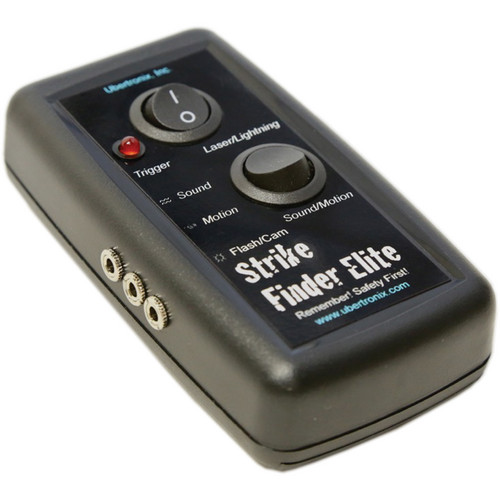
I used watercolors here to color the water and later I've added a bit of milk to kill the transparency of the water a bit. As seen in the set above, I've used here only 2 speedlites (580EX II) and didn't want to use my third speedlite (430EX II). I used here also my UV filter over the lens front just to protect the front from water droplets. I should have protected the flash heads as well with plastic bags but I skipped that actually. The big hurdle was to get my old Ubertronix trigger to work, specifically with a laser-gate. Without detailing the troubles, at the end the laser-gate method proved useless to me because of the shutter lag and the cumbersome laser pointer I was using. Thus, for the rest of the experiment, I went on doing a manual job, holding the cable remote in one hand and dropping the cherry with the other.

Cherry Boom I
Canon EF 100mm Macro, f/9, 3200-1sec, ISO200.

It was apparent from the beginning that I'm having a problem and probably should have used a larger bowl of some sort since the white edge of the plastic dish was hard to remove. Some problems did not show up till later on as I was inspecting the images like Cherry Boom I. Beside the shallow depth at f/9 (which was not enough), it seems that 1/3200 of a second was not enough for the shutter to freeze the water movement! However, during the experiment, I've raised the speed a bit more without really knowing the final outcome that I will be getting later on. Good luck? Maybe!

Cherry Boom II
Canon EF 100mm Macro, f/9, 4000-1sec, ISO200.

The speed of 1/4000 seemed just enough to freeze such a fall! In total, out of 20+ shots, I got merely 2 useful shots and one or two shots for splashes without the cherry(ies) which I simply liked for their shapes but I don't think they would be useful as stock images or printed and displayed. As for Cherry Boom II, the cherry here fell upside down and my brain being in love with illusions, I've decided to rotate the image 180o and thus the water came up and the cherry down, but standing up. What annoys me about Cherry Boom II is, like the other shots, the white space from the plastic dish edge which cannot be removed or substituted. I continued the work further in the next day and going manual too with 1/5000 shutter speed, and changing the camera tilt little bit (and pouring some water into the dish) to hide the white edge as much as possible. Again, out of 20+ shots, I've one suitable shot here.

Cherry Boom III
Canon EF 100mm Macro, f/20,
5000-1sec, ISO320.
Beside enhancing the looks, I went on enhancing the depth of field as well pushing it to f/20 (to have greater chance of having the cherry sharp wherever it falls), but that of course called for an increase in ISO, as I didn't want to use my third speedlite still. Water splashes now are more stable and live! In Cherry Boom III, seeing that the two cherries fell on their side, I've decided to rotate the image 90o clockwise to add a surreal feel to it.
In all of these shots of high speed, there was always a problem with the noise level when processing the images, despite the ISO being relatively low. With my Canon EOS 7D, I'd say that the ISO is somewhat easier to handle up until ISO 800 or around that, but in these images the processing was cumbersome and I do have my doubts about being accepted for exhibitions with the group (if they pass the aesthetic critique). However, some stock websites did already accept these images without a problem and they are up for sale!
Finishing from this cherry project I did proceed to another one, involving high-speed shooting as well, but I will keep that for a future post, as I'm still trying to work on it further.

Finale

After kindling my passion again for high-speed photography (adding to that the lack of locations and ideas for panoramas), and after the failure of my trigger, I've emailed the company asking about the reasons for such time lag and after some discussion, it seems that the reason is my shutter and not the trigger itself. I was advised to connect the trigger to the flash instead of the camera but in my working conditions this is not possible, as working with triggered flashes means opening the shutter in a dark environment while the flash becomes the only source of light. However, reading about some aspects of my camera, it seems that I do have also to adjust some of my photo-shooting habits to reduce the time lag in shutter release (depending on LiveView being one!).
Though I'm on leave without traveling but seems I do have a busy schedule here (beside taking care of Mom), but I feel some satisfaction that I didn't feel in a long time now since I could work with my camera and really think of something to do with it, without feeling exhausted like everyday after coming back from work through the traffic jam. Meanwhile, the idea of traveling is still ticking and tickling my mind, despite the fear of the hassles that I might have to face outside because of all the madness going in the world today, specially for a guy like me from the Middle East.
In the meantime, August is getting closer, my birthday that is, and I'm preparing to have some big order (well, not so big, but a bit big maybe?) of some gear and maybe some books. I would have to place the order before August I presume since there are some items that are considered "special order" (i.e. need time to be prepared and dispatched). This is to be a gift to myself, since no one around give such gifts except of perfumes! On my mind is a 4th speedlite (and probably another 580EX II if available still) and maybe some filters. I feel so excited that I want to place the order right away in the coming few days, but my financial situation and the course of Ramadan makes me hold it back and wait. Thus, I might be placing my order by the end of June or so! I need to miss my camera so much to work with it with passion…

Stock photography by Taher AlShemaly at Alamy

Thursday, May 4, 2017

Stacked…

It's a slowing down time, and summer is hovering heavily with its beginning here. Air breezes are slow and barely enough to breathe here, with waves of dust suspended in the air. I miss winter already. I didn't do much photography lately but few video shooting, again, as I'm waiting to settle down with a topic for the project of the month of May. We'll see what that would be. I had some work with macro shooting too as I was trying my old rail to do some focus stacking, which I have to say from now, it was a fail for many factors. However, I got still some nice out come as well.

VaVaVoom...

Let's head first to the video. In my last post in this blog I've posted mainly 2 infrared videos done as I was driving. It was about time, however, to do the same while using my B+W 403 Black UV-Pass filter. I didn't want to use the old and cumbersome 18-55mm kit lens which fits this filter perfectly and I didn't have any wide angle lens better than my Voigtländer 20mm semi-manual lens, which has a diameter of 52mm, and thus a step-up ring is needed.


Without going into details here with the settings I've been using (basically automated), you might have noticed vignetting around the corners. I need to do a thorough check up and comparison with my other B+W 092 infrared filter and Voigtländer 20mm lens, as it seems that vignetting happens only with this lens, for which I use a step-up ring to fit those circular filters (all of them are 58mm in diameter while Voigtländer 20mm is 52mm). If vignetting appears with both filters then, of course, it has to be the step-up ring, but if not, then it has to be the filter itself and its nature and make. However, in regular single shots, fixing the vignetting is quite easy but with a video clip, I'm still not sure about my capabilities in that venue. 
Sigma 12-24mm for Canon.
I thought I was over with videos until I've noticed that some of the infrared images online are actually, and most likely, images taken with a converted camera but without any filter, which produced a strange hue of colors because of the full spectrum involved (specially when the sun is shining), and then colors would be converted (sometimes) and the resultant image is something "fantastical," so to say. This is what I planned to do then specially after acquiring a new lens (but an old one) from a friend who converted to Nikon. The lens is Sigma 12-24mm. It is a big and a bulky lens but the range of zooming here is quite useful for me specially for recording a video inside the car, and with the absence of any 18-55mm kit lens in my collection (it's there, but it's old and hardly used).


Again, sorry, I have to remove the audio here (for your own safety trust me). I was lucky and unlucky in the beginning of this video as you can see: I was trapped between my brother's car (which is red but turned blue with channel swapping) and our neighbor's car on the right, yet it was a good chance for some interesting footage! Anyhow, I think I'm going to like this new old-lens. There are some problems though which I'm hoping to find a solution for later:
Rokinon 800mm f/8.0 Mirror Lens
  • The lens with its case is too large for my camera bag, even if the case is to be removed.
  • The lens front is fisheye-like, meaning no filters can fit. But there is a special hood to cover the front of the lens and provide a base to attach filters, yet it can hardly be used for now since it's 82mm in diameter.
  • The rear of the lens is large as well and it might be hard to stabilize any gel filters at the back.
Nevertheless, I still think this old lens will be of great use in the future. If only I can find a proper place to store it. This brings me memories of my Rokinon 800mm mirror lens which I didn't use much as well and I have to see about using this lens as well and getting active with it too! As you can see from the video above, the colors are pretty close to, for example, many portraiture shots that are said to be taken in infrared. This makes me think that many of these infrared shots are actually, simply, taken with a converted camera without an infrared filter. I've seen some pretty colored infrared shots that are said to be taken with Hoya infrared filters, with threshold of 720nm; Yet, I don't understand the vibrant colors which I don't even get with my B+W 092 infrared filter of 650nm in threshold. This needs more research!

Minute

Min-Yoot; to be precise about the pronunciation. Along with my videos, I've taken my chances to work with my old macro-rail for a while, as some tiny plants are blooming at home and I didn't want to lose this "rare" chance without documenting some of them. Got to say that the aroma that spread around the place in the early morning hours is just refreshing (despite the bad weather of dust and humidity sometimes).

Beauty Explosion
Canon EF 50mm + 56mm ET, f/11, 10-1sec, ISO250.
Focus Stack

I have to say though that all my trials with the rail were a chain of failures. Yet, some people liked some shots despite the errors like Beauty Explosion, which was shot indoors (after moving the pot inside). Yet, I made a mistake for not using higher f-number. Despite being inside, the branch was still shaking because of the slight breeze from the AC! This was so obvious even with 1.12X magnification, so I can't imagine what kind of shake I would be witnessing if I went over this ratio of magnification even! The 20mm and 36mm extension tubes would be used for every railing experiment still. It can be noticed in Beauty Explosion how some areas are smudges; those are specifically some merging errors probably cause of the little shake of the branch and changing the position and also there might be some missing millimeters along the way as I was rotating the knobs of the rail (making more than 20 shots along the way). The colors here are, of course, a result of swapping Red and Blue (the shoot was done using my converted Canon EOS 7D but without any filters).

SpectraOnion
Canon EF 50mm + 12mm ET, f/22, 30-1sec, ISO100.

Away from that plant, outside under the blazing sun, I got some memories back of me doing some of my first 3D with onion blooms, and we have it again! I didn't want to skip the chance so I tried my luck with it, this time with my converted camera. In SpectraOnion, I've the 12mm extension tube just to get closer to the bloom, as the 50mm lens has a minimum focusing distance of 45cm, and I needed to get closer than this distance. My aim wasn't really going into the field of macro here, yet I got a nice close up, despite the back-breaking situation (very low) and the blazing sun. Of course,  I didn't forget to aim for a 3D rendition so I've taken several shots by nudging the whole tripod to the left gently.

SpectraOnion (3D)

I've examined doing the 3D anaglyph on both, colored and B&W versions and, despite the distractions with the colored version, it seems that it stands out more than the B&W version. Not sure why, but it is kind of weird to see such thing with my own eyes, because it is believed, typically, that B&W images are better for anaglyph rendering to reduce the color distractions in general! Anyway, it looks fine to me specially at the base of the little stems as they stand out when viewed with anaglyph glasses. Moreover, I had a go with swapping the channels as usual with such images specifically.

SpectraOnion (Red-Blue channel swap)

Being beautiful as well, but not favored over the original by some, probably because the original has a strong color contrast between yellows and blues (the two are opposites on the circle of colors). However, another trial took place and this time I've done it outside (for the same plant) in a somewhat quite evening with barely some breeze. The light outside was strong so I was relying a bit on the fast shutter to stabilize the image with the same settings for the previous experiment: 50mm lens and 20+36mm tubes.

Stacked Bloom
Canon EF 50mm + 56mm ET, f/22, 5-1sec, ISO400.

As it can be seen, I was wrong. Though I increased the depth to f/22 but the shutter slowed down significantly. For this reason, I had to time my shooting, holding the remote in one hand and trying to block the air current with the other, and shooting only when I feel the branch was stable enough. The ISO had to be raised significantly which meant more noise. However, I can say that the range of proper merging here is better than my first trial despite the fact that I was doing it outside in the fresh air. Here in Stacked Bloom we see that it's all blue after channel swapping unlike the very first trial, Beauty Explosion. This is probably related to the change in IR levels from indoors to outdoors (outdoors being more, naturally).

Crystal Bloom
Canon EF 50mm + 56mm ET, f/16, 10sec, ISO100.

In my final trial, Crystal Bloom, I've decided to cut a portion of the branch and it take it inside then stabilize it further by holding it with a paper binder. The length was small so AC air breeze wouldn't have an effect on it, which encouraged me to go mad with the exposure! At that moment I've remembered my problems with my Canon EF 100mm f/2.8 macro lens, and thus decided to work with f/16 instead of f/22, as I thought it might be a factor playing in the mishaps with merging the focus stack. In average, the exposure for each shot in the stack was between 8 seconds to 10 seconds and the total was about 40 shots. Tried to be precise as much as possible with the rail this time and moved 1mm between each shot and the other. However, in merging the focus stack, things went OK except at some portions close to the edges away from the center of the image. This leads to me think that what is happening here is a change in the virtual size of the image beside the change in the focused area, and for this reason the stacking doesn't go well. There is, of course, some room for human error, always. Also, it might just be that using many extension tubes like that doesn't go well with the rail method? Not sure. Too bad I didn't think of doing reversing lens back then since I have the proper gear for that. According to calculations (which I hope are right!) if I'm to use Voigtländer 20mm lens in reverse, the magnification power is supposed to be about 2.5X. The question remains though about how practical the focusing distance would be (it is REALLY close already with extension tubes and 50mm at 1.12X magnification!). Seems we'll have another round with that. I didn't forget as well to render a 3D out of these images!

Crystal Bloom (3D)

Finale

This was a... brief (?) about what was going on with my life lately. Excluding the ups and downs and the mood swings. There was a bubble of eagerness to write a poem with all that mix of feelings inside me, yet I couldn't find the power nor the mental order to pin it down. I think my dreams of seeing Morocco must be kept for some other time. I've signed in for a leave for the whole month of Ramadhan and it will start by May 28th and will end by June 22nd. Thus, I'm not sure if there is any chance for a vacation this year either. All what is left for me here, I presume, is the company of my own thoughts, and projects…


Stock photography by Taher AlShemaly at Alamy

Thursday, March 31, 2016

Staidéar…

Two weeks with barely anything to write about. I was busy with many things, starting from games that I MUST play to lens testing that I MUST work on. I tried to prepare also for writing an Arabic article about lens testing for my other blog, but unfortunately things were not done in time. Thus, all is delayed.
They were stressful 2 weeks in fact, with contests and photos and home issues. I feel drained already and not sure how I'm going on with my everyday life. Anyway, I've finally made a lens test, which I cannot say it is a perfect one but I tried hard at least. My main aim was to test and compare between 2 lenses, the almost-new to my collection, Voigtländer 20mm f/3.5 lens, and my old (trusted for panoramas) Canon EF 15mm f/2.8 fisheye lens. However, I've completed my tests as much as possible with most of the prime lenses I have: 8mm, 50mm, and 100mm. These tests are not the end of the story as I have to do more with the former two to check out further, mainly, the possibility of doing a panorama without doing further calibration for the VR-head (which is calibrated specifically for Canon EOS 7D + Canon EF 15mm f/2.8 fisheye lens).

For the following tests, I've used a simple chart provided in B&H website. However, I'm not sure how to extract more information from these charts but they were enough for my uses right now, like checking for chromatic aberrations and for the "sweet spot" in apertures range, and probably I would check out for any possibilities to measure the amount of distortion and correction needed (using DxO; but I doubt it's possible). Checking for vignetting is also possible as explained in the main text, but seems all my tests were prone to some error of some kind, and hence testing for vignetting is not assured. Mainly, it was lit from one side (and I preferred working in daytime since the sun beams seep through the door at this time and the exposure times are shortened significantly). According to the text, the chart must be printed on glossy paper (probably for increasing contrast), and that proved problematic with my lighting conditions as there were several harsh reflections off the chart and using speedlites was out of question (would complicate things further). However, the majority of the images taken seem to have proper balanced lighting anyway (with exception to the Rokinon 8mm fisheye lens).

The chart in use. I've printed it on A0 size, even though according to the text it is printed on a smaller size. Both sizes, however, are smaller than the real image size (when printed as it is that is).


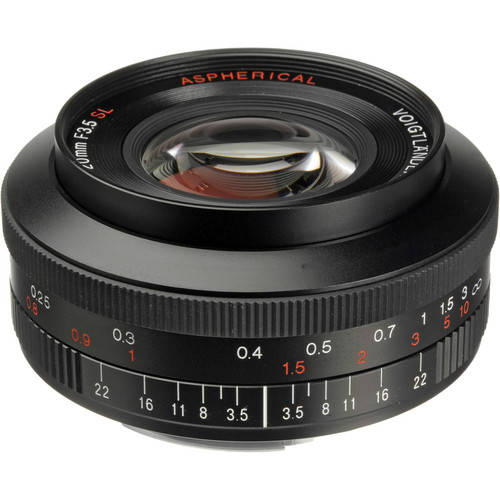
Voigtländer 20mm f/3.5


Source: B&H
 The lens is not a fisheye lens, thus it has a rectified perspective (though not absolutely flat). The only wide angle lens I have which gives such a perspective is the very old and out-of-date kit lens, Canon EF-S 18-55mm. The lens is semi-manual, if I can call it so; meaning it is generally manual with no Auto-focus function, but it does apply some communication with the camera. One can simply turn the focusing ring slowly while pressing the shutter button half way and wait for the beep to confirm the focus. However, I've realized that it is a good practice to re-check the LiveView for the sharpness of the lines and fine-tune the focus.
To make things systematic a bit, I've divided my work to two parts: inspecting the center circle for maximum sharpness and best setting chromatic aberrations (mostly it is the same as the aperture of the sharpest image), and the second part is to do the same with the corners. Most of the time, the aperture that provides the sharpest image at the center does so as well to the corners; at least in my case here, but I don't think this is a general rule. More complicated charts (look for ISO 12233) would provide more information, specifically on the resolution power of the lens. Not sure this is possible in the chart above. In the following strip, the change in sharpness of the center circle is shown with varying the aperture. The view is supposed to be an original 100% crop, so please allow some time to load. I was mainly interested in the very central point of the circle where all these triangles meet:

Click the image for a high resolution version


Well, now to results! Upon inspecting the center of the chart, it looks that the range between f/7.1 and f/10 got the sharpest lines (that is, it is the "sweet spot"). Most probably f/8 would be the best, but since the lowest f-number here is f/3.5, I was going in full stops from that point up to f/22, and thus shots were made at f/7.1 and f/10 (instead of the more typical stops of f/8 and f/11). The amount of chromatic aberrations at the center are more or less linked to the same range of apertures. The chromatic aberrations are there at all apertures, but they "look" lesser at this range of apertures.

As for the corners, the results are around the same in fact. Checking the corners is essential since in optical design, the majority of calculations and considerations are done about the center region of the lens mostly, and hence checking the center of the chart and the corners for comparison is a must. However, with this lens I didn't find much difference in the values of sharpness.

Canon EF 15mm f/2.8 Fisheye

Source: The Digital Picture
This is my usual and typical lens for panoramas and I rarely do use it in any other situations, for when I need a really wide angle, I would then switch to my humble Rokinon. This said, it doesn't mean I wouldn't pick it for specific situations anyway. This lens is stopped and not issued anymore from Canon which somehow put me in some troubles now and then when I try to find some specific information about it. Anyway it is still the darling which I prefer for panoramas (and the VR-head is calibrated according to its combination with Canon EOS 7D). The lens has a slot at the back for gel filters. Unlike the Voigtländer lens, it does support AF function, even though it has a slow mechanism. Anyway, with a wide angle, why the hurry! Of course as a fisheye lens, the distortion is, normally, not rectified. This of course makes it a challenge to fit the chart into the view, thus portions of the wall were included in the shots. In the same manner like the previous lens, I've focused automatically, then manually to check the sharpness, and then took shots at full stops of aperture (starting from f/2.8 and ending with f/22).

Click the image for a high resolution version

As for this center, I was fluctuating between f/8 and f/11 as the sharpest, but looking further to the center, I see that the center is less condensed with f/8, which I think it signifies that f/8 is the sweet spot for this lens. However, upon inspecting the corners, the story was a bit different, and I'm hoping that this difference is significant and not caused by a human error from my side.

Click the image for a high resolution version

Inspecting one of the corners here, I've realized that f/8 was not the sharpest but it was f/11. This means we have a difference in terms of sharpness in the various parts of the image. I think this might be considered normal since we are speaking of a fisheye lens which exhibits some distortion. But this observation is really significant when I bear in mind that I used to do panoramas all that time without realizing this fact. Could it be that such fact is the reason behind many failures of stitching in the past? Not sure…
In terms of the chromatic aberrations, it is the same all over and specially at the corners and edges, where it doesn't seem to change at all with the change in aperture; the red and cyan bands around the edges of lines are the same. The image can be sharp (visually), yet it does show aberrations.

Conclusions

From my humble observation, and I know I did make some mistakes in shooting the chart, but it seems that each lens has its advantage and disadvantage, specifically when compared having panorama-making in mind. For example, we can see that the Voigtländer 20mm f/3.5 lens has an almost unified focus from center to the corners when it comes to the sweet spot. On the other hand, the Canon EF 15mm f/2.8 fisheye lens does change in sharpness from center to corner; Where the center is sharpest at f/8 and the corners are sharpest at f/11. Probably we are talking here about the focus shift phenomenon, in which the focusing plane is shifted as the aperture changes and that would require a slight change in the focusing distance.
Chromatic aberrations are apparent in both lenses. However, they are typically more at the edges rather than the center. In my observations, I've noticed that despite displaying chromatic aberrations at most apertures, the distance or the width of the aberrational bands are quite thicker in Canon's lens while being thinner in Voigtländer's lens. This would supposedly mean and easy treatment (digitally) for such a problem in the future for the Voigtländer's lens more than it is for the Canon's. For a fisheye lens, though, this is quite normal I believe, as the distortion at the edges of the frame would naturally be accompanied by such aberrations in high contrast situations.
As for vignetting, my test was quite simple: increasing the contrast for the image. However, no significant vignetting occurred in any lens, at any aperture value. This is probably quite normal since my camera (Canon EOS 7D) has a cropped frame. I think vignetting would be more apparent with full-frame cameras.
One main factor (divided into small factors) which I didn't get the chance to study yet at this point, is the capability of Voigtländer's lens to be adapted for panorama work without the need for re-calibration for the VR-head. Meanwhile, the Canon EF 15 fisheye lens, with its slot at the back for gel filters, is capable of carrying my Kodak gel filter of 1000nm threshold. I can fit my other circular IR filter on the Voigtländer's lens (with some step-up ring), but the threshold is only 650nm; meaning some Red spectrum would seep through still. In both cases the art is possible. An extra point for Voigtländer's lens is the fact that I do own also a UV-pass filter which I can fit it to this lens and do panoramas in UV for the first time (and yet I don't have a UV gel filter). All that work with filters is planned to be with my new converted camera of course (also Canon EOS 7D) and not the regular camera anymore. Another advantage for Canon's which must be pinned out, is the fact that it has a "red dot" to define the focus under infrared influence; Something that Voigtländer's lacks. The critical factor here is finding the no-parallax point for the Voigtländer's lens and see if re-calibration is needed or not. If a re-calibration is due, probably it won't be worth it, but I'll try.
Doing this does encourage me somehow to print the more elaborate and complicated ISO 12233 chart, with which I can do measurement for the resolution power of the lens (in simple terms, it is the power of the lens to differentiate between two closely-spaced lines).  But I don't think this idea will be applicable in the near future.

Finale

Even though I'm having my break from the camera yet I'm working still with the camera(s). Ironic, isn't it? I wish if I can even work further with other projects floating around like the the Geltani, but I'm trying hard to concentrate on one thing at a time. Though I was planning for a long break somewhat, yet it seems I'm much obliged to join the group in another "adventure" for shooting theater performances. This made me think as it would be a good chance to put my converted camera into practice and see how it would act in a dark atmosphere like the one usually offered by theater performances.
This busy schedule after all does not provide a protection from harsh mood swings now and then or simply rolling back with flashes of memories with a simple trigger; could be as silly as a sign on the road. Anyway, now I will be busy writing some articles for the group, and also writing an Arabic illustration for how to test lenses for my other blog, and till then, I'm not sure I would be able to post here soon…