Showing posts with label book. Show all posts

Thursday, February 25, 2016

Cold…

The engine is non-stopping and steam is venting from every ventilation route possible. Well, this is what I'm trying to do. My stuff are scattered around the house and I feel so pressured with time, and yet I didn't achieve much. I was hoping that I would be over with the project RED soon, but this wasn't the case, despite the encouraging feedback to my images.

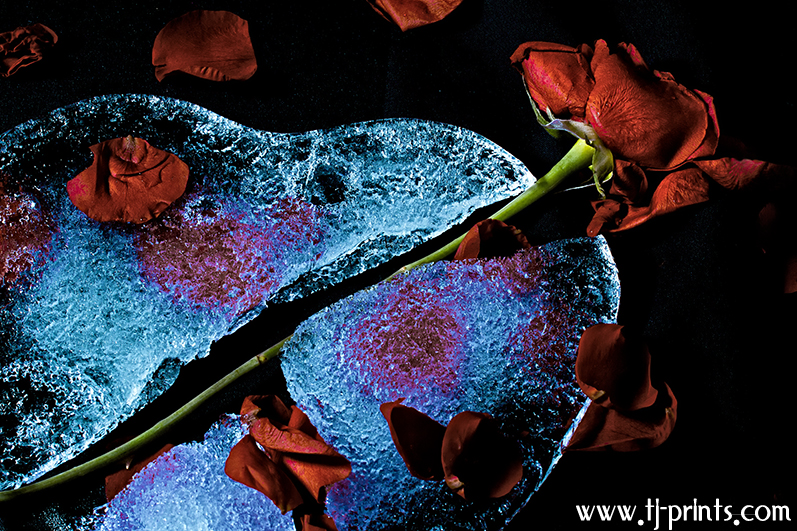
Cold Love (II)

My first trials with the project resulted in Cold Love series. I had one idea in my mind and many liked the image but understood it as something totally different, but nevertheless, it's a good thing they liked it. What I like about this project is the push it makes (despite the pressure and stress) to make up the image, instead of waiting for a chance to make it. The first trial with this idea were good but not good enough and I was given some instructions; unfortunately though these instructions were challenging. First, the rose must be a cast inside the ice heart (which I made using bakery molds by the way), and the petals should be removed as they make a distraction. I tried 2 times more to make these instructions into fruition, but to no avail so far. However, I'm going to put on these results in the coming sorting meeting. If all fails, I think I will need to sort out to Photoshop to fix some of these problems (but not all). More ideas are waiting to be implemented and I've wasted enough time with this one and another idea involving strawberries (which will never see the light).

Black and white version from
a test shot from the project.
Meanwhile, my other trial for Selfie theme was also rejected for some technical problem (away from other problems in composition I believe). The focus is said to be on a portion of my back hair behind my ear rather than my eye. Well, with f/9 probably this is too obvious though on my monitor it wasn't pretty obvious. It's hard to do such a shot again because I'm doing it all alone. No one is going to set the focus for me!  Anyway, it's done and that's it. Now off to other projects to finish. This is getting really tiresome.

Little Universe (II)
 In the rush of projects and ideas, I've started to process a series of shots I've taken a while ago and totally forgot about them in such rush. A repetition for my previous trials with glass marbles and reflections. This time though I've changed the lighting method from dark field method to bright field method. The difference is obvious I presume. Here, however, I tried to get out of the typical scenery of reflection images by, first rotating the image, and then cropping the main subject and keeping the reflection, while cropping into a square (too much white area) and fitting the contact point between the marble and its reflection in one of the thirds' contact points. The reflection of the black boards on the sides is something I'm not sure of how to feel about really. Sometimes I see it as an ambiguous reflection and some other time I see it as something breaking the monotonous trend of such shot. I'll keep that for the next meeting to sort it out, though I'm not even 50% sure that such shot would pass. After this shot was published in the media, some friends suggested other variations to the main idea, so probably I'm not yet done with this experiment just yet.

Source: Amazon
As I go through my recent projects, I'm also reading this awesome book (which I've discovered it is volume 2 in fact). I'm trying to implement some of its tips in designing shots to my work with these projects. However, my reading pace is slow as I'm having no time to read except at work, and mostly at noon time just before I leave. The book discusses elements of design for the images in an abstract sense, as it connects between the human perception and basic elements of the image. At some point though I have to be careful about it because these interpretations are based on a Western view about the surrounding environment, and there might be critical differences between that view and our (Middle Easterners) view. For example, lines that slant to the right (/) in the image would give a sense of increment because eyes subconsciously follow the direction of writing and reading, thus making the line going up in direction from left to right. We, however, might see this line as a sign of going downward because our native writing and reading direction is right to left. This is just a simple example of the amount of information included in this book. The amount of information included makes me a slow reader as well.

Finale

Chain Reaction
Using Dark Field method.
Looking at my life now and all the things I want to do. I'm really running out of everything and time is such a huge pressure on my shoulders now. One of the projects that I've realized that I've stopped for long now is the Geltani conlang, which really saddens me to see it hanging there without a progress. I even thought, in moments of despair, to call it off and cancel all that progress, but I stepped back and said to myself "let's wait and see." I'm so taken away with photography now that it makes my life pace on brakes, and I don't know when I'm going to step on the acceleration paddle. Every time I try to manage my time and do some time management, things just slip out of my hands. Drastically. Makes me wonder now: do I need a long vacation away from my camera? Maybe…


Thursday, January 28, 2016

Black-Out…

It's been some tiresome 2 weeks, so this is just going to be a quick wrap. I'm still enrolled in some workshops which I'm trying to get over with. Unfortunately, for some reasons related to the lecturer (the founder of our group), things got to be delayed a bit. Anyhow, my Abstract Photography workshop is over, yet no concrete results yet. I tried my best trying to make up some ideas but to no avail. I usually shoot abstract which already exists, but this workshop was about "creating" abstract and play with ideas; and let's not talk about how hard it was to make up an idea from scratch! In fact, I've never made up an idea; I was solely playing with techniques. Afterwards, there is an ongoing workshop about the philosophy of colors, which also required some assignment to do. Anyway, things on hold now for some private matters.

One of the abstract shots of marbles.
Canon EF 100mm macro, f/7.1, 400-1sec, ISO200.


Meanwhile, I've abandoned my idea for shooting a bursting bubble. It seems to be a pure team work needed with this one, and for someone like me, it is hard to be get it at that. Add to that, I cannot yet get the right mix or tools to have good bubbles production. Thus, I want to invest my time doing something else for the time being, beside the assignments for my workshops. Also, I do have some specific projects in my mind. All that will be done with the help of flashguns.

Probably the best single bubble shot I've made so far.
Used Dark Field technique: white background, black sides.
Sigma 70-300mm @70mm, f/16, 4000-1, ISO400.
Used three flashes on HSS mode against the background:
2x 580EX II + 1 x 430EX II


I'm having some weird issues with my flashguns and cables; specifically, the 10m (~33ft) long cable, and my newest 580EX II flashgun in particular. Researching the issue a bit, it seems that 580EX II does indeed have some glitches and that's why it was hard to find (and it's discontinued already). Anyway, I can always rely on making it a slave after all. It is just a matter of time before converting completely to radio systems though (which is more expensive). Till the utmost need urges so, I'm not going to get into the radio systems for the time being. However, I'm gonna have some hard time because of that long cable.
Source: Amazon
On the other hand, I finally got my new "toys" but I still could not try my new lens for real. I don't have the time, yet! I also got a new book, which I'm not sure how to start reading, but for the time being I've read 2 pages or 3 in bed along with some other (thick) book which I'm supposed to read since last year!! Yes, such a stuffed schedule, and mind. The book is about the so-called Visual Design. Something I think I do need indeed in the current time specially that I want to work on converting ideas into photographs and kick in some creative work. I'm not sure if it is just a temporary black-out for my brain or it is indeed a basic problem with my own imagination trend, but I feel paralyzed and unable to achieve something unique with my camera away from the panorama trend and landscapes. Well, not portraiture as I completely have lost interest in that field specifically. In addition to this book, I've also ordered a stack of 3D (anaglyph) glasses (100 pieces) which I'm planning to put to some good use when circumstances allows it!

Now, I think it is time to add a bit more to my forgotten website, and check out more for chances to add artwork to stock sites as well. I think I can call this as a real work since I'm not doing any real work (or gaining real respect) in my own workplace. If only I can have my enough of sleep…

Thursday, December 31, 2015

Firsts of 2015…

Been a long week (by feeling that is). I can't wait to get my share of holidays; well just one day for the new year, but it's worthy. I've been having sleeping problems again but this time because issues with the retracting health. Despite all of that, I did have some fun with my camera and I'm trying to come up with more ideas to work with it.

Checkmate!

Source: Amazon
As I am close to finishing my last photography book in hand at the moment with few pages left to read (in fact cutting out reading it to type these words), I've decided to work on some tiny project 2 weeks ago when I was around the beginning of the book. I didn't post the images in my previous post because they were not processed and not ready. However, I had to change my initial plans drastically for the time being, until I find a suitable set of Chess. Yep, Chess.
Those who know me well, probably know that I hate chess (and checkers); not my typical games for fun. Anyway, I had an idea I wanted to imply which consists of showing a contrast between luck and planning, or maybe you can call it: Fortune and Strategy. I'm thankful to my friend who provided me with a chess set which he got as a present from Iran. Anyway, found out that the chess set is not the typical set as I wished, but the pawns were small miniatures made of metal. The board, though, was beautifully intricate with oriental design. I didn't want to say No to the chance!

Last One Standing
Canon EF 50mm + ET 12mm, f/10, 320-1sec, ISO100.

I have to say, though, that setting up the gear and the set is much of a hurdle! For this reason, and after setting up everything, I left the scene or set as it is and continued the work on several days, trying to find a new perspective in every day visiting the scene along a 3-day period. I've made many shots but probably 2 or 3 were to my liking, like Last One Standing above or Battlefield below. In Last One Standing, and due to the proximity to the set, I had to switch to extension tubes which cause a shift in the focal point of the lens to help the photographer get even closer (and zoom further as well).

Battlefield
Canon EF 50mm, f/7.1, 320-1sec, ISO100.

The general activity is in fact to help me understand flashes more (and I didn't use them in a long time). Thus, there was a plenty of changing positions for the flashes (580EX II and 430EX II) and switching between TTL (Through The Lens) and Manual work. In fact, I find most professionals advice with using TTL mode except in few delicate situations (few of them depend completely on manual mode). Despite the easiness when working with TTL, I've found myself more inclined to switch to manual when my work starts to involve 2 flashguns. Anyway, I started to follow the advises and build up the lighting in the scene one step at a time with test shots (many of them!).

The lighting diagram approximately (the camera as at an angle with the flashgun on the left, and the reflector was closer to the table)


As I was building my lighting setup, one of the points I kept in mind is how to reduce the usage of flashes by re-distributing the beam using reflectors. The reflector I used here is not the "real" professional one, but simply a car shade (cut into half). This reflector is essential to reduce the harshness of the shadows, even though I did raise the 580EX above the tabe level a bit to get a softer touch (a process called "feathering"). Finally, I decided that I needed an overall increment in exposure, specially to light the topmost parts of the pawns. Thus I used the 430EX wrapped in a flag (black modifier) and pointed it up to bounce it off the ceiling. The flag of course is essential to block light coming to the scene. This last addition was put on full power as the ceiling was a bit high up (the table was low-level). As for the camera settings, I've found myself prone to use high-speed or HSS and that means a speed over sync speed. Despite the general low ambient light level, the background was not dim enough and it happened that the flash power in HSS mode was just perfect. It's not necessary to use HSS mode ONLY for moving and freezing objects you know! After all, the depth of field was the main decision-maker and I had to depend extensively on viewing the scene by pressing the DOF button; Not only to ensure the main figure is within range completely, but also to have a nice background blur (not too fuzzy, not too sharp). My main idea was to have a golden atmosphere as to add warmth to the scene (better than the cold look of the metallic pieces). Thus, I've switched the WB to manual and set it at 10,000K (Flash WB would balance the flashgun output only).

The Stand

My last trial was inspired by my brother who helped me with shooting a series from above the set (using the same diagram above but without the flashgun pointing up). Unfortunately, that series wasn't to my liking but I'm still viewing it from time to time and try to extract a good shot from it. My brother suggested that I would capture the set as you see above in The Stand; to have the focus on the far end instead of the near end as in Last One Standing and Battlefield. Here though, and because of the angle of view and the distance I've positioned my camera in, I've thought of using the stacking method. more than 33 shots were taken while moving the camera backward for 1mm at a time. Unfortunately, the initial position for the soldier here didn't help to put it on focus in the beginning (might look good in a small size version but not the original). I ended up using only a fraction of that collection (probably 10). This roll back of the camera also helped in shaping the blurred figure better (if the soldier is in focus, the other pawns in front of the camera are way too blurred to have any recognizable details). Well, that was the last experiment here and I had to pack my stuff after that… such a tedious process!


Firsts

 As 2015 is about to end, I've decided to have a little fun and look back at the pictures I've taken this year. It would need a long time to go through and study back my own work for the whole year and find out my mistakes to learn from them. However, I decided to look for the first things I've done this year.

Cold Fire

I remember Cold Fire was taken when the family was gathering outside when the weather was nice in February (yep, not January). I'm not sure what I was aiming at exactly or what was the initial idea (yes, initial ideas can change in my mind and be something else like the chess experiment above).

BPF in Al-Hamra Tower

Then we have the first panorama done this year: A panorama inside Al-Hamra Tower with BPF group as we were doing a workshop there. It was such an architectural attraction. I wished though no people were around but I had to do it that way. Still a delight to my own eyes. The first panorama this year was stitched in May.

The list ends with the first QTVR, which was done from a panorama taken inside a summer photography gallery by the end of August The panorama and QTVR were done in the last day of the exhibition (which was so quiet back then).


Esir
(captive)
Then, we have the first infrared shot which was a simple setup for a simple idea and using a single flashgun (580EX): Esir. Many shots of this set and many processing methods were done to the photos but probably this edit is my favorite. The infrared filter used here is the circular B+W filter with a threshold of 650nm (weak filter allowing some visible spectrum in the reds to pass).

By this, the list ends. I can't think of "first" stuff to add here for the time being but each shot is typically a new thing for me which makes me think and try to find something new about it. There is some UV shots made but they were all experiments and not quite favorable; they do need a converted camera for real!
I'm currently busy with a workshop in HSS and probably I would share some results here by next week if I could process the images I've taken. It's quite a fun time away from home with some group members doing things together and having a laugh.

I wish for dear readers a happy new year and a more peaceful one than 2015 was. Also, one with low prices as well and more simplicity to our lives. Though I don't usually make resolutions for new years (as it is something that doesn't belong to my own culture) but probably if I was to make a resolution probably it would be to have a simpler life, and courage to work more with my camera.


Happy New Year
Bliain Nua Sásta
كل عام وانتم بخير


Thursday, November 27, 2014

Book Fair…

Things had been busy a bit here, particularly for the matter of the Expo which accompanies the annual book fair (Arabic Book fair that is). Things went fast, as the organizers called the group's leader to get some photos ready for the expo, leaving the leader no choice but to "pick" directly instead of the usual sorting out process for the members - members that he chose and picked himself out of all of the around-34 members. They, the organizers, specified the number to be 10 photographers, with 2 photos from each photographer to be displayed, and thus the total would be 20 photos. To our surprise though when the expo started by last Wednesday, our group's position was apparently picked by the organizers in a haste or simply our group was thought of as the last solution for some problem they had! Other groups had the chance to get 30 photographers in, with two photos for each (i.e. 60 photos in total). Moreover to this, our group's photos were not gathered specifically into one booth, but spread over 2 places, with some photos of other groups into the booth containing most of our photos.

Our booth in the expo, with the right wall belonging to another group.
The photos of the leader and 2 other members are displayed on the partition,
and on the other side into the next booth.

Also, apparently other groups knew what was going on and brought stickers to put them on the names of their members. We didn't bring ours till next day. There were no signs showing which belongs to what, but they simply dumped the stock side by side.

Anyway, things are going fine and so far so good - we are considered by now the best contributors to this expo; testified by both: photographers and non-photographers. The distribution of the prints made me a trouble for how to document this event by a panorama. However, I decided to go ahead and do one panorama for the main booth. I did another panorama for a general view of the expo. The panorama for the main booth had to be done in HDR because of the harsh contrast coming from the windows above, and yet I didn't bother doing some metering here, since it was just for documenting after all. As for the general panorama, which I didn't stitch yet, it was a simple 360 panorama of single shots, as I didn't care much about showing fine details or making a dramatic look out of it.

This is all for now and till I get some free time from the expo, I might get back to writing this blog. I do have some ideas that I need to work on (at home and outside) but because of the time consuming expo, I can barely have some rest from work before going to the expo, or even barely having some time for myself. See you later!

Thursday, November 6, 2014

Ar An mBóthar…

This post contains QTVR environment and needs QuickTime to be installed. Please give some time to load.


I'm not sure if this is the idea I had in my mind for the term "vacation". Not that I'm bored, but quite the opposite; I'm overwhelmed. I technically can't have a rest and my sleeping pattern is not helping as well. At least I got to play some of the games I wanted to play.
Processing the images is still going on even though in a slower pace, specially that I wanted to play these games which made me stop the process for a while. But more to come about that later. Most important thing right now is, almost all panoramas were stitched, in flat format. Which means I, now, have to work further with other projections! and I've made some QTVRs indeed, so hope you have installed QuickTime already!

Pano

In the field of panoramas, there were some panoramas that I'm reluctant to work with further for various reasons; colors, mood, and even the structure. However, in the next round of panoramas (in other projections other than flat ones), I guess I will re-checking those. Particularly here, the panorama taken from the lounge of the Waterfront B&B. I'm sort of glad though that one of the panoramas, for which I've expected lot of hurdles, turned out to be finely stitched!

An Seomra Folchta
The Bathroom

I was expecting such panorama, An Seomra Folchta, to have problems because of the very narrow space I've taken it in. But it was finely stitched in HDR with the help of a model made out from JPG slides. The detection of the white balance on location with the help of the WB disk paid well here, as the atmosphere inside this small space was mixed, between a bluish tint (hence yellowish WB would be needed) and some hot colors on the ground from the carpets (hence bluish WB would be needed); but all was set just by using the WB disk. The main difficulty in this panorama specifically would be aligning the panorama and making sure that some lines are truly vertical. OK, now to the QTVRs.


QTVRs

Concerning QTVRs, I've been thinking lately if there is another way to represent them instead of the current methodology I'm following. I've had a peek into the matter and seems there are other methods indeed, but probably more rigorous in terms of application; yet they can be useful for viewers of this blog as some of them don't require installing QuickTime. I'm not sure how this would work actually since converting the panorama into a QTVR is already done through PTGui here and the file type would already be a MOV. Need some time for this!


In this QTVR you might notice a mistake. Well, more than one in fact. Anyway, it seems that when I tone-mapped this HDR panorama with Photomatix, I've forgot to tick the "360" option, which ensures that the left and right edges of the panorama are seamless and flow together without a cut. This is one of the problems with tone-mapping in Photoshop; there is no option to make the panorama seamless - not that I'm aware of any anyway! Despite this fact, sometimes I'm forced to use it for tone-mapping specifically as it comes...


This QTVR was made from a panorama which was originally tone-mapped in Photoshop. Fixing the seam here was relatively easy; just some cloning work and I guess it is not easy to notice the seam line when rotating the QTVR. The reason I tone-map with Photoshop sometimes is the fact that I can use curves to establish the tonal values for various luminance levels all around the image, and this is how I worked out the disk of the sun here and made it sparkling instead of having just white bright spot in the sky. Such specific control can't be done in Photomatix, unfortunately. Imagine the power if the two are merged: one application to control the light by curves (beside other methods) AND making sure the panorama is seamless. Awesome!
Left to say I'm kind of surprised for Aughnanure castle's QTVR, because here, I didn't add a nadir point as I was experimenting only about the seam line. However, it was seamless AND PTGui seems to have identified the vertical limitations of the panorama; in old QTVRs, these vertical limits would be black zones if the panorama is not in the format of 2:1 ratio. But here, the viewer would automatically stop before reaching the cut of the nadir point. It was experimental after all thus I left the watermark as is on the image.

Well, there are plenty of other QTVRs but maybe I will keep them for some other time, like Kylemore Abbey's QTVR and the one for the interior of The Waterfront, beside the exterior panorama too. In all of these, and despite the fact that it was easy to clone the nadir image, I've decided to use the classic method of putting a label at the nadir point to identify the panorama and work as a "watermark" of some sort.

Singles

Meanwhile, along with the panoramas, I'm doing more single shots in between. Even though people now started to look at me for panoramas and related fields (here at least), single shots, nevertheless, are equally important. The problem, or should I say the dilemma, I'm in is: am I just good because I do panoramas? Things in the group somehow agree with this statement, specially with the upcoming events.

Uaigneas Lúcháireach
(joyous solitude)
Canon EF 50mm, f/16,
25-1sec, ISO100.
I'm trying not to put all the egg in one basket as they say; whenever there is a sorting out for the group, I do pick up some old files along with the new ones from Ireland. However, chances are still low. I can't deny that there are some fatal mistakes in some images after all. Mistakes that just don't appear for the regular viewer (who enjoys colors and setting more than composition and clarity). However, there are images that did somewhat gain popularity (on the internet at least) but yet they were rejected, like Áilleacht Dhorcha which I've posted about last week.
 On the other hand there were images that I was glad to work with but then it turned out it's all a mistake. Well, I did like the color at least! Uaigneas Lúcháireach here is an example, but maybe I do have my excuse here at least. The boat was moving fast and I had to snap the picture fast before it's gone out of sight! The main problem here is the "guide line" which literally extends from the middle of the frame below to the extreme left side; such a wrong position. In addition to that, the leader said there are some distracting elements which makes it out-of-harmony. Well, my confidence is not shaken yet for this! At least I'm glad I didn't use polarizer here to clear the water which provided some reflection, and the whole atmosphere was mainly achieved by changing the White Balance without sorting to HDR technique. Maybe another version of the scene was better (despite the emptiness)...

Maidin Ghorma Aon (one blue morning)
Canon EF 50mm, f/16, 125-1sec, ISO100

Probably not better here with Maidin Ghorma Aom, but the annoying "wrong" guide line here is removed (this shot is taken before they reach that point). Lot of work here was involved (mainly dodge and burn) to control light and shadows, and specifically approach the image to a silhouette style.

Amharc Éagsúil
(different view)
Canon EF 50mm, f/8,
20sec, ISO400.
On the other hand there were desperate trials to create something out of... desperate shots, to say the least. Images like Amharc Éagsúil for example, were simply test shots in the dark (dusk time), but since the quantity of shots taken this year (single shots that is) is at low, I had to gamble a bit with shots that were intended as tests, like this one. It would have been some nice shot if only there was a full or partial reflection on water, but all I got is clouds and the tip of the house. Thus, to make things interesting a bit, I flipped the image upside down just to make out some interest! Controlling the tones later was just as desperate trial of creating vividness without oversaturating the image. I'm really not against rejecting this image at all. But there was something strange too...

Roimh an Dorchadas (before the dark)
Rokinon 8mm fisheye, f/8, 12m, ISO100.

Roimh an Dorchadas, an image which was on the list for sorting out for future events. There were comments about over saturating the colors but I believe there had been a problem with color calibration in that laptop (wasn't color-calibrated). However, what I consider the strangest comment was "you have better than this already". I'm not sure what was meant by that or what picture in particular was meant here. Maybe Through My Window? But if this was the case, I do consider Roimh an Dorchadas better-looking...

Through My Window
Rokinon 8mm fisheye, f/8, 7m, ISO100.


Yes, the clouds line is apparently better in Through My Window, yet Roimh an Dorchadas has probably more interesting elements in the image itself. The problem with Roimh an Dorchadas is that the air was almost static and hence the clouds didn't move much.

Finale

The coffee table book cover
It is finally here! My own copy of Coffee Table book of the luxury edition (2014) of Trierenberg Circuit contest, which contains my own panorama, Ludendorffs Wirklichkeit. The process of retrieving this book was something out of one of those adventure games: tasks, questions, investigations. Still, the case is not over yet with the (bad) post services here, as there are copies of the catalogs that did not reach us yet (supposedly sent back in June). There is a probability that they were sent back to Austria, but no news from Austria still. Many issues were here as why this has happened, like not providing a track number for receivers to see where the parcel stopped, and no phone numbers provided on the parcel so at least we would expect a call from the post service, and yet the post service here, of course, wouldn't do a thing (probably even with a phone number provided).
Ludendorffs Wirklichkeit as
printed in the book,
in a small corner.
I didn't go through the book yet but I do believe there is a lot to learn from other contestants' photos in the field of architecture and landscape photography. Yet, I can't hold my disappointment here. Let aside the fact that my "large" panorama was printed in a small corner (and the colors aren't as vivid as on monitor), the book itself is a demonstration of clear bias for specific "items". I'm not saying photos aren't great, but a quick look through the book made it clear that if you are a portrait photographer, and specifically into nude photography, your chances are dim. Sorry, but it somewhat feels like, and sorry for the wording here - like checking a brothel's catalog. I know what I will get for such a comment (retard, old-fashioned, know-nothing-about-art, ...etc). But seriously, I can't help it. Doesn't seem that you make a woman just a toy of cosmetics in such field of photography? Well, to me it does. On the other hand, other fields deserve some attention more than it is already.

Anyway, far from the book, I'm trying to cope with the busy schedule I'm getting with my group, as we have some activities going on. Majorly Al-Thani contest is a major concern, and despite the ideas for sending prints, but seems it is not a plausible idea by now. The contest ends on November 17th (my brother's birthday as well!), and we barely have time to submit the images online. On the other hand there is even a more urgent matter, concerning some expo here for which the group was personally asked to join in. I'm not sure what kind of expo is this, but the leader is also relying on my panoramas, and gave my number to one of the organizers to discuss the matter (still waiting for that call). Also, months from now, there will be some preparations for Mawahb expo (in which the group will be enrolled for a 4th time). I might get into it if I don't get the burden of organizing the booth or the prints; my time right now doesn't really allow for that!

In the meantime, I'm keeping my thoughts busy as much as possible, but this is not a good thing either. When my thought is active, my consumption (specifically for coffee) is also active. Despite all this activity, there remains something empty deep within. I can't deny the fact that I do feel like being lost; someone who doesn't belong to where he was planted. But I'm keeping on going, in a tunnel that I just can't realize where does it lead, or ends...

Bóthar na Scáthanna
(road of the shadows)


Thursday, September 19, 2013

Bridge-O-Rama...

Hectic week. Or maybe I should say hectic 2 weeks. I thought that allergic reactions have long gone from my body, but with the wake of last week, I've realized that this is not "completely" true! Itchy nose and sneezing continuously with a red face and eyes. It seems that it is related to the dust wave that we've encountered that day. Everything is calm now, except of some sneezes here and there.
Anyway, this gap of a week without a post did accumulate some materials to be posted here, so this post might be lengthy a bit! I'll try to follow some chronological order though.

Back to Flora
With my sister's delivery, flowers hammered in the house. Not so many in fact but it was a chance anyway to do some macro and some other types of magic. The flowers (and roses), however, are typical and seen them before and took pictures for such types before. Thus, it was my task to find something new about these flora.

Comrades in Beauty
Canon EF 50mm + ET, f/22,
400-1sec, ISO100.
Typical in such floral situations I would go into macro level because the floral arrangement is and might be a good thing for still life, but this is something I'm really not going into for the time being. However, the floral arrangement might be inspirational as I will show later - but not in the case of the first bouquet, thus going macro, to me, was a natural choice as can be seen in Comrades in Beauty. I've named it Explosive Beauty in the beginning but, let's say I didn't like the violent name for such gentle shades and hues along with the soft stems. I've taken pictures like this before in a workshop with the photography group and experimented with the same flower indeed (Lily, or is it lilly?). I see that using a speedlite in such approaches is a must to add some flavor and atmosphere. Otherwise, the shot under the ambient light might be plain and flat. In Comrades in Beauty, the speedlite was adjacent to the lens and to the flower's stems. Because I was using high f-number and High-Speed (to kill the ambient light), I had to get the speedlite by hand so close to a "ridiculous" distance! Probably using 2 speedlites would have solved the problem, but no need to add more stuff to an occasional work.

InfraRose
Canon EF 100mm macro, f/16, 100-1sec, ISO100.

Then, the idea of doing macro and infrared visited me again (I've done the same 2 weeks ago). However, this time, it would have more abstract sense since it is to be taken from the top of the rose and not from the side like I did before, two weeks ago. Originally, the shot would be highly overexposed but with the IR filter on the lens it retains the details back (and might be underexposed sometimes!). In the processing of InfraRose the red hue (the rose was white) was swapped and turned blue. Red was beautiful as well, but it was so typical, for roses that is.
InfraRose specifically, stirred some weird criticism by some people (and some others do like it as it is). Not something new to me actually, but it is the type of criticism that was handed to me that made me re-think of what or how do people think about such images. Probably I should list these points:
  1. Some people said they like the general color, but everything was off and there is a loss of details. My answer is: what details? It is indeed a macro shot, but the general theme is abstract and I don't see any details are to be preserved in the original shot in those white petals.
  2. Halos. I didn't pay attention to those in the original shot and I'm not quite sure if they are the result of extreme sharpening, or simple because of the speedlite light (which was used in taking this shot). Yet, I don't understand still, how come such thin halos to make a big deal of the general view.
  3. Some people edited the shot already (without my permission) and fixed the general tint and retained the original white color of the petals. OK. Some people did like the white version more, yet I didn't send any invitation to edit my own photo. I know how to make it white, IF I wanted to do so!
This is some of what has been said already about this shot. Anyway, enough with this bouquet, and let's get to the next bouquet which was delivered later. As I've mentioned before, the arrangement of the flowers in a bouquet can be inspirational by themselves. I know, lot of photographers do arrange their own shots specially if they are into still life photography, but this is not the case with me. I work mostly by rules and lines, and if not, I deal with what life throws at me.
The floral arrangement in this bouquet specifically inspired me to show uniqueness and separation from the rest of the herd. Simply, by pushing the central rose upward above the rest, and shooting from the top. It was time for using the lateral arm again!

Eigen
Canon EF 50mm, f/1.4, 15-1sec, ISO100.

Probably in shots like Eigen I should've zoomed in further, but since the 50mm lens is a prime lens (no zoom) and I'm completely relying on the lateral arm and the tripod to get closer or further from the rose, it was better to settle down at this level and work with some cropping later when required. I did some cropping indeed to remove some edges and to shift the center of the image to the center of the rose, as it was a bit off-center. Another self-note is, probably f/1.8 or f/2 was better just to include the edges of the central rose further into the focus. However, personally, I do like the dreamy sense of it that way in general.

InfraEigen
Canon EF 50mm, f/1.4, 15sec, ISO100.

Of course, the idea of the IR filter visited me again, and I've applied it. I think it does give a mysterious (and maybe melancholic) feel to it that way. Even though InfraEigen seems like a black and white shot, but there is a slight tint in the image. I can't really remember if I swapped the channels like it is customary with IR shots, but judging from the light bluish tint at some part, I guess I did indeed swap the channels!
After taking the first shot with a shallow depth, I thought it's a good chance to try IR with really sharp focus and a lengthy exposure (because I seldom try this!).

InfraEigen II
Canon EF 50mm, f/22, 6min, ISO100.

InfraEigen II (soft)
Canon EF 50mm, f/22, 6min, ISO100.

In many occasions, and while processing the shots I take, I find that increasing and decreasing the Clarity when dealing with the RAW file can produce many chances for interesting outputs. When dealing with InfraEigen, the situation was the same but probably because of the already-shallow depth of the scene, softening the edges did not have a strong impact on me, but when dealing with InfraEigen II the softening effect was apparent. The green tint in some areas in the soft version (after swapping channels and processing) is due the fact of increasing the Vibrance. Of course, in all infrared versions, dealing with the noise was a hectic matter, but no need to go into those details for the time being!

Bridge-O-Rama
It was about time till I get the chance to do some photography project that I had in my mind long ago. Photography on the top of a pedestrian bridge.
I've delayed this project mainly because the bridge is somehow close to some sensitive buildings and my mood was (and still) not open for more conflicts with some authorities. Anyway, this time I had some spare time so I decided to head to that bridge and work a bit just before dusk time. Finding where to park my car in the first place was a big deal by itself!

Arabestract
Rokinon 8mm, f/22,
6-1sec, ISO100.
As I climbed up, the first thing to try was my Rokinon fisheye. I was quite sure that it will make up something interesting when it is combined with such straight long lines tending (or seems to) go to infinity. I think this is what classical artists would call Vedutismo. I've taken some shots on one side of the bridge and tried the best I could to place the tripod and camera exactly at the center (but typically my trials failed anyway). Later, I've headed to the center of the bridge, almost, just to check the view from that point. I've realized how hard it is to judge your position in the air compared to the ground, and while I thought I'm at the center of the bridge because the ground below me looked so (!), but the fact is I wasn't and I didn't know this fact until I've shot Arabestract. In this shot, I've literally laid myself down on the ground and lowering the tripod as much as possible while pointing the camera upward. It was hard to look at the viewfinder or even the LiveView, thus I had to use a high f-number with focus to infinity to ensure the depth encompasses the roof of the bridge. Anyway, there were no other details, but only the roof, so I guess no need to worry about the hyperfocal distances. My only fear was to be lying down there while some passers would decide to "pay me" a visit!

Originally, I didn't really plan for a panorama even though I did take my VR-head with me (usually I take it just in case some idea pops up). However, after checking the result of Arabestract I've realized there is a great potential for some amazing geometrical plays, judging from the abstract of Arabestract. Thus, I've settled as fast as I could (because the light was changing and dusk is getting closer) and started taking the panorama.

Bridge-O-Rama
Hungover
I Dream
Before doing this panorama, I tried some weeks ago to re-calibrate the Manfrotto 303SPH with my EOS 7D and Canon 15mm fisheye lens and make sure about the no-parallax point. However, I've realized that because of the distortion originally inherit in such lenses, it was almost impossible to achieve such point, but rather we can reduce it, as I came to believe. Anyway, after doing the panorama I wasn't disappointed, despite the many stitching errors that I had to conceal or fix in one way or another. Lot of these stitching errors are somehow hard to notice in a small size scale. With my new PC I was able to stitch relatively large HDR panoramas in relatively a short time, and I've stitched almost two versions of each projection just for comparison. At times, it is even hard to judge which projection is the best. The vertical projection for example produced two nice panoramas, with each giving some specific feeling to it: Hungover and I Dream. To tell the truth, I do feel that I Dream is closer to my heart.
One of the major problems here though is the tone-mapping of such panoramas. There were many factors that made this a hard task to do somehow:
  • I've used the Fluorescent WB which typical for me in such time of the day, but probably the tones of the place were not forgiving for such white balance.
  • Photomatix tone-mapping was hard to control with its aspects, thus I had to turn to Photoshop itself to tone-map the tonal curve point by point. Photoshop versions after CS4 really amazed me (currently I'm using CS5) with its tone-mapping capabilities. They have improved significantly.
  • Under such circumstances, it was hard to decide whether the color cast should be corrected or left as it is. Lot of work with layer masks was required to control this aspect.
This was just some of the problems, excluding the original hard time in stitching the panorama in the first place, where the computer was unable to generate lot of control points for some reason I'm not aware of still. However, my amazement was still to come in two projections that I did not even think of or even had a vision for...

Planeta Arabesqueia

Swept Away
The planet projection was an amazement for me. I didn't realize this fact until I've worked it out in PTGui. These lines make an intriguing atmosphere. Ironically though, the tunnel-view projection which is the reverse of the planet projection (i.e. aiming upward from below) did not make an interesting figure, to me at least. This made me make up some theory about the visual attractions and panoramas, which I will mention below. Another interesting projection which was made completely by mistake as I was trying to settle down with I Dream above. This time, probably, I should name such style as the "tilt" or "twist". Without complicating the text, when I try to change the point of view of a panorama I usually work with specific and fixed amount of degrees, like 45o or 90o and so on. Sometimes though, I mix things up unintentionally, as it happened in Swept Away, which has an irregular vertical axis (relative to the bridge of course). This image and Planeta Arabesqueia were published in my group's instagram's gallery and received some applause from the viewers.

Arabesquette
Canon EF 15mm fisheye, f/16,
5-1sec, ISO200.
Not only the panoramas themselves were interesting, but there was one specific point in the whole set where I loved to see alone and separate from the rest of the panorama. Talk about must having an attentive eye while working with more than 40 slides of HDRs. I rarely use the 15mm fisheye lens for anything else other than panorama shooting, but this time as it is in Arabesquette the 15mm fisheye lens made as if by virtue, all the lines vanish into the lower right corner. This point of view, I think, could have been so hard to achieve with Rokinon's 8mm fisheye because the field of view would be wider, and more details would be included. This tight point is just fine as it is.

Arabesquearium
Rokinon 8mm, f/22, ISO200. HDR.

After finishing the panorama above, I've decided to give it one last try with my Rokinon 8mm lens and shoot the bridge from the first point where I started originally, but this time, from the ground level. To stabilize my camera here I've used the battery charger under the lens hood itself! Well, shaky, but with a 10sec time, all was fine. The only problem was to check for the center of the image (which I was somehow lucky here to have the center in a proper place almost). Even though I tried to flatten and fix the distortions in such images taken with Rokinon's 8mm lens, yet I've figured that such step would take all the amusement and the visual interest out of the image, and it is better as it is; all lines converge into the horizon. Vedutismo! I loved this perspective more than the ones I've taken in the beginning of the journey from that same point exactly, in which I've used a tripod and the camera was above the ground (around 1m high, ~3ft). For this reason, I didn't really touch those taken at the beginning. In between also, there was some trials with my 18-55mm lens (yes the old kit lens) with the infrared filter but I was aiming at the road below and the general cityscape. I have to say it was just experimental as the lines did not appeal to me very much.

Theory
Gazing on and about the panoramas that I've already made here, made me think of some visual aspects and how to render or expect an outcome from a panorama. Leaving Swept Away aside for the time being as I need to check it more (probably doing old panoramas in this way and see for myself), the main interest for the time being is the planet and the tunnel projections. It seems to me that the interesting projection for some space is highly relevant to the direction of the interesting feature in the scene. As you can see above, the main feature in the bridge is the roof, which has elaborate designs. Doing a tunnel projection would bring this feature to the middle of the scene, and that specifically rendered it dull and idle. I see that Planeta Arabesqueia, in which the view is from the roof, has a more interesting render. I would lucky of course if the place I'm doing panorama for has more than one interesting feature, like the case in the panorama of the Grand Mosque of Kuwait, done back in 2011. The main interesting in the mosque was the dome and the ceiling in general beside the floor which was covered with laminated carpet. For this, a tunnel and a planet projection (beside a wide view projection) all had some interesting feature displayed - this feature should be exactly the point of the view (i.e. as if we are standing at that point and looking in the opposite direction). This might sound like a paradox; as to how I'm supposed to make an interest by standing or viewing the scene exactly at the point which I'm supposed to be interest in? The answer relies on geometrical plays and the abstract sense of the scene. If there is an intriguing design in my scene, I'm supposed to represent that design in the strongest possible way. This can't be done if I simply put this feature in the middle of the scene (as it is the case in the tunnel projection). I have to stretch or change the perspective of that feature specifically to make it an attraction to the eye. I think I didn't think in details about this point specifically but only this time I'm trying to approach the topic analytically.

Finale
For Sale

Some days ago my brother advised me to get rid of those prints that I've framed (and did cost me a plenty) by offering them for sale on instagram. I'm trying to do this slowly in the current time even though I know there won't be anyone who would like to buy them despite the price reduction to almost 50% of what it was. I need to get rid of them in fact, because there is no use of leaving them lying around in my room like that; occupying space and collecting dust. Yet, all what I can do is just wish for some luck to get these sold at such prices. Also, I'm planning to add some more new images to my website, specially those taken recently. I need, however, to check on the panoramas and fix them the stitching errors properly, which will be a very time-consuming activity!

Source: Amazon
On the other hand, because of the lack of the new books, I'm turning back to some of the older books (as I've mentioned in previous posts). This time, I've decided to read The Practice of Contemplative Photography by Andy Karr and Michael Wood again. I felt the need to re-connect with that magical feeling deep inside me, away from trying to make a set-up and planning for shots ahead. I need to awaken that feeling of seeing as the book put it. Probably I need more books like this one in the near future. With the rush in my life and the mess, with all these contests that I've been trying to put up with and the rest of the obligations; photographically and domestically, I think I need to get back to my camera and treat it as a companion, rather than a tool. Specially with an empty heart like this one.

In my work I've signed for a little leave just to get some rest from all the damned traffic jam in everyday. Mom told me that I've should taken this to travel out. My reply was: where to go mother? I didn't like to tell her directly to the face that I'm actually trapped, for taking care of her because, simply, there is no one I could rely on for such a mission. I don't think that would make her feel any good. Anyway, despite the dialysis timing which will still keep me active in the morning and out of bed 3 days a week, I'm hoping that such a resting time would do me a favor and make me produce some more images, beside sleeping more, and dreaming more...

Thursday, July 18, 2013

Dilemmas...

Here we go, and as expected. Ramadhan has arrived and the unneeded stress started along. There is never enough time to do anything. Majorly, the main problem is the after-work nap which takes from 2 to 3 hours and sometimes even for 4 hours, and that makes me awry at night and unable to sleep early as in regular days. People in Ramadhan do indeed make a time shift and sleep late (because working hours are also shifted as well) but for me, I always try to fix my sleeping time as in regular days and never stay late unnecessarily. Now, I need to do that more than ever because Mom's dialysis timing is not changed and I do have to pick her up to there in the same time as in regular days. Moreover, I have to make her something to eat before leaving home (while we used to grab something on the way in regular days). In Ramadhan, it is insulting (and illegal) to eat in public while the whole nation is fasting. Well, we do have a medical permit or reasoning, but still, no need for embarrassment.
I've been to the doctors to check up with my nose and see the reason for bleeding. He said that the capillaries are probably weak and I need to have more vitamin C in my diet and provided me with some method to stop the bleeding as well. Finally, he said if that didn't work, then I have to go back to cauterize, probably by laser (?). I think in this week alone, I've lost a quarter liter of blood just through my nose!

The Dilemma (1)
This week I've been working on an idea for a panorama (and barely did) which I've been cooking in my head for a while. However, unfortunately for me, I'm having technical issues and a sluggishness in my skills. The panorama was taken twice in two different days, and two different lighting conditions, and with two different techniques.
In the first trial, in order to fix the bracketing for the HDR merging later, I've used my light meter and measured the light (incident) from different angles to the camera. There was a considerable gap in the EV values. In the beginning, the expansion of the bracket was from -2EV to +2EV but apparently that some shots were somehow dark and the +2EV shots appeared as if they were taken at 0EV instead, thus I've started all over and made the expansion from +3EV to -3EV. However, the story was not over here.
In the current time and because the memory issues in my old PC, I've decided to work with my (new) laptop as I'm still preparing my new PC before plugging it online completely. Sincerely, I'm so lazy to do all of that and it's connected to my TV at the current time; Not a pleasant view and my room is a mess. However, in my laptop and after merging the RAW files into HDR slides and trying PTGui to stitch them out, it turned out that the slides were apparently dark and PTGui could not find control points at all!
This matter triggered me to do another trial and this time, instead of working in Manual mode and taking light measurements, I've decided to go back to the old methods (tried and true!); Working in Av mode and letting the camera decide for the shutter speed, and I had this occasion to increase the f-number from f/8 (as in the first trial) to f/16, to make sure than things are sharper.
The reason I've decided to do a second session is the assumption that the dynamic range was so wide that PTGui could not assemble some control points in between any two images. However, even in my second trial, Photomatix and PTGui followed with the same behavior: dark slides, and unstitchable panorama. After many trials to install and re-installing older versions of both programs, I've finally came about to some solution and finally the panorama was stitched.

Wooden Hall (trial stitch)

I've spent several days trying to figure out what was going wrong with my (usual) procedure and why things do not work out in the laptop as they do on PC. The panorama above, Wooden Hall is just a trial and not a final image to be submitted to stock sites because of the weird (and usual) blue spots, but I've decided to put it online anyway without any fixes and ask for help about this matter, if there is any available! I'll try to summarize my thoughts here in points:
  1. Apparently, the main problem was in Photomatix and not the (new) PTGui. After installing several versions of both, it turned out that Photomatix v4.0.2 yielded clear HDR slides that are viewable easily in PTGui (any version), but the new version (v4.2.4) was problematic. I'm not sure why this is happening but there were already some issues when I moved from Photomatix v3.0 to v4.0, like the ability to tone-map without opening the HDR slide - a problem I used to encounter with large little planet panoramas, and my way around it was to set the values in v4.0, save the settings and use the side-cart file (the XMP file in which settings are saved) into v3.0 using the batch process facility. The thing is, because of the large file size, v4.0 used to give me a memory error and stops responding when I try to process the tone-mapping at once. Why don't I use v3.0 to tone-map already? Well, it turned out that v4.0 has a better on-monitor representation of the actual image after the tone-mapping is done. When tone-mapping in v3.0 (as far as I remember), opening the image in Photoshop later would yield a completely different image in terms of colors and shades and I would have to work around this with adjustment layers. The situation here is somehow similar in between v4.0.2 and v4.2.4. Advice: Don't always jump on newer versions of any particular software. It is good to try new stuff but always make sure you will be going smoothly with it. Keep older versions in store somewhere, as you might need them at any time!.
  2. The new PTGui (v9.1.6, and I think v9.1.7 is out there) has lot of interpolation possibilities, more than I had in the old stuff in my old PC. Interpolation is the way that a program would interpret or "read" the pixels across the image. The three basic ones were Bilinear, Bicubic, and Nearest Neighbor. Each one of those of course got a specific usage (some of them are explained in Photoshop resizing facility), but in PTGui there are no descriptions about any of them. In the new version, however, the list is expanded further to include Lanczos and Spline (with each one of those got several types). Speak about new stuff to learn and burn the time with!
  3. I've merged the RAW files several times and stitched the panorama several times (and thanks to my fast laptop, the stitching process takes merely 5 minutes for a 10,000x5,000 pixels panorama!) as I was trying to figure out the reason for these blue streaks across some regions in the panorama. My conclusion is (and I've done that before actually) it is more related to the color space, and it might be related as well to some gaps in the dynamic range of the HDR slides; I'm not sure yet. However, merging in different color spaces and stitching the panorama after, proved to me that the blue color spots (you can see them in the image above) were reduced significantly (in saturation let's say) when merging the HDR in a lesser color space as sRGB. Also, the streaks appear more or less around regions were there happens to be some stitching errors. Stitching errors cause such problem? Color space? Dynamic range? All of them? Not really sure, but it is surely annoying. I couldn't edit the panorama and fix it in this laptop mainly because of the size of the laptop and my sluggish movement with it and the display is small already. Thus, I've decided to upload it as it is and might try to fix it later when my new PC is ready.
My world is spinning right now and I have to finish up with this PC and try to hold to my camera again, and work with more panoramas even.

The Dilemma (2)
Well, this second dilemma is somehow to a lesser degree. It is just a dilemma about Geltani and some aspects about it. I've been working a bit with the sounds that are to be used in Geltani and I've figured out that it is almost impossible to avoid repeating some sounds. I've decided here that it is time to introduce some sounds that are unfamiliar to the far east in general, thus giving a touch to alienate the conlang from a typical Asian sense. With these new sounds, like the Arabic ħ [ح], I've decided to add some possibilities for creating dual-consonants and doubling (or stressing) some. Even with those creations, it is impossible as it seems, to provide a distinctive sound for each combination of leading and driving couplet. Would there be two words with similar sounds and different meanings?
In that sense, the scenario would be a mimic of reality of the far east languages, and specifically Chinese and Japanese, where is typical to find one character with several pronunciations and even meanings. However, I don't think Geltani would be close to that level of complexity of the real languages, but it has a comforting effect to think that having a repetitive scheme of sounds for different types of couplets is not really a bad thing, and it somehow mimics the real world to some extent. The characters (or logograms) would be definitely different if, at any chance, two words or more bear some resemblance in the sounds. The question now is, on what basis I should base the driving sounds?

Finale
David Schap's book is over with right now, and I'm trying to find something to replace it with from my arsenal of old books. As I've mentioned before, probably I would go through my old languages books.
Many ideas are racing through my mind right now, like having a leave for the rest of Ramadhan just to have my own timing and not to worry about work and waking up in the morning, but Mom's dialysis schedule holds me back from this idea, because the center is near my work place and eventually, the torture won't stop (but yes, I would have more time for myself).
Because of all this pressure, in the work-front and the home-front, all what I'm trying to do right now is to break all the cuffs and find a way out of obligations to work with my own projects and my camera. Feels like being married without a real partner, I guess.
Also, I'm trying to consider some way to integrate myself through the group back again, but without the work load that I used to get. Probably my membership would be changed from special to regular because of the low activity level I'm participating with. There is also a crazy idea cooking in my mind: to write a book in Arabic about the basics of photography. This idea arrived to me looking at the arsenal of the photography books that I have that are all in English, and many people here can't have the benefits of such books despite their love for photography because their lack of expertise in English. It is such a sorrowful thing that a language can stand a barrier in learning. Not sure this idea will go further but it is worth considering anyway!
I'm typing this post and watching TV in the hall, with some show about the Canary islands; It makes me dream of vacations and traveling again. I want to see the world again out there... if only I can find someone to take care of Mom as much as I do...