Showing posts with label mom. Show all posts

Thursday, October 27, 2016

Mental Diaspora…

Some weeks passed without counting them. I had to stop writing in this blog for a while (and the Arabic one too of course) after some drastic downfall in my mother's health; something almost costed her her life. Even though she is in a better condition somewhat but it is far from being the normal-her, as she is mostly bound to bed here at home and I'm trying, with the rest of the family, to take care of her and most importantly of all, to raise her self-esteem and make her smile despite the painful times.
Meanwhile, I was in fact trying to prepare for some photographic experiments which eventually were put on hold after the events, and trying slowly to get back to the pace and even trying to force myself to work on some projects.
I know, though, that some photographers advise against forcing oneself to work with the camera and leave it to inspiration alone, and initially I'm in that line of thought, but circumstances right now require some special measures, and probably forcing myself might take my mind off from the domestic problems that plague my life for the time being.

Let's Cook!

I've attended (and will in the near future) a workshop with members of the group given by the leader of the group which was about the imagination of the photographer and how to develop it. Our main theme for the practical part of the workshop was "kitchen utensils."
The topic of the workshop was, in some sense, forcing your brain to think differently about ordinary subjects (with a side dish of planning beforehand).

Boring Cold
Canon EF 50mm + B+W 920 IR filter,
f/9, 320-1sec, ISO200.
Before the practical part, I've picked a box of utensils which I didn't really consider what was in it, and thus I had no time to explore or think about what to do until I reached the meeting place. Anyway, the first idea to pop in my mind was to use a friend with 2 ladles as hands and show some boredom, as seen in Boring Cold. To add flavor to this shot specifically, an infrared filter was placed on lens (using my converted camera here and 580EXII speedlite on camera with diffuser). I didn't feel comfortable with this one, and probably my friend here didn't gauge his expression perfectly (trust me, modeling needs skills). I changed to my second idea which was inspired by the Jolly Roger flag (and, let's not talk how I got the inspiration).

Kuwaiti Jack Nickolson
Canon EF 50mm, f/9, 250-1sec, ISO200.

Using the same converted camera but without any filter on the lens, and also a speedlite here, the Kuwaiti Jack Nickolson was supposedly to be looking like the Jolly Roger, but with the facial expressions here and the hardships in holding the ladles in proper positions, the idea drifted away from that. Anyway, I liked the looks here so I worked for some time on enhancing the sharpness and the colors (specially the eyes and the mouth) to make it look more like a maniac's profile shot! The sharpness here was exaggerated on purpose and it was not done with convenient plugins (e.g. NIK or Noise Ninja), but it was done manually using layers in Photoshop (implementing the High Pass command). After these 2 shots, seeing that I don't work well with faces, I decided to concentrate more on the abstract lane of my thoughts and started playing around with the same ladles to come up with something unusual.

Metallic Lane
Canon EF 100mm macro, f/14, 250-1sec, ISO200.

I've finally arrived at that idea when I made a contact between the bottoms of the ladles (and it was hard to stabilize the set). Usually in such situations, I automatically switch my mind to think about macro details and look for abstracts and shapes, just like in this situation with Metallic Lane. A twist to the WB was applied to give it that bluish luster instead of the dull metallic one.
Major problem with these experiments is that the ladles were scratched and not polished in a good way, and however I washed them the stains and scratches remained. The practical part of this workshop was not the final deadline to present some work but it was a practice under the guidance of the founder and the teacher of the group, and we agreed to give results one week later which unfortunately passed without doing anything, since I've been busy with my messy life. However, I got new ladles with good polish and worked on them later on, as I will explain later in Rain-Bubbles section below.

Nailed It…

Before the dramatic events with Mom, I was already working on a little project, related to my previous post, The Fakhroid Muse, which is about getting inspired from a song or songs from the Syrian master, Sabah Fakhry (صباح فخري). Might be a good idea to read that blog post if you didn't.
I've been working on this idea, as I've said, before the dramatic events, and even after Mom being out of the hospital, I couldn't put a mind to it and finish it until just recently. I have to say though that I did a lot, a lot, of testing shots. The main problem was that the set was on ground level and I had to find a way to levitate the camera up to a certain level from the set (beside finding the good lens and the good position for speedlites).

Lovely Pain
Voigtländer 20mm, f/4.5, 4000-1sec, ISO200.

Generally speaking, the idea was inspired from the same song discussed in the Fakhroid Muse post, but a different line:
أثاريك نسيتني مع الأيام
ورضيت تفوتني على الآلام

Just to find you've forgot about me along the days
And you were satisfied to let me through the pains

The second line of this verse is the one that ticked in my mind and decided to implement the idea here. I've spent some time drawing a valentine heart on a cardboard and pinning some nails in it as it can be seen in Lovely Pain. In the beginning, the idea was to use 15mm fisheye lens because its perspective would help on forming the valentine heart more clearly (because of the distortion), but the wide field of view made it problematic to use such a lens, specially with speedlites placed around the set. As it can be seen above, the shutter speed is high, because I wanted to kill the ambient light completely (and of course that requires working in High-Speed mode).
I wanted to work with red food coloring in the beginning too, but apparently that was hard to show on metallic heads and (since I had no model to work with except of myself) it would make a mess for me, thus it was safer to work with red gel filter placed on the main speedlite. One speedlite was actually enough, sort of, but added another one on its side (was planned to light the feet alone), and for this we have here light heads sparkling (and lighter red tone). At the end, I've changed to Voigtländer 20mm lens for it is not as wide as the 15mm fisheye lens. Working with this lens can be tricky somewhat since it is manual completely and I had to re-focus as I adjusted the elevation and the direction of the camera several times (beside changing the spot to be under the focus several times).
The tricky part here is after shooting: on camera's LCD view, everything was alright, but when the file is opened on PC with large monitor, the valentine heart is barely recognizable and would require longer time of concentration to realize that it is a heart. Maybe it was my mistake even to draw it in reverse like that!
I'm still on the lookout for more inspiration and probably from the same song still. I do have some ideas already as I'm typing this, but the vivid glimpse of this idea would require having a model - someone to work with; something I'm not good at, and not available as well for me (of course, unless I pay money for a professional model I believe). I'll keep that for later though.

Rain-Bubbles

As a continuation for the kitchen utensils project which was started with the workshop mentioned in the first section of this post, Let's Cook!, I've tried to work with new ladles I've purchased specially for this project, and they are with good polish (but completely though). Big, small, and some tiny metallic container; I liked how they looked in the store without really thinking what to do with them. It took me some time to wander and to look, and finally got the idea of shooting reflections in some way, since these utensils do look like half spherical mirrors (concave or convex). Anyway, I did reflections, but in some other way. Completely different way!

Qtar 1 (droplets 1)
Canon EF 100mm macro, f/10, 250-1sec, ISO100.

As for the title of the image above, Qtar, I somewhat miss the Maltese language so I decided to use Maltese to name this series of images. After roaming my mind about, I finally sought hanging the ladle on the edge of a table (using clamp) and putting some drops of corn syrup (as a substitute for glycerine); water won't help much here with its low viscosity. Of course a setting as plain as this seem boring, so we have to add some colors to add life to the abstract, and thus I got colored sticks (like those tongue depressors used by doctors) out of my accessories arsenal, and placed them on the top of the ladle making a small window for the lens to peak into the droplets.

Full setting used with 2 speedlites. As it can be seen, the tripod legs were opened wider to get lower and closer to the ladle. Upon the ladle sit a number of colored sticks. Click to enlarge.

The first problem to encounter is which proper lens to use and I have discovered that sometimes, lot of times, we tend to complicate things instead of going directly to the problem. After trying a lot of lighting methods, and lenses with extension tubes, I reached the decision that I should keep it simple: single lens, no tubes, and even speedlite without any modifiers. The only thing here, as seen in the settings, the speedlites were not pointing directly but almost lighting the edge of the ladle which in turn spread the light all around the droplets.
Qtar 2
Canon EF 100mm macro, f/3.5, 200-1sec, ISO100.

Qtar 3
Canon EF 100mm macro, f/2.8, 200-1sec, ISO100.

Qtar 4
Canon EF 100mm macro, f/10, 250-1sec, ISO100.

As it can be seen here with this series of 4 shots, each change in the aperture (i.e. f-number) or the direction or power of the speedlite can produce interesting results; all that without touching anything in the settings but only changing the parameters in the camera and speedlite. Not to say also, the order of the colored sticks can be changed or the colors themselves (or even use something else other than sticks). Such a simple experiment can have great variety of results and the expectations are limitless!
Probably of the 4 above, Qtar 3 is the most liked one. Processing these images underwent a number of cleaning processes and adding lens blur to remove some of the scratches in the background (except for Qtar 3).

Finale

My mind is scrambled right now after all the dramatic events. Somewhat the world doesn't mean much for me. I don't feel it. But in the middle of all this sway and trying hard to concentrate and to work on something I like, to take my mind off from my personal problems, despite the fact that my work of art would mostly reflect some of the personality side, as in Lovely Pain.
On the other hand, my addiction to games is increasing as well as a way to escape reality (and people), as well as my worries. What does the future hold? Would I be able to see the outside world again? I'm going back to work by next Sunday, just to add more to my mental struggles…

Thursday, July 18, 2013

Dilemmas...

Here we go, and as expected. Ramadhan has arrived and the unneeded stress started along. There is never enough time to do anything. Majorly, the main problem is the after-work nap which takes from 2 to 3 hours and sometimes even for 4 hours, and that makes me awry at night and unable to sleep early as in regular days. People in Ramadhan do indeed make a time shift and sleep late (because working hours are also shifted as well) but for me, I always try to fix my sleeping time as in regular days and never stay late unnecessarily. Now, I need to do that more than ever because Mom's dialysis timing is not changed and I do have to pick her up to there in the same time as in regular days. Moreover, I have to make her something to eat before leaving home (while we used to grab something on the way in regular days). In Ramadhan, it is insulting (and illegal) to eat in public while the whole nation is fasting. Well, we do have a medical permit or reasoning, but still, no need for embarrassment.
I've been to the doctors to check up with my nose and see the reason for bleeding. He said that the capillaries are probably weak and I need to have more vitamin C in my diet and provided me with some method to stop the bleeding as well. Finally, he said if that didn't work, then I have to go back to cauterize, probably by laser (?). I think in this week alone, I've lost a quarter liter of blood just through my nose!

The Dilemma (1)
This week I've been working on an idea for a panorama (and barely did) which I've been cooking in my head for a while. However, unfortunately for me, I'm having technical issues and a sluggishness in my skills. The panorama was taken twice in two different days, and two different lighting conditions, and with two different techniques.
In the first trial, in order to fix the bracketing for the HDR merging later, I've used my light meter and measured the light (incident) from different angles to the camera. There was a considerable gap in the EV values. In the beginning, the expansion of the bracket was from -2EV to +2EV but apparently that some shots were somehow dark and the +2EV shots appeared as if they were taken at 0EV instead, thus I've started all over and made the expansion from +3EV to -3EV. However, the story was not over here.
In the current time and because the memory issues in my old PC, I've decided to work with my (new) laptop as I'm still preparing my new PC before plugging it online completely. Sincerely, I'm so lazy to do all of that and it's connected to my TV at the current time; Not a pleasant view and my room is a mess. However, in my laptop and after merging the RAW files into HDR slides and trying PTGui to stitch them out, it turned out that the slides were apparently dark and PTGui could not find control points at all!
This matter triggered me to do another trial and this time, instead of working in Manual mode and taking light measurements, I've decided to go back to the old methods (tried and true!); Working in Av mode and letting the camera decide for the shutter speed, and I had this occasion to increase the f-number from f/8 (as in the first trial) to f/16, to make sure than things are sharper.
The reason I've decided to do a second session is the assumption that the dynamic range was so wide that PTGui could not assemble some control points in between any two images. However, even in my second trial, Photomatix and PTGui followed with the same behavior: dark slides, and unstitchable panorama. After many trials to install and re-installing older versions of both programs, I've finally came about to some solution and finally the panorama was stitched.

Wooden Hall (trial stitch)

I've spent several days trying to figure out what was going wrong with my (usual) procedure and why things do not work out in the laptop as they do on PC. The panorama above, Wooden Hall is just a trial and not a final image to be submitted to stock sites because of the weird (and usual) blue spots, but I've decided to put it online anyway without any fixes and ask for help about this matter, if there is any available! I'll try to summarize my thoughts here in points:
  1. Apparently, the main problem was in Photomatix and not the (new) PTGui. After installing several versions of both, it turned out that Photomatix v4.0.2 yielded clear HDR slides that are viewable easily in PTGui (any version), but the new version (v4.2.4) was problematic. I'm not sure why this is happening but there were already some issues when I moved from Photomatix v3.0 to v4.0, like the ability to tone-map without opening the HDR slide - a problem I used to encounter with large little planet panoramas, and my way around it was to set the values in v4.0, save the settings and use the side-cart file (the XMP file in which settings are saved) into v3.0 using the batch process facility. The thing is, because of the large file size, v4.0 used to give me a memory error and stops responding when I try to process the tone-mapping at once. Why don't I use v3.0 to tone-map already? Well, it turned out that v4.0 has a better on-monitor representation of the actual image after the tone-mapping is done. When tone-mapping in v3.0 (as far as I remember), opening the image in Photoshop later would yield a completely different image in terms of colors and shades and I would have to work around this with adjustment layers. The situation here is somehow similar in between v4.0.2 and v4.2.4. Advice: Don't always jump on newer versions of any particular software. It is good to try new stuff but always make sure you will be going smoothly with it. Keep older versions in store somewhere, as you might need them at any time!.
  2. The new PTGui (v9.1.6, and I think v9.1.7 is out there) has lot of interpolation possibilities, more than I had in the old stuff in my old PC. Interpolation is the way that a program would interpret or "read" the pixels across the image. The three basic ones were Bilinear, Bicubic, and Nearest Neighbor. Each one of those of course got a specific usage (some of them are explained in Photoshop resizing facility), but in PTGui there are no descriptions about any of them. In the new version, however, the list is expanded further to include Lanczos and Spline (with each one of those got several types). Speak about new stuff to learn and burn the time with!
  3. I've merged the RAW files several times and stitched the panorama several times (and thanks to my fast laptop, the stitching process takes merely 5 minutes for a 10,000x5,000 pixels panorama!) as I was trying to figure out the reason for these blue streaks across some regions in the panorama. My conclusion is (and I've done that before actually) it is more related to the color space, and it might be related as well to some gaps in the dynamic range of the HDR slides; I'm not sure yet. However, merging in different color spaces and stitching the panorama after, proved to me that the blue color spots (you can see them in the image above) were reduced significantly (in saturation let's say) when merging the HDR in a lesser color space as sRGB. Also, the streaks appear more or less around regions were there happens to be some stitching errors. Stitching errors cause such problem? Color space? Dynamic range? All of them? Not really sure, but it is surely annoying. I couldn't edit the panorama and fix it in this laptop mainly because of the size of the laptop and my sluggish movement with it and the display is small already. Thus, I've decided to upload it as it is and might try to fix it later when my new PC is ready.
My world is spinning right now and I have to finish up with this PC and try to hold to my camera again, and work with more panoramas even.

The Dilemma (2)
Well, this second dilemma is somehow to a lesser degree. It is just a dilemma about Geltani and some aspects about it. I've been working a bit with the sounds that are to be used in Geltani and I've figured out that it is almost impossible to avoid repeating some sounds. I've decided here that it is time to introduce some sounds that are unfamiliar to the far east in general, thus giving a touch to alienate the conlang from a typical Asian sense. With these new sounds, like the Arabic ħ [ح], I've decided to add some possibilities for creating dual-consonants and doubling (or stressing) some. Even with those creations, it is impossible as it seems, to provide a distinctive sound for each combination of leading and driving couplet. Would there be two words with similar sounds and different meanings?
In that sense, the scenario would be a mimic of reality of the far east languages, and specifically Chinese and Japanese, where is typical to find one character with several pronunciations and even meanings. However, I don't think Geltani would be close to that level of complexity of the real languages, but it has a comforting effect to think that having a repetitive scheme of sounds for different types of couplets is not really a bad thing, and it somehow mimics the real world to some extent. The characters (or logograms) would be definitely different if, at any chance, two words or more bear some resemblance in the sounds. The question now is, on what basis I should base the driving sounds?

Finale
David Schap's book is over with right now, and I'm trying to find something to replace it with from my arsenal of old books. As I've mentioned before, probably I would go through my old languages books.
Many ideas are racing through my mind right now, like having a leave for the rest of Ramadhan just to have my own timing and not to worry about work and waking up in the morning, but Mom's dialysis schedule holds me back from this idea, because the center is near my work place and eventually, the torture won't stop (but yes, I would have more time for myself).
Because of all this pressure, in the work-front and the home-front, all what I'm trying to do right now is to break all the cuffs and find a way out of obligations to work with my own projects and my camera. Feels like being married without a real partner, I guess.
Also, I'm trying to consider some way to integrate myself through the group back again, but without the work load that I used to get. Probably my membership would be changed from special to regular because of the low activity level I'm participating with. There is also a crazy idea cooking in my mind: to write a book in Arabic about the basics of photography. This idea arrived to me looking at the arsenal of the photography books that I have that are all in English, and many people here can't have the benefits of such books despite their love for photography because their lack of expertise in English. It is such a sorrowful thing that a language can stand a barrier in learning. Not sure this idea will go further but it is worth considering anyway!
I'm typing this post and watching TV in the hall, with some show about the Canary islands; It makes me dream of vacations and traveling again. I want to see the world again out there... if only I can find someone to take care of Mom as much as I do...


Thursday, June 6, 2013

Şaşırmış...

I can't help but say, it is one weird week that has just passed me by. Despite the fact that I've stopped my fasting, in hope to continue by the beginning of the month of Sha`ban, yet I did feel tired excessively with some weak body and dryness most of time - talk about acting as a sponge.
On the other hand I was able to work with my camera just a little bit. I've made up ideas already from brainstorming my mind with the help of some of the websites I've mentioned in the previous blog post, but not all of these ideas are technically available for the time being, or maybe too much time consuming with my hectic schedule in the meantime. Mom is still taking much of my week, and despite some previous talk from the doctors that the dialysis time might be reduced in the near future, I can't see any of that happening soon. With this load, some problems from home are added. They usually call them Domestic Problems but in my case I'd rather call them a Jungle Survival game by keeping my dignity in this house. I've already started picking Mom to and from the dialysis center (before that I used to pick her from there only) because Mom is not happy to go with my sister in the morning in the traffic jam rush. Thus, she decided to go with me from now on in very early hours in the morning to avoid the high blood pressure that my sister causes her on the way to there.

Die geltanische Sprache
I hope you don't mind the German subtitle for this topic here. I'm not a German speaker myself but probably this is how I would write the adjective geltanische if I was German!
However, during this week I didn't put much thoughts on paper with Geltani, but mostly it was some work of thoughts in the mind and having mental notes about some drawings of the characters. In the meantime I'm having problems assigning phonic values for some of the characters. I didn't go through the syllabary system all over again as I've promised myself I would do this week. The major change in the syllabary system is about some characters' drawings and not the phonic values given already.
The language do sound, at the current time, a mix of an Arabic base with an English flavor in terms of general aspects; mainly when it comes to the feminine and masculine cases. However, I do have to work on the phonic values for lot of the combination of characters together and the situation is even more critical when it comes to diphthongs, that is the combinations of 2 vowels, or we might even face cases of more than two!
I'm trying to systemize the combinations of phonetics but I'm not sure yet that this would work. The only thing that would prove the usefulness of such approach is the excessive trial and error, with a pen and paper!

Silhouette
In the past few weeks I was trying hard to take a silhouette shot of my brothers depicting the evening life in a typical weekend here. Yet, despite its simplicity, I had to abandon the idea mainly for the cooperative attitude from the family members (and please note the sarcasm here) and then the unavailability of some suitable background or backdrop to represent the idea of an evening gathering. Majorly, I was trying to use some features in the guests room but this was a bad idea because it did cast a shadow and that complicates the matter further raising the necessity of using two speedlites (or even more) rather than one as I was planning. With more speedlites, then you'd need more light modifiers, and in my case, I don't have plenty of those.

Silhouetted Mother I
Canon EF 50mm, f/11, 250-1sec, ISO200.

Thus, just to keep up with the idea, I've decided to use Mom as a model! Yes, she's more flexible and the idea is simple enough and doesn't need much acting like I had in my mind when I was planning the silhouette shots with my brothers. It is just a profile or an outline of the head. To do this, I've simply placed Mom in front of a green curtain that's already there, and of course I had to use a green gel on my 580EX II speedlite, otherwise the color would get messed up; adding to that a reflector on the speedlite to spread the light to a larger area with a soft approach.

Silhouetted Mother II
Canon EF 50mm, f/18, 250-1sec, ISO200.

I've taken here two shots (close up and further away) just in case (and I was thinking somehow in a marketing venue as such images can fit into the stock sites for specific topics). Communicating with my speedlite, however, had to be done remotely without a cable, which means I'm stuck with the sync speed (250-1
sec). The speed was fine however as the lights in the room were not too strong and not so demanding to be killed out. The only change between the several shots was the aperture and this is how I controlled the intensity of the speedlite reflecting off the curtain. I don't quite remember why I've fixed the ISO to 200, but probably I've forgot it like that from the previous session! The noise level after all is not quite dramatic and was easy to smooth out, specially with such style of images not having so many colors.

Freeze Me!
Few days later after doing the silhouette shots of Mom, I headed to do another shot that I've been thinking of for some time and trust me if I say, I had to force myself and my mood to do so! The sole subject of this experiment was a glass vase brought to me as part of a bouquet by the group when Mom was still in the hospital back in March.

Pouring Down
Tamron 70-300mm @92mm,
f/16, 5000-1sec,
ISO1000.
I have to say that the vase is really seductive for many experiment, but the preparations to do such experiments is really exhaustive to myself, specially when preparing the props. The fact that my older sister wanted this vase too, made me do something, anything, just before the vase is taken away!
I've placed the vase on a table which has a glass surface in the center and placed my 430EXII speedlite below the glass. In typical situation I would actually place the speedlite light on the sides but I just wanted to do this experiment here, specially with the hardships involved because light is refracted through the glass table before reaching the subject. I've placed a white screen as a backdrop and in the beginning I've placed 2 black boards on the side (to emphasize the edges of the glass in a bright scene), but then however I've realized they are not necessary.
If you see the info in Pouring Down, you can see that I've used a telephoto lens (Tamron) while the shutter speed is 5000-1sec; quite faster than the sync speed. Thus, a cable is required to control the speedlite but with a telephoto lens, I need some distance away from the vase. In this case, I've used the Vello cable I have (which extends only 2 meters, hardly) and connected it to the 580EXII to control the 430EXII and enable me to use high shutter speeds above the sync speed. This is in case you were wondering why I did use 430EXII under the table in the first place and not the 580EXII. In the beginning, the master speedlite (580EXII) was turned off and it was set to control the 430EXII only, but then I've decided to turn it out and help me with the front little bit. It did make a little enhancement though and probably not a big deal, but I've kept it on.

There were many shots to test the light first and settle down with a certain type of lighting. I've made some light patterns because of the refraction that would look nice otherwise, except that I needed a plain background in this situation. After all is set, I added some dishes soap inside (you would think it's beer!) and set up the motion trigger. This is my first time to use the motion trigger. I have to say here that it is bulky and not quite the easy-to-handle thing. The motion sensor (with a long cable from the trigger body to the vase) was not easy to be placed to track the motion of water that I was going to pour down. How ironic it was when it triggers my body movement when I was going to the vase, but as I move my hand to pour down the water into the vase the trigger, sometimes, wouldn't respond. After some trial and error, I've finally made something right.

One of the failed trials at 1000-1sec.
Notice the movement blur.
Click to enlarge.
You might think about the high ISO here? Well, as I was trying to pour water down I did capture some amazing water texture and movement, but unfortunately, most of them were blurry. I've realized then that 1000-1sec shutter speed was not enough, and/or the depth of field is not deep enough. For this reason, I've poured down the water out of the vase (which was full after some trials) and filled it again with soap, and then worked again on fixing the light and this time with 2500-1sec shutter speed, but I've changed my mind quickly and made it 5000-1sec to ensure the freeze in motion. If I have more speedlites, I might as well have gone further than that speed! However, because of this change in aperture and shutter speed, I've realized that I must raise the ISO as well. The subject is here is not complicated and I thought that cleaning the noise in post-processing won't be such a hard task to do (specially that the experiment took a place in a cold environment and excessive chromatic sensor noise is unlikely).

Thoughts
After my experiment with the glass vase in Pouring Down, I think I've realized why I used to run away from using flashes or studio equipments in general and loved the free life of an architecture photographer, along side with doing abstracts and landscapes. Setting up a specific set, be it a tabletop or some studio is really an exhaustive process for me and by the time I sit behind the camera I think most of my power is gone already. More over, the fact that in architecture or landscape I deal usually with a light that is already there and all I have to do is control how it looks to my camera - this is quite easily done compared to the completely controlled environments of tabletop photography or studios in general where you have to imagine everything almost and do a lot of test shots before doing the actual work.
There is probably another problem that I have to put up with, but this time it is all inside my mind. This problem revolves around the processes in my mind and how my mind works in general when it comes to space orientation and organization. I'm not sure if this is a serious problem or not, or if it is somehow linked to a psychological problems as well or not, but I do have hard time setting up some configuration from scratch without having any clue about where to begin. Suppose you provide me with an empty room and some pieces of furniture and just ask me to arrange it for you freely - this is something that would be so hard to do from my side because I, simply, can't recognize what freely means in this context. I have to start up with something to build on my hypothesis of the space and how it should be arranged; say for example, how the sun rays get into the room from the window, if there is any, and how I would imagine some furniture pieces against such rays and then try to imagine a specific purpose or relation between the sun rays and the furniture pieces, and then and only then, my mind would start to arrange the objects.
Now, I reflect on such thoughts and how my processing goes with my photography projects and workflow. It seems it is pretty much the same, specially when it comes to tabletop and studio environments. I just can't make up my mind out of a free point in the space. Working with architecture is much easier when all I have to do is frame a previously configured set rather than do the whole thing by myself!

Finale
Source: Amazon
I'm still on reading my Lens Design book which far way too complicated than I thought and it is probably not so practical if I keep reading this without a practical trials or at least some visual aids to help me understand the mathematical formulations inside the book which describe many aspects about the lens (mainly the errors and aberrations aspects).
In the meantime, I've been active for a while on Instagram with all its hassle, but I'm lurking trying to catch photos of people (ahem, females) to edit. I didn't do such activities in a really long time now. Some people might thing that photoshopping or editing the photos is some kind of cheating, specially when it involves fixes. Well, I deal with art. Not all my edits are fixes in fact. Lot of them are simply artistic retouch and somehow a sway from reality at times. I feel the need to do such edits just because it endows my eyes with some beauty that I've been missing for a long time around me. One of the problems though in editing such images is that most of them are taken with phone camera (naturally) and the nature of the color space and the noise level is very questionable and vary significantly. I've seen great faces and great poses, with great facial features (mainly the eyes, I'm fond of those) but unfortunately, the low quality disturbs most of those, second comes the background or the nature of the light in the scene.
There are some ideas of ordering some new toys, but not sure what they will be exactly, but I'm still consulting my budget about this matter. Probably more details in next week's post, hopefully!

Strangely, I've been lately moved around following some foreign music, from Greek, to Uyghur, to Turkish and it keeps on rolling! I think I'm compensating for my inability to have a vacation and travel by listening to foreign music and dream; daydream, that is. Just like how it was in the old days when I was a kid, when my family used to visit only specific places, while I kept dreaming of the big world and couldn't see some of it until I reached 29 years old.
I'm living day to day, without really knowing what will happen the next day or what are my plans. Pressing hard to work my mind on photography projects yet the efforts are humble so far. Makes me ask myself more often, do people still got portions of their feelings, and does anyone out there who would really feel what burden I carry on my shoulders. Most likely, the answer is well-known and no need to state it. Einsamkeit ist ein Killer. Aber mit jemandem nicht versteht zu sein, das ist ein ewiger Folter.

Tatiana


Thursday, April 25, 2013

Geometria...

Here we go, another week, with not much of activity, but at least I'm trying to grease the engine slowly. In the meantime, I do have something for mathematics and geometry still going on in my mind so far since the time when Mom was in the hospital, and that made me think of some weird stuff - simple, but weird I'd say. I'll come to that later on. Also, the group sent me (or maybe I should say put me in front of the cannon) for an interview on TV regarding aluminum prints. Ironically, I have nothing to do with this, except that I was "supervising" the printing process for the expo back in March. It went well (and short) but I have problem getting and viewing the video from the TV channel's youtube channel, mainly because they used a copyrighted topics and issues in their show which made the episode unwatchable in Kuwait! Thank you guys!

As for Mom, her health is progressing, specially that she started to head to the kitchen often and THAT is a very good sign in general, yet, personally and for my own state of mind, I won't feel comfortable until the number of dialysis processes that should be done per week is reduced. At the current time, we have to pick her to the dialysis center (luckily near my working place) 3 times a week, and each session takes around 4 hours. As far as I know (and some by logic), doing dialysis on the long run can cause more hibernating to the kidneys (because dialysis is doing what the kidneys should do) and that would weaken the body even more, beside weakening the immune system naturally. Two things that I don't wish Mom to be acquainted with.

Grease:

Source: B&H
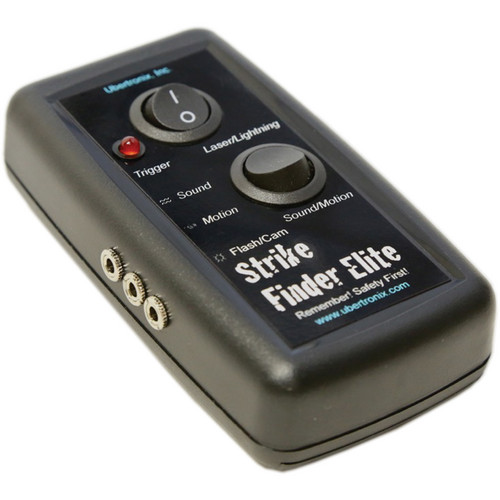
It's been a month or a bit more since I've got the Ubertronix Strike Finder Elite for triggering the camera (or flash as it seems), but unfortunately I'm still unable to work out any ideas to work with it. Sure, water drops and splashes seem to be an obvious target but they are cliches by now. I was trying to find something new or some creative venture within these two topics (water drops and splashes). Since I couldn't think of any, I've tried at least to do some testing for the device.
The Ubertronix seem to work fine except for few awkward delicacies!
  • The wires of the sensors (for sound and motion) are short, but probably can be lengthened by some means.
  • The device contains no controls for the sensitivity of detection (specially when it comes to sound detection).
  • The port used for connection to the camera also bears "Flash" on it, but in the instructions manual there is no explanations involving triggering flashes instead of cameras. Could that be with the help of the PC port in the flash itself?
  • Motion and Laser detection seem a bit unpredictable. 
  • The sensors for sound and motion with their short cord are also hard to be placed. Probably duct tape is due in some situations. They are in a bulky rectangular box shape and because of the sturdy cord it can be hard to make them stay flat on a table for example or make them still on their sides.
These might be some awkward points, otherwise, the device works in a wonderful way. I think even the Laser detector can be used as a motion detector but I'm not sure of that yet and I need to do more experimentation.

Rising Eye
Canon EF 50mm + 12mm & 35mm tubes, f/11, 400-1sec, ISO100.

On the other hand, I was trying to catch some eyes with the help of extension tubes but my trials with other people were in vain, so I've tried to do it on my own eye. Of course it is not like a piece of art (specially with all these reflections of flashes on the iris). I've been fascinated with the lines formed on the iris and I thought maybe the best way to do this is to use extension tubes. Using speedlites, on the other hand, was problematic but it was a must; otherwise no light is available in such narrow corner! Doing the whole thing on my own eye is a really hard task, specially with using an external portable monitor to judge the focus and the composition. After many shots, I've decided to pick Rising Eye to work on its RAW and filter it a bit more. I like this version mainly because the iris is situated in the corner (and I cropped a little from the top right corner to emphasize this fact) and it breaks the monotonous look of the iris being in the middle of the frame (and I did take shots that way as well). I've never imagined myself going so deep with the macro field, but it might be time to plan for some rails for fine adjustments?

Geometria:

With my sudden amusement with geometry and mathematics (not something new in fact), I've been playing around with circles and rectangles, along with squares of course. Needless to say I had some crush on Schläfli and his symbols.
From that perspective, I've been thinking of ways to organize my composition or the way I see things in my pictures. I'm quite a believer in what Bruce Barnbaum mentioned in his book The Art of Photography about the myth of the law of thirds; something that I would beheaded for if I talk about in here inside the photographic community in Kuwait! Bruce, however, had his own points and logic indeed. Anyway, for me, I do tend to think of the law of thirds and the golden spiral as means to merely organize the objects in the scene but not a critical tool to get the attention of the viewer. I'm aided with this point by the common belief among photographers that Rules are made to be broken in general!
Stemming from this point of view, I've been working around to base some order based on geometrical means rather than visual means opposed to the theory of the thirds and the spirals.

Red: Golden Spiral.
Blue: Law of Thirds
Green: Diagonal-Circles

My first trial was to draw quarter circles from the corners of a 3:2 rectangle; with 3:2 being the usual ratio for imaging sensors (at least for the APS-C cropped sensors?), and the radius of these circles is half the length of the diagonal. Thus, the quarter circles would meet at the center point of the rectangle, and by drawing the diagonals of the rectangle we can specify the points of intersection between these circles and the diagonals (green on the image above). Now, would these points make an interesting composition? This, I wouldn't know without trials. However, I do imagine it is a good starting point for circular (specially overlapping circles; e.g. in a rose) subjects. But the intersection points seem a bit far away from the center which makes me skeptic about its use in general, but again nothing can be talked of without trials.

Red: Golden Spiral.
Blue: Law of Thirds.
Green: Diagonal-Circles.
Yellow: Central Circle.

Another thought then occurred to me is to draw a central circle within the 3:2 rectangle in such a way that the center of this circle is shared with the rectangle, bearing in mind that the radius should not exceed the height of the rectangle (the y-axis length). Then, drawing quarter circles from the corners like before. This one diagram is unusual for me because it shows here more than the usual 4 intersections; in fact we have 8 intersections. However, four of these intersections don't seem to be practical (the two central intersections up and down) because they touch the edge of the frame itself. Probably, after removing the 4 central intersection points, we are left with the other four that are close to the diagonals and work more in harmony with the law of thirds and the golden spirals (yet far away from the diagonals-circles intersections). I guess placing a subject in these points won't make much difference visually since it is close to the other perspectives. However, those points close to the edge of the frame which I've omitted in the beginning might make a difference if they are to be included in the rules of the composition. Notice here that I'm talking about placing a subject in ONE and only ONE of these intersection points, whether it may be law of thirds, golden spirals or any other perspective I've been mentioning so far; but what if some of these perspectives, specially this last one (Central Circle method) would work as a whole, meaning that intersection points are to be used all together to organize subject(s) in the scene and not one subject only? You think this would be visually interesting? Again, only trials would prove if it's appropriate or not.

Red: Golden Spiral.
Blue: Law of Thirds.
Green: Diagonal-Circles.
Yellow: Central Circle.
Grey: Diagonal-Central Circle.

By the end of my thoughts chain I was almost going to forget about the result of intersecting of the diagonals with the central circle. Not strangely, these grey points are in harmony with other perspectives like the thirds and the spirals, as well as the central circle intersecting points. In fact, I think the four perspectives or divisions: thirds, spirals, central circle and diagonal-central-circle do all make clusters for one position at a time around the center of the frame, and if we have one big subject within the frame it would be covering these four points in one corner at one time probably. This leaves two main questions of how affective these perspectives are when it comes to the Diagonal-Circles perspective (Greens) and the central intersections of the Central Circle (those closer to the edge). Well, as for the central circle perspective, we might, as I've mentioned before, work with the 8 points altogether (or 4 of them at a time) to place a certain subject. The greens, however, might have been tried before from my side without noticing like I did with one of the shots for some roses and petals.

Die Sanfte Ringe

Probably Die Sanfte Ringe reflects in a way how the Diagonal-Circles perspective would work - but I have to say here that this shot was taken long time before thinking about these different geometrical plays within the 3:2 frame. Yet, it does coincide somehow as a subconscious drive I presume! Notice that the Rising Eye mentioned before does somehow imply the Diagonal-Circles perspective and again it is as if it is a subconscious drive within my mind to do it that way, specially when it comes to circular subjects or rings and loops. There is a difference though between the Rising Eye and Die Sanfte Ringe in that the former is indeed a 3:2 rectangle, while the latter is a square. Not sure yet how to think about the visual impact in between these two but one step at a time - I think there is a plenty of time to think about these crazy geometrical means. As for now, I need to work a bit more on more serious stuff!

Libros!

I've exhausted all my arsenal of books by now (and only one or two short stories are left). I've been working on my queue of Arabic books that I've purchased some months ago from the books fair back in November. Back then, I did purchase some stories just to rest my mind little bit from the technical aspects that I usually wander on. Now my eagerness is back to the technical side and I've decided to purchase 3 new books from Amazon. As usual, I've decided to take up 2 books about photography and 1 about science (specifically archaeology).

Source: Amazon
One of the books that I'm eager to read is Lens Design Fundamentals by Rudolf Kingslake. The book is cheap and in fact I was going to order another one which costs around US$150, but judging from the contents, I believe the latter is way too advanced for me for the time being (it appears to be too academic in style). Thus, I changed my mind and picked this one since it's cheaper as well as it is aimed for beginners. I'm not sure where does this lead me but I've always wished to gain more insight about the make of lenses and where the power lies in the design after all.

Source: Amazon
 The second book deals with Tabletop Photography, by Cyrill Harnischmacher with some twist about using speedlites. From what I reckon about its table of contents, it is dedicated for people who don't like to work in studio environment, and eager to use some tricks with their speedlites. Not sure how much I will gain from such a book, but I'm pretty sure that I won't be disappointed as it is the case with most of rockynook publishing.

Source: Amazon
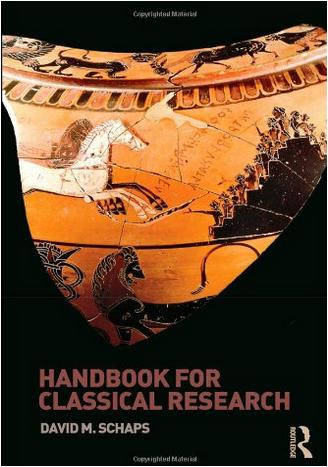
The last book is something attracted me mainly because of some formulae inside! The Handbook For Classical Research, by David H. Schaps, seems to be a general overlook about humanitarian sciences and how mathematics merge into them for purposes of studies. I was looking for a pure archaeological book with pure scientific prospect, but unfortunately most of the books I've found were novel-like and don't deal much with the scientific and mathematical side. This book, however, bears much about studies and how to do them and how to analyze data in such fields like anthropology and archaeology, in different sub-fields. This is, at least, what I've regained from reading the table of contents and some few pages in between the covers. I don't think I would be disappointed here though - anything that has some numbers in its language can be quite interesting in the current time!
The only problem that remains now is how to manage my time between these 3 books. I think I'd read the rockynook issue first, because they can be over with quickly, usually!

Conlang:

In the meantime, I'm not forgetting my beloved conlang(s) in such frustrating times, but actually I'm not putting ideas onto papers or notes - but simply everything is going on in a mental note. I need to enhance my memory about some basics about the Bulughman conlang as well as Betenic.
There had been an idea of a funny or a comic version of English as a conlang. I thought about it long time ago and proposed it to Simon Ager, the author of Omniglot.com, but as he said, the priority is for conlang with conscripts (i.e. artificial and new scripts) while my version was simply using modified Latin alphabet. From that point I've been thinking of inventing a new conscript indeed. Priorities for now, however, is for the Geltani project that seems endless. Sometimes, I do think I need a wife not to love or share dreams together, but simply to organize my time. Might be a plausible idea, but I don't think I would call it a marriage, can I?

العين التي رعتني
The Eye That Cared For Me


Thursday, April 18, 2013

Sorry...

Another week without much productivity I'm afraid. I didn't have any guts to touch the camera. I thought when Mom is back home things would be calmer a bit but in fact they are still busy almost to the same rhythm but in another timing, since Mom got dialysis to do 3 days a week and we have to pick her to and from the dialysis center. Moreover, we are doing a regular check up and checking updates with her doctors behind her back - she doesn't know much about the situation, but we are working on it and we get highs and downs from the doctors. Good thing that she is moving more often, and her spirit is getting back slowly and she started to get into the kitchen slowly! I think I can call this good news.

Because of this mental stress and continuous thinking about her condition, my mind is lacking of ideas for photography (specially with my new Ubertronix trigger that I got a month ago almost), and also little plans and thought about what to do next with my conlangs projects. Completing the Geltani is of course a must, but I was thinking also of studying Ayvarith back again to refresh my memory about the words I've made already. In hope this would make me a more fluent speaker of my own conlang! I think it might help me as well to make a stronger sense of the language as to make some words even without referring back to the basic ingredients: Arabic, Aramaic, and Hebrew.

Beside all of this mess, there is the real or the physical mess that is in my room and around the house that I've set my mind to organize and fix, yet I can't do this for the time being with this exhaustion and busy mind and body. All what I can do for now is to hope for some productivity by next week. As for the time being, I'm going to read a bit more about mathematics and geometry...


Wednesday, April 3, 2013

I Miss You...

Mother's Heart
Mom, after two weeks or more, still in the hospital. I'm barely thinking of anything else other than herself. I even got new toys for my camera but I'm putting all that behind my back now. I get into her room in the hospital with a smiling face, and get out with a crying eye. Despite the fact that her lungs infection and water is all out and she can breath easily and normally without any difficulty, yet blood tests show increasing amounts of Creatinine in her blood and it won't go down. On Thursday, April 4th, doctors decided to make a surgery to fix a tube under her skin in the chest for future dialysis processes.
Mom is annoyed, and I'm worried. Dialysis processes can leave kidneys weak (just like how a muscle shrinks without training). I'm so sick of home without her.

Friday, March 22, 2013

Love you, Mama...

Hard times seem to be waiting for me wherever I go, in whatever I do. With all the stress I've been trying to push back, here comes Mom falling sick in a serious condition.
I'm typing this early now as I don't think I won't be posting anything next week. My mind is occupied with thoughts and memories of Mom right now. The only valuable reason for my existence in this life, till now.

Beg you all, you who read this, for prayers for Mom's health sake.
Amen


Thursday, December 31, 2009

Happy New Year...

A fierce windy day, that is today! I like such weather despite all the rush and diffusion that accompany such weather. The hard part comes from the people (specially drivers) who dramatize the events. Some slow drivers and some are just crazy drivers causing dangers in the streets... it is one crazy world.
The wet streets gave some nice impressions in the darkness of the early morning hours with lights of houses and the streets and the traffic lights all got reflected from the ground making snap-worthy scenes. Unfortunately, no camera, yet no time to do that in such weather and wind even if I have my camera with me.


I spent last night doing some enhancements and translation work for the brochure that I'm designing for my work place. But actually before this work, I was doing some design for an old photo of mom when she was 18 (I think she got married at 18). I can't say it is really a good design, since I wanted to make it even more a professional-like thingy but with my recent capabilities. I had to fight even with my printer which was like a dog chewing my papers! I framed the printout with a ready-made frame and gave it to mom as a tiny gift to her. She's beautiful, young and old...


After this, I went on doing my own business with me back to doodling again. This time, I had no meeting, but my mental status and my eyes that were closing, and the boring time in the last few minutes at work were unbearable. So I had to resort to that thing;

The Devil's Wife


I don't know why I called it the "Devil's Wife" but so it sounded to me! Does that mean I'm going insane? Hopefully... yes.
But before doing all of that I had to take a shower with plain water when I tried to fix some pipe out of the kitchen. It was changed and fixed, but the price was, wet pants!


Today, the translation yield was 4 verses altogether. Although the "nice" weather makes me sooth out and want to sleep for the sound of the rains, yet I felt some energy to go on and complete some more verses above the count of 2. I think I'm going to take the work back home with me, even though I know I won't be able to work with it much. The ability to memorize as much words as possible while translating is a crucial factor for speed writing and a non-stopped process. Sometimes, looking up a word in the dictionary and checking backward and forward slows me down for some seconds and sometimes minutes! If it is a new word to be made then the delay might become greater than this. I'm sure though there are many mistakes in the Ayvarith translation but well, I'm going to finish this one story and head to do other stuff with it. I guess this is my resolution for the new year!


Of course we don't celebrate the new year, just like we don't celebrate the Christmas as well, but anyway I think I'm allowed to say it to everyone who celebrate those events, so, Happy New Year all of you...