Showing posts with label splash. Show all posts

Thursday, June 1, 2017

Colorado…

Well, Ramadan is here and boy ain't I happy to have a leave off work during this month! Despite my usual troublesome sleeping pattern during this month, yet I feel refreshed at some level and I'm eager to work with my camera more often than before (specially with me doing my experiments near my room). With May project with the group, which is about colors, I've started to re-kindle an old passion for high-speed. The work is still going on as I'm typing this, as there are a number of issues I need to fix still and some more ideas in hope I can try later.

Colorado

The May project was a priority, so I spent some time thinking about what can be done in that venue. It is easier said than done, as colors are everywhere but it's hard to get some concrete and unique work of art involving colors. In the beginning, I was trying to follow my typical steps in creating an idea: Find a deep emotion inside myself, and cast that particular feeling on the subject at hand, be it color, shadows, or whatever. However this step seemed hard and technically I was so mentally confused that I couldn't realize my own feelings or how to organize my thoughts! Thus, I had to shoot for mere fun and I started mumbling with my props and gear to find something colorful.

Colorado I
Canon EF 100mm macro, f/29,
250-1sec, ISO100.
After playing around with some props and accessories, I decided to use the refraction power of water to create some colorful abstracts by using colored Popsicle sticks placed in a separate glass jar behind the glass of water. Later on, however, I've decided to add corn syrup into the water during the shot (putting the camera on timer while pouring already). This was just to add some action to the scene instead of plain silent colors. There was no need to high-speed mode as 1/250 of a second for the shutter speed was enough to kill the ambient light, but the greater hardship was in having a proper framing for the shot since I was working inside my room and could barely have a proper distance to stay away from the set with my 100mm lens, while using 50mm lens would require me to get closer beyond the nearest possible point of focusing.

Colorado II
Canon EF 100mm macro, f/29,
250-1sec, ISO100
Distributing the light was not so hard to do but it was rather hard to adjust (as I usually work in manual mode). I've used 2 white boards on the sides to reflect off the light and later on I've placed a shade on the top of the set to reflect any astray light from below and reflect it back (and it did a great job!). While shooting, there was always something going off which made the power sometimes excessive or too low without even touching any flash settings. Not sure what is causing this but the first culprit in my mind right now is the fact that I was working in LiveView mode. Some professionals always warn against using LiveView mode for serious shooting. However, with my back problems, I find myself often forced to work that way!

Colorado III
Canon EF 100mm macro, f/32,
250-1sec, ISO100
After shooting Colorado I I decided to increase the amount of action and pour even more corn syrup to fill the frame (while some were already accumulating at the bottom of the glass) which created such a mess as seen in Colorado II, but oh well, I guess this is much better than having much plain space as in Colorado I. There was one last shot I needed to try, and here, I've replaced the colored sticks with colored pencils and filled the glass with corn syrup instead of water as I loved the looks of the bubbles in the bottle of the syrup. To add something to the scene, I've placed a small cut from a branch of some plant I've found here (no animals were killed to try this!). At this level, I wanted to step further and try the risks of using f/32 with this lens which I've experienced some weird behavior before at this aperture value. However, after several shots I did get something stable as seen in Colorado III, and even created a 3D Anaglyph out of this scene. Now, I'm creating the habit of documenting the set every time I finish one experiment. I guess it is a good practice?

The set used for Colorado I and Colorado II. A reflector was placed on top during the shoot.

The set used to shoot Colorado III.
I used 2 small candles on the sides in hope to excite the fluid and produce more bubbles inside the syrup but that wasn't useful!

Cherry Boom

I thought I was over with the Colorado experiment above, but then I thought why not implement high-speed onto the project, specially that I'm trying to work in a space near my room (even though no proper table for me yet, as you can see from the sets above). Implementing the idea of colors here emerge from the concept of the color circle and complimentary colors. Thus, I simply googled "Cherry Red Color" and I got the code #a61f34, and starting from there I got the complimentary color which is some degree of cyan. I picked cherry specifically because it was available, and because of its distinctive red color and tiny branch which typically stems out of it. I could have gone with grapes but I think grapes do not have a distinctive shape or color (and the red variety would be typically larger than I need them to be). Thus, the choice for cherries seemed legit!

Final look for the set of the project.

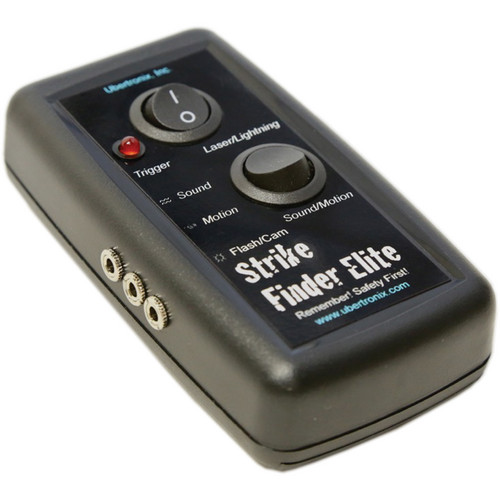
Ubertronix Strike Finder Elite.
Source: B&H
I used watercolors here to color the water and later I've added a bit of milk to kill the transparency of the water a bit. As seen in the set above, I've used here only 2 speedlites (580EX II) and didn't want to use my third speedlite (430EX II). I used here also my UV filter over the lens front just to protect the front from water droplets. I should have protected the flash heads as well with plastic bags but I skipped that actually. The big hurdle was to get my old Ubertronix trigger to work, specifically with a laser-gate. Without detailing the troubles, at the end the laser-gate method proved useless to me because of the shutter lag and the cumbersome laser pointer I was using. Thus, for the rest of the experiment, I went on doing a manual job, holding the cable remote in one hand and dropping the cherry with the other.

Cherry Boom I
Canon EF 100mm Macro, f/9, 3200-1sec, ISO200.

It was apparent from the beginning that I'm having a problem and probably should have used a larger bowl of some sort since the white edge of the plastic dish was hard to remove. Some problems did not show up till later on as I was inspecting the images like Cherry Boom I. Beside the shallow depth at f/9 (which was not enough), it seems that 1/3200 of a second was not enough for the shutter to freeze the water movement! However, during the experiment, I've raised the speed a bit more without really knowing the final outcome that I will be getting later on. Good luck? Maybe!

Cherry Boom II
Canon EF 100mm Macro, f/9, 4000-1sec, ISO200.

The speed of 1/4000 seemed just enough to freeze such a fall! In total, out of 20+ shots, I got merely 2 useful shots and one or two shots for splashes without the cherry(ies) which I simply liked for their shapes but I don't think they would be useful as stock images or printed and displayed. As for Cherry Boom II, the cherry here fell upside down and my brain being in love with illusions, I've decided to rotate the image 180o and thus the water came up and the cherry down, but standing up. What annoys me about Cherry Boom II is, like the other shots, the white space from the plastic dish edge which cannot be removed or substituted. I continued the work further in the next day and going manual too with 1/5000 shutter speed, and changing the camera tilt little bit (and pouring some water into the dish) to hide the white edge as much as possible. Again, out of 20+ shots, I've one suitable shot here.

Cherry Boom III
Canon EF 100mm Macro, f/20,
5000-1sec, ISO320.
Beside enhancing the looks, I went on enhancing the depth of field as well pushing it to f/20 (to have greater chance of having the cherry sharp wherever it falls), but that of course called for an increase in ISO, as I didn't want to use my third speedlite still. Water splashes now are more stable and live! In Cherry Boom III, seeing that the two cherries fell on their side, I've decided to rotate the image 90o clockwise to add a surreal feel to it.
In all of these shots of high speed, there was always a problem with the noise level when processing the images, despite the ISO being relatively low. With my Canon EOS 7D, I'd say that the ISO is somewhat easier to handle up until ISO 800 or around that, but in these images the processing was cumbersome and I do have my doubts about being accepted for exhibitions with the group (if they pass the aesthetic critique). However, some stock websites did already accept these images without a problem and they are up for sale!
Finishing from this cherry project I did proceed to another one, involving high-speed shooting as well, but I will keep that for a future post, as I'm still trying to work on it further.

Finale

After kindling my passion again for high-speed photography (adding to that the lack of locations and ideas for panoramas), and after the failure of my trigger, I've emailed the company asking about the reasons for such time lag and after some discussion, it seems that the reason is my shutter and not the trigger itself. I was advised to connect the trigger to the flash instead of the camera but in my working conditions this is not possible, as working with triggered flashes means opening the shutter in a dark environment while the flash becomes the only source of light. However, reading about some aspects of my camera, it seems that I do have also to adjust some of my photo-shooting habits to reduce the time lag in shutter release (depending on LiveView being one!).
Though I'm on leave without traveling but seems I do have a busy schedule here (beside taking care of Mom), but I feel some satisfaction that I didn't feel in a long time now since I could work with my camera and really think of something to do with it, without feeling exhausted like everyday after coming back from work through the traffic jam. Meanwhile, the idea of traveling is still ticking and tickling my mind, despite the fear of the hassles that I might have to face outside because of all the madness going in the world today, specially for a guy like me from the Middle East.
In the meantime, August is getting closer, my birthday that is, and I'm preparing to have some big order (well, not so big, but a bit big maybe?) of some gear and maybe some books. I would have to place the order before August I presume since there are some items that are considered "special order" (i.e. need time to be prepared and dispatched). This is to be a gift to myself, since no one around give such gifts except of perfumes! On my mind is a 4th speedlite (and probably another 580EX II if available still) and maybe some filters. I feel so excited that I want to place the order right away in the coming few days, but my financial situation and the course of Ramadan makes me hold it back and wait. Thus, I might be placing my order by the end of June or so! I need to miss my camera so much to work with it with passion…

Stock photography by Taher AlShemaly at Alamy

Thursday, December 26, 2013

Macromatic...

Here we are, another week passed, with a special twist of Christmas, of which we don't celebrate in fact. In this week, I was somehow busy with paperwork and going back and fro to finish some business related to my car, and by the evening I'm left exhausted (and mostly with a headache). Thus, I couldn't do much either with my photography projects or with my Geltani project.
I've finally got my new car; a Pajero. I'm used to drive salon cars and this is my first time to drive a somewhat elevated car; I mean like owning one and drive it daily. In the meantime, I don't think I'm getting rid of my old car, because apparently Mom's flexibility and movement won't give her much when riding a big car like a pajero. The plan for now is to drive her to the dialysis with my old Seat while in other days and doing other chores with my new pajero.
I do have my plans for this new car of course, other than just driving! But I need time to think things through and to get myself more used to its dimensions. I really wanted to shoot the car in a cloudy day to have some long exposure but the sky had been clear for days now. Hopefully, the opportunity will come soon.

The Lava Bloom

Source: B&H
Source: B&H
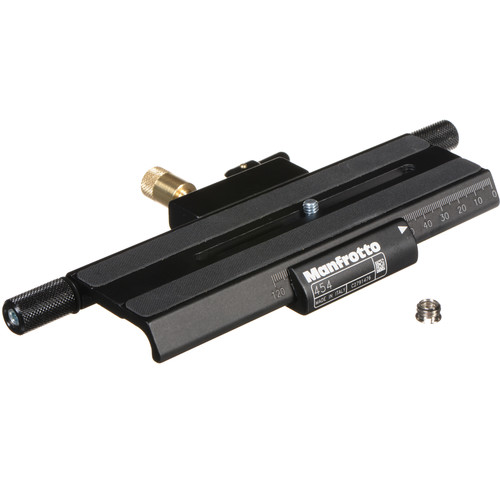
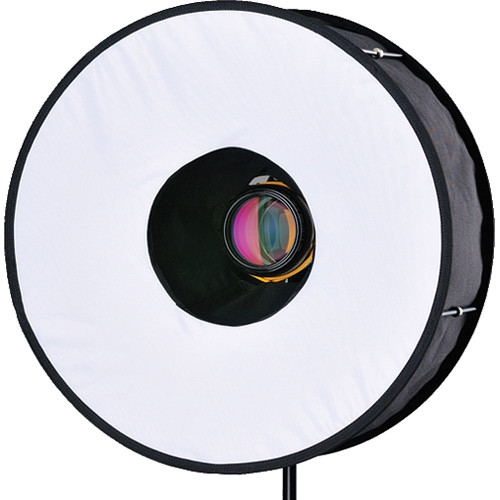
In a simple experiment just to test my Manfrotto macro rail, I've tried to shoot some flowers in the flower bed in the yard that have been planted few weeks back. Initially, I thought that this is an opportunity as well to try out the RoundFlash for macro shooting. Later on, however, this proved difficult, and to really use it for such a purpose you'd need to elevate the tripod higher from the ground and make sure there are no barriers between the camera and RoundFlash set, and the subject. However, I've tried to use the RoundFlash with 580EX II connected but in wireless mode but it wasn't practical because receiving the signals from the camera body can be cumbersome. A cable is better fitted for this task while moving the RoundFlash. After trying several shots, I've discarded the RoundFlash and worked with the speedlite alone. After sorting out the images I've came out with 3 shots only that I "somehow" like - not completely though.

Lava Bloom I
Lava Bloom II
Lava Bloom III
The settings for these shots were almost not changed using Canon EF 50mm lens with addition of 68mm of extension tubes. The speedlite direction and distance were changed between shots (in a manner that I don't quite remember right now). As you can see the 3 sorted out shots are cropped as the leftmost parts of the images were somehow (almost always) blown out a bit and to reduce the dramatic edit in the RAW stage, I've decided to crop it and to serve the composition in a better way (despite the random folds). I've just realized after all this cropping and editing that one particular feature seems to be at the center of image, not abiding to the rule of thirds. I'm not sure yet how to feel about this; is this a weak point in the image (regardless of the overall aesthetics), or it is an unconscious break from the rules?
By experience, I've realized that the most interesting lighting for macro shots, specially floral ones, it is when the light strikes from the side to give some dramatic sense of the scene and accentuate the features of the bloom further. Anyway, in this particular incidence, it seems other direct or close to the top directions were fit as well - and probably the color of the bloom helped me a lot with the vision I had later about this bloom being as a lava! In any case, at such level of macro, experimenting is always a key feature, specially if not using a ring flash.
Trials to render one of these shots into Black and White wasn't successful as the tones appeared somehow "monotonous" and didn't provide that striking contrast that I was seeking. This is understandable, since the tones are closely related (Reds to Yellows), and separating them by black and white rendering is hard if the original hue gap isn't wide enough.

The hue spectrum. Notice the blue circle and the distance between the yellows and the reds (connected through orange).

After these trials I've tried my luck with extreme macro (reversing lenses) and using teleconverters, along with the RoundFlash again, but to no avail.

Forgotten

Source: B&H
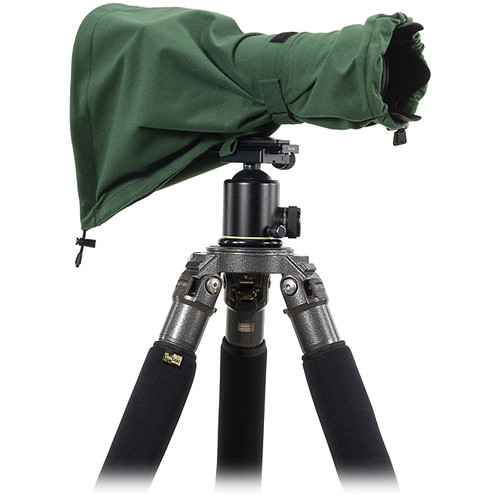
Two weeks ago, when it was somehow raining a bit now and then, I've decided to do some outdoor activity and this is mainly just to test my new LensCoat. I've simply forgot to post about this experience last week. I got the chance during a weekend morning, when I've decided to head to a place I'm quite used to since I've done lot of shots there before. The challenge, however, was to drag my stuff to that spot and settle and mount my camera while the rain is hammering (though it wasn't a heavy rain after all). I've found it plausible to just fit the camera and cover it with the coat and then change the lens (if not already mounted on camera) from under the cover; which might need a bit of practice if your movement is clumsy as mine!

Denkmal für Freiheit
Rokinon 8mm, f/8 (?), 0.8sec, ISO100.

Ironically, I was the one without a cover under the rain! The situation was awkward as I was trying to use the calculator as well under this rain to estimate the needed exposure. Not only that, but I've even disconnected the Rokinon lens and tried to fix gel filters on its back with my old method of attaching the gels to the back of the lens. I think I've added 8 stops. I had to move fast (and cover the camera mount fast too). It is not something I do not advise anyone to do, but it gave me a lesson on how to really prepare if you have a real goal in mind!. Anyway, the preparation here is out of question was it was just to "use" my new LensCoat.
Anyway, I've tried long exposure here but, despite the nice clouds formation, didn't produce much nice results, and this is natural in fact because the clouds shouldn't be so massive if you want to create and observe concrete lines in your image after a long exposure. After all, I've picked a single shot image and worked through it with some processing. The noise level wasn't cozy, thus I resort to the old trick of blurring a bit and isolated the background from the foreground by lens blur, beside cropping.
This image in particular, beside others taken with Rokinon 8mm fisheye lens, revived in me the dream of having some sort of a profile for this lens to be used in DxO to correct (or de-fish) the image. I've been checking for some methods to create such profiles, and some of them involve some really large prints, which is something out of my hand for the time being. I'm still looking for alternatives though.

Eigen

It has been a trend in the past few weeks, and because of the dormant activity with my camera lately, to visit some of the older images (and specially old panoramas) to do some kind of a perspective change by editing the images in a different way; mainly by doing a selective discoloration, or what some call it color splash.
Probably the color splash is a phenomenon that occurred and is a product of the younger generations and the modern photo-sharing websites. As they say, the cool imagery. However, nevertheless, it is something worth a stand from the artistic point of view I believe. I didn't study arts myself but at the end I have a mind, and I have emotions. I think I can relate to some aspects of such effects to the images.

Coelus Ignes

The concept of selective coloring or color splash is not new to me in fact since I've done it before for some panoramas, but this time the perspective is different. I'm looking at it as a possible venting. Meaning, the colors of one image might not be flexible with your vision, or maybe the composition is not quite what you have desired for the image, then a color splash might be an option to enhance the visual impact of the image. I've excluded here the black and white option because the black and white, even though it is an option indeed, but it would depend heavily on the composition and the visual arrangement in your image. There are no colors, so the only way to attract the viewer in a black and white image is the composition in the first place, then comes the tonalities.

Planeta Victoria Verde
Orbis Fidei (II)
When it comes to choices as to which color or range of colors to pick for such task, I find the matter is a bit philosophical in nature. Just a bit, not much! As I went through many images from my past, I've found it plausible in more than one image to select more than one color to show while leaving the rest black and white. I've asked myself, what rules here? Probably I can put it down in points:
  • The color can be the most important color in the scene. The most expressive color in the scene. As an example, in Coelus Ignes above, despite all the "nice" features in the image, like the lights and shadows and the wooden beams and the distortion, I've found myself compelled to show and accentuate the reddish sky (and here I've tinted the black and white with little blue). The same goes for Planeta Victoria Verde.
  • The color can be important to show a certain feature in the scene because that feature is in that specific color. For example, in Orbis Fidei (II), the main feature of the ringed strips on the ground was the popping part of the image. However, because the rings were yellow and the image has a wide range of yellows originally, I've decided to show this feature specifically by showing the blue instead. 
  • Even though a color splash scene can be composed of more than one color, yet I do think that showing one color ONLY is more powerful than two ore more.
  • The question is, how firm is the relation between the composition, and the color splash? Would I really give an image with somewhat bad composition a push by sorting to color splash? The initial answer in my mind says "no". Composition is of utmost importance even in a color splash - but who knows!

From the thoughts pinned above, it seems that panoramas (specially those with symmetrical attitude somewhat) are a good target for color splashes.

Irish Home VII (II)

Finale

Right. Still there are books on the queue line waiting for me, and there is a Geltani project that I didn't touch for some time now, with me being busy with my life. How much I do wish if I just can change everything in my life in one night and a morning. Now with a new car at hand, I have to bear in mind the future expenses as I have to pay the installments for this car which renders me with a lesser amount of money every month, after deduction.
Meanwhile, all the mental work with the macro photography and even fisheye lenses, made my brain somehow active with mathematics again as I try to calculate and find some solutions or imagine some solutions for future usage of these lenses. In fact, I'm thinking of an experiment already as I'm typing these words. Also, let's hope for more night time photography as my last week's outing was not so promising and I really felt it not appealing to write about in here this week. Probably I'll give it a mention at some other time.
I find the real question deep inside me is, all this busy mind work, is it enough to really make me forget my worries and my personal problems? I'd say the answer is 50-50. Yet, it's really hard for me now to give even more than this activity already. My life pace and my physical conditions are giving me a real push downwards.

Now with the new year coming, I'm having plans to go to Failaka, and this time with my new car if possible. The schedule of the ferry for the days left of December aren't good at all, so I hope by 2014 the conditions are better. Just to do this simple trip I do have to arrange stuff with Mom concerning her medicine.
We don't celebrate Christmas here, nor New Year's, but some people do ask me now and then, what's your resolution for the new year. I'd like to say, simply, not to be lonely anymore, but I know this will be a failure already - regardless of how optimistic, or pessimistic person I am.

For those who celebrate it, I say Merry Christmas, and a Happy New Year


Thursday, September 20, 2012

10K...

Thank you all regular visitors and passer-by's for 10K views for this blog, and also my Flickr!

Here we go with another hectic week. Despite the fact that I've finished my Techniques (2) workshop, I've been struggling still with its last attachments. A homework and an image for a contest. Since the last week there had been a load of images that I've been working with from various experiments and trying to do some homework, and lately been to some ice hockey training session with the group on some training for panning and motion freeze; the sort of stuff you see sports photographers do. Not my thing, but I did it anyway and tried to have some nice time.


Before going to all these details and images, I might as well mention that I've been almost wrecked with my last order from B&H and Amazon. Since last Thursday, my package has been in my US mailbox, and I couldn't pay for its release for some credit card rejection. Finally, and only on next Sunday, I was able to pay and after contacting my bank. Turned out (seemingly) that they locked my credit card for suspicions, as I placed an order in B&H that's worth around KD160! Pay attention please that I've been dealing with this store in the past 3 years, and I've placed orders as high as KD700 before, and NOW they are suspicious for KD160!!!

Anyway, these are the new toys I'm waiting for and I'm really, really, urging to see them between my hands...

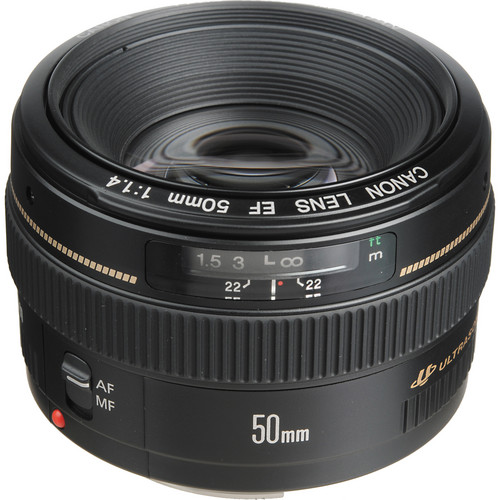
Source: B&H
The first item that I'm dying to see is this babe. Perhaps I do have 50mm covered in the range of some of my lenses but here the case is different. This lens works in USM and with max aperture of 1.4 which makes it perfect for isolation and bokeh effect. I'm not into portraiture as you know by now, but this one could push me on trying, and not necessarily with people; I could even use it for some street photography on the go! That's why I want to have it urgently before my travel on October 10th. I was hesitated in the beginning as I was wishing for Voigtländer 80mm f/2, but keeping in mind that my camera is a APS-C type, then 50mm is better than 80mm in the matter of field of view (wider) and we have the f/1.4 case of course!

Source: B&H
The other item from B&H is the ExpoImage Rogue Master Lighting Kit. A special kit to aid with speedlites usage as it includes gel filters and flags (to block the light against certain areas) or snoots and other stuff. I'm not sure though I would take such kit with me when I travel, as I try to make my pack as light as possible, but in all conditions I'll be taking at least one speedlites just in case I would need it for some scenery, and my Vello cord for off-camera speedlite usage. ND filters are a must of course.
Currently, I'm putting all the speedlites kit along with the filters kit in one case (my old 350D camera bag) but I might have to change this soon as well. A new headache on the way!

And then we have the books. I'm going insane at work for not reading any book. I've tried to read some of the old books but I couldn't even concentrate further (because I get bored easily) and I do have a concentration problem already! I've decided to add two more books to the stack and probably take one of them with me when I travel abroad to pass the time.
With this order I've put some pressure on my budget (and credit card) a bit. However, in my work place they have some weird system when it comes to salaries and leaves; they would give the salary for more than a month ahead of time - I couldn't understand this system even though I've been working here for 7 years now. Anyway, hopefully with the next pay, I'll be reducing some hunch from my credit debt hopefully and would be better prepared for the travel. Let's just hope my bank won't decide to lock the Visa card again!

Splash Splash Splash!

It was about time to try out my 2 speedlites for some high-speed photography, but this time without any sound trigger. In fact, I might as well try it out with sound trigger and see if 580EX II can work as a master even off the camera and connected with the trigger. However, before reaching there, the beginning of the whole story is not a trial for high-speed, but a homework I had to do for my Techniques (2) workshop.

Refreshen
Canon EF 100mm Macro, f/22,
38min, ISO 100
As I've mentioned in the previous post, our teacher assigned to us to take a picture of a glass in any one technique of what we've learned in this workshop. After thinking a bit, I've decided to do 2 main ideas: thawing ice, and dropping water.
As for thawing the ice, it was relatively easy to set-up. I was hesitated to light a candle under the set-up (in a specific setting of course) to fasten the thawing a bit, but then I've realized that the blue floodlight setting on top of the glass and somehow close is producing some heat and might work in fastening the process. With the help of 6 stops and a dark room, I've managed to make Refreshen as you can see. In the beginning, I've tried 20 minutes, but I was not happy with the results so I've increased the time further to 38 minutes and changing the aperture accordingly to yield the same exposure.

Lust of Hell
Tamron 70-300mm @161mm, f/36, 30min, ISO 100
The second idea was to have a long exposure of dropping water. The idea was somehow hard to do because I need tools I don't have; some stuff to hang a bottle or something to drop water slowly into the glass. However, this was somehow solved later with some innovation if I should say, with the help of a pierced plastic bag!

Setting for Lust of Hell
Hope you don't mind the lousy shoot!

Later on though, the plastic bag was out of water in a time of 15 minutes approximately, so the rest of the long exposure ran almost static. At the end, and with some contrast enhancement, the glass retained the red color and yet looked as if it was empty, except for the droplets on the outside. I was hoping to record more movements on the surface of the glass. One of the things that still annoy me is the flare on the edge of the glass because of the floodlight. I couldn't use any polarizer here because of the space and the heat from the floodlight (and I don't have a frame to hang the polarizer).
At that point, the idea sprung up to do some high-speed photography - with the help of an eyedropper. It took me around an hour or even more just to settle down with the positions of the speedlites, and I would say that 3 are even better than 2 in such experiments!

Tröpfchen
Kollision
Aufruhr
Hängend

From the hundreds of trials I guess I got those 4 as the best. In particular, Hängend and Tröpfchen were closer to my first aim in the beginning; to have hanging droplet in the air. However, the droplets were caught closer to the water surface rather than being hung in the air in front of the black background. I've used green gels to change the color with the help of Custom WB and biasing the WB to green (i.e. giving a green tint).
One of the hardest aspects in this shot is to decide on a proper f-number and a focus point. After trial and error, I've decided to focus on the front edge of the glass, and then increase the f-number for one stop (to f/5.6), and try to drop the droplets closer to this edge to ensure they stay in the focus range. It is quite a tiresome trial and error process, specially when done by one man alone. This said, there is a lot to be hoping for: C-stands or something similar, umbrellas, a third speedlite - but I'll keep my dreams for now, and I don't even have the space for all of that!

Architectura

Friday is the family gathering day in my house, and for me, it is a nightmare that I just wait for it to be over all day and night. Last Friday however, I've ran away for lunch in the Marina Mall and keeping my camera bag with me. I didn't take any tripod with me as I was planning for fast session for anything I might see; it is just nice to feel free for once with no heavy tripod dangling over the shoulders!
After lunch however, I didn't know what to snap as taking photos from inside the mall or its surroundings is prohibited (I guess the whole thing is just a private location?). Thus, after lunch I've just started my engine again and went out of the mall, and there on the other side towards the seaside, I've discovered what I call now a secret spot.

Architectural Oasis
Rokinon 8mm, f/11, 250-1sec, ISO 200.
Corrected with DxO

This secret spot is in fact just a tiny portion of a beach with a diameter of around 5 meters only while the surroundings of this spot is majorly made of rocks. It would be dangerous to get down that slope of rocks to reach that spot but it is tempting and I'm planning ahead for some panorama there if possible. Not far away from that spot, with little walk, I reached a place which seems to be a public rest place and a fountain. The design was intriguing so I had a walk around with my fisheye alone and snapped pictures like Architectural Oasis. Even though all my shoots in that location were bracketed, as usual, but only one image after all was picked for processing.

Über
Rokinon 8mm, f/11, 200-1sec, ISO 200.

The place itself is also intriguing for some panorama under the dome in Über. The problem is, in Über I was standing at the edge of the fountain's well (the fountain is not working when I was there), making it a thought-processing task for how to set up the tools over this well, or keep it on the edge of the fountain - and also at what time I would shoot this panorama? Lot of questions and so little time...

Am Zentrum
Rokinon 8mm, f/11, 320-1sec, ISO 200
Unlike Über which was corrected in DxO and the color rendering was fixed to Fuji Velvia, Am Zentrum was fixed for other issues but maybe the colors turned dull as I didn't fix the rendering to Velvia as well. However, I like the composition and the shadows play. Tried to fix the distortion in DxO for more intriguing looks but I didn't get the effect that I was aiming for, so I've decided to keep this one.

Puck Me!

Just as I was waiting for it, the day had come to watch one of the hockey teams we have training on the skating ring, as it was promised by our teacher. My teacher is an expert and an official photographer for the Asian League - and his expertise in such field is superb.
Now, action and sport photography are not my field nor I do have the appetite for such type of photography, but it was something to do after all. It was somehow a relief when my teacher said that in sport photography, it is allowed and accepted to raise the ISO level to some crazy levels!, and flashes were not allowed.

A Trial With Panning
Tamron 70-300mm @148mm, f/5,
60-1sec, ISO 2000
The main aim of training there was to gauge our levels for panning and freezing the motion. It is cool to talk about it or see it in other photos, but to do it, that was one heck of a struggle, specially with the lighting conditions in the arena. I was changing between Tv and Manual modes, and changing the lenses between Tamron and Canon's 100mm macro, but I've settled finally with Manual mode and Tamron 70-300mm.
The key features or the guideline to stick to during such session is to use AI SERVO focusing mode, and High-Speed drive mode. Meanwhile, the ISO is to be fixed accordingly whether you would be using Tv or Manual mode. One of the first advices from our teacher is if you are going manual, meter the shirt of the player and start fixing your options from there. This is mainly because of the way that reflective metering in the camera works, and how white spaces trick such meters into pulling the whole scene into the shades.

Ice Hockey Field
Rokinon 8mm, f/8, 1sec, ISO 500

Frankly, I didn't even know we have a hockey team in the first place, but anyway as I was going there for the first time in my life ever, I've decided to take most of the gear, specially the VR-head in case I would be doing a panorama there. The location, however, as you can see from the image above was not much suitable for such panorama. As I told my teacher, the most proper place for a panorama in this place would be in the middle of the field! Which is unthinkable of course. Anyway, I had to rejoice myself with some fisheye shots like the one done above and I've slowed the shutter down to 1 second to record some movement in the field and make it plain white. These movements however were more apparent when I started to fix the contrast by Curves in Photoshop and the field, originally, was blown out.

Hockey or Fresbie?
Tamron 70-300mm, @168mm,
f/4.5, 1600-1sec,
ISO 6400
Maybe one of the hardest aspects of working here is to hold the camera in portrait and try to do some panning or freezing the motion as well. Needless to say of course it is even hard to expect in which corner the action would be! In a regular game play, you would know that the action is where the play-item is (.e.g ball or puck), but in a training like this, the players were moving randomly to my eyes (not necessarily random to their own order).
Now after all of this, I've came back home with more than 800 images and I have to sort through them, as, of course, not all of them would be good to be published. These images with high ISO are always good to look at when small in size, but I would not think or imagine of one of those images to be in a large print at all!
The astonishing part in this experience, however, was the ability of my Tamron to focus relatively fast under AI SERVO mode. I've always put my Tamron lens behind and I would call it only when desperately needed and usually I'd work with manual focusing (even in this event I did do that for some time). However, when I turned it on Auto-focusing (as I was using Servo), I was expecting the typical delay in response and in focusing, but that didn't happen. The lens coped well in following the players' movements and adjusting the focus accordingly with relative ease. Anyway, I don't completely neglect the "luck" factor, or maybe the focusing distances are close together that the lens had no problem changing between the focal planes.

Thoughts

Some time ago, specifically in last Ramadhan if I remember correctly, I was invited to attend a seminar by a photographer who works for National Geographic. He was Iranian and I beg your pardon because I don't remember his name right now, but his first name was Reza (or Ridha, both transliterations are valid [رضا]). He talked about his experience all over the years and how he went through all of these war zones, like the Soviet-Afghan war, Balkan war and so on, and he did variety of other types of photography. You can check out more about him in his website: www.rezaphotography.org; if you do get an error, please refresh and hopefully you will be there.Now, during the seminar, one of the audience asked about the methodology, or how does he work with his camera and does he try to append to the common rules of art and photography (e.g. law of thirds). His reply sparked something. Reza said (not word to word):
"... we think about these rules as the only way to do art because we studied and brought these concepts from the West. Thus, we tend to think this is the only way to do it. Actually, it is found out that we as orientals, we tend to see things around us in terms of loops and not thirds as artists in the west always suggest. However, I just tend to capture the moment and make an image and I don't think about the rules - it is like second nature..."

These words opened my eyes to two things: First, most of the books I've been reading are from authors in the west, which makes their styles and aesthetics under an oriental perspective, questionable. Not something about right or wrong at all, but about effect and look and am I not supposed to do things differently? Secondly, what are the loops he was talking about, and how come loops can be a guide for composition!?
After questioning my teacher about it, and digging out some information myself, I've introduced myself to the new concept (to me) of the golden spiral. Well, for artists, I believe, this concept is nothing new. To me it is and I was wondering how it works. In fact, checking back on some of my images, probably I've been using this rule unconsciously!

Golden Spiral

So, I've decided to check further of my possibilities with this rule. You see above a typical golden spiral. When composing an artist is supposed to put the point of interest in the center of loop or the spiral. By the way, without going into much details and mathematics, this type of spiral is also connected to the Fibonacci series (for further information check out wikipedia here).
Since the spiral can start from any corner then we do have 4 distinctive positions (just like it is with the law of thirds).

Four spirals combined

Now, what if we combined the points of interests together with the law of thirds and check for a comparison, to see what are the main differences in spaces between the two?

Points of interest in the spiral system (in red dots) against the points of interest of the thirds system (green squares).

It can be a bit of philosophy in work here. As to why both cultures do see things differently, this is something hard to answer. We begin our studies and our comprehension of the space around us in terms of the Cartesian coordinates (i.e. the XYZ system), and boy didn't we have horrific days in physics because of this! Then we upgrade our view of the world around us gradually as we encounter more shapes and more situations when the XYZ doesn't work or doesn't make things simple; thus we came out with ideas for other systems, like the cylindrical and, the more general, spherical coordinates. At least this is what we have learned in schools here and this is how we started to measure the volume and the mass, starting from XYZ up to spheres.
But now imagine, there is a system that gets you directly to a curvatic world without passing through the hassle of the XYZ or the Cartesian coordinates (or rectangular coordinates as it is called sometimes). Can we say that the orients did indeed understand the complexity of life forms in earlier stages before the West did? I'm not sure, but it is worthy to stand still and think about it.
Notice, how the points of interest in the spiral system (red dots) are pushed closer to the corners of the frame. Does that signify a look to life? Spatial freedom? Is it possible that such mental attitude to the arrangement of the surroundings is a direct consequence for the type of living conditions? Europeans usually were packed in cities while in the orient people were more rural even when they lived in cities and in proximity to each other. Or was the whole thing related to the elements available in each culture in the surroundings and nature?
Personally, I've noticed myself being more inclined to nudge things to the corners further thinking of applying the law of thirds, while the law of thirds stays in the vicinity of the center point (i.e. closer to that point). I generally don't see an effect on the arrangement or the composition alone, but also in the shape or the general move in the image. There are certain images when applying the law of thirds is more applicable, probably because the scene is generally arranged in a rectangular way, or rectangular layers, or rectangular shapes. In other instances, the spiral rule might be more applicable mainly because of the pose of the model for example, or the shape of the subject (imagine an image of a rose!). Anyway, I will try hard to enjoy my photos without thinking much about these rules; they got a time of their own in the future, I hope!

Finale

Now, in the coming weeks I'm supposed to prepare for my travel - of course that means buying stuff, and printing stuff and, plan some stuff. It is common for workshops within my photography group to be finalized with some contest for the best photo taken with one of the techniques taught in the workshop.

Untitled
Tamron 70-300mm @300mm
f/36, 90sec, ISO 100
Unfortunately, I was not prepared properly for this contest so I had to work fast the day before sending the image to the group's organizer. Of course my pick of technique for this was the long exposure since I'm already in love with it. I had many ideas but unfortunately most of them require working at night time, and by then it would be too late (and exhaustive). Thus, I've decided to work in the afternoon that day, in the secret spot that I've talked about before. I did some trials for 5 minutes but unfortunately the noise and the water movement made the images taken inappropriate, thus I had to take the least effort and do something about it at least - thus I've zoomed into some rocks in the corner of the spot and recorded an exposure for 90 seconds, with the help of 6 stops (2xND8 filters). Typically, the filters gave out a tint, and it was fixed when RAW editing later. I think I should think of calm water instead of raging one if I want a cotton-candy effect!
I've sent the image already to the organizer and no news so far.

Now, after all the fuss, I'm hoping for a period of tranquility. As my travel time comes near, I'm becoming wary of it. The stupidity in the world doesn't stop to astonish me with new events. Makes me wonder, why do we respect all, but none respect us?
At home, I'm becoming more and more isolated. Sometimes talking to myself is the only break from isolation I could get, beside daydreaming. I've realized keeping your sorrows to yourself is far better than letting them out and get a face-turn - because then you will be shocked to the fact, the none did care...