Showing posts with label books. Show all posts

Thursday, April 12, 2018

Set Back…

Been weeks now and my health still on a swing. Though better than 2 weeks ago when fever struck me, but the remnant cough is taking its toll on my lungs already. I've been thinking seriously of checking back with the doctors to see if I should take Seretide; a steroidal inhaling powder that I used to take 2 years ago when my lung was apparently damaged or something because of some renovation in the house when apparently so much particles got stuffed inside my lungs. The case is different here since it is a remnant of some fever (apparently for the weather change), so I'm kind of reluctant to ask for Seretide for the time being. All I've been doing for it is having a herbal cough syrup which helps a bit, and sometimes having a spray of Ventoline; though it is not a case of asthma.

Rolling

DR-655
Been a while now since I got my new filter, the DR-655 hot mirror from Kenko, which is supposed to block IR for good in combination with my B+W 403 ultraviolet filter. Ironically though, I couldn't do a real test for the filter yet, as I'm aiming for capturing faces and flowers. Around 3 weeks passed already now and I still can't do a real shoot, except for a quick check-up. I did make a video indeed just to compare between Tiffen's hot mirror and DR-655, but of course it's not a photography project with depth.

First: B+W UV pass filter alone.
Second: B+W UV pass filter + Tiffen IR Cut.
Third: B+W UV pass filter+ DR-655 IR Cut.

As I don't have a good UV source for indoors work with the filter, I'm forced to try and work under the sun; And here comes the irony: For 3 weeks, I couldn't work outside with the camera, either because of the timing, the weather (haze and dust), or because of my health issues. However, I've realized the point that DR-655 is indeed a good hot mirror since the exposure time doubles or even triples in comparison to Tiffen's hot mirror. This typically would call for a higher ISO as well, that's why I'm planning ahead to work indoors with UV sources, such as blacklights, or maybe we do have some hope with regular CFL lamps. I thought seriously of bringing my camera to work and try to do something with this filter as there is a nice garden around my workplace and could be a good target, but first we have the weather that does not come in terms with my aims, and then we have the hassle and the fuss around this place (I don't want to be walking around with my gear while everyone is looking). 

(re-make)

Thus, for the most part, my work involves mainly some edits for ignored images from the past, or re-makes for old images (specifically with the LAB technique edit), and for some of those, the results were astonishing indeed. One part the sets it back though is the hard bleeding (too much saturation that could not be put down, or could be but with lengthy work), and/or the noise level that raises significantly. 

Għabex

Generally speaking, I find myself picking at those dark exposures (most of them were part of bracketed series to merge into HDR) and that explains, partially, the rising noise level when the exposure is adjusted in RAW editing and then in LAB technique. However, since I do not have any plans to print any of those and only for online displaying in small sizes, I didn't bother much on reducing these noise levels. But I have to say, though, that the idea of printing some of those newly/re-made photos does fascinate me.

Polladhearg

As I said earlier, my work with the camera now is minimal as I'm trying to do something about the newly-acquired filter, yet I did manage to take a "test" shot. This shot, Polladhearg, was actually a test shot during my work indoors with the DR-655; Taken before placing the filter on the lens. It is a macro shot using 50mm lens with a 35mm extension tube. The shot with the DR-655 filter turned into a fail since the image, which took 40 minutes to complete, was severely blurred and shaken. Not to go empty-handed, I decided to work on the regular test shots. Funny thing is that I didn't notice all those pollen dots on the petals when I was working behind the camera, but only when I was processing the image. No wonder my allergies are stuck to me still…

When I Was A Boy

It's been a while since I've written (typed) some poem, and lately there had been an urge besides some signs that I find along the way of my every-day that points to a fact that I must be a writer of some sort. Not sure how real or true these signs are/were, yet I did have this urge for some time and in on many occasion I've just dispersed the ideas for writing something, mainly because of my confused mind. Not long ago, I've written a little piece which I've called "The Ghost" and it was inspired mainly by one of my artwork with my photos in fact. This time, however, it is completely off my head. I've downloaded Verse Perfect again after abandoning it for a long time, in hope to help me with my writing. It is a good tool with many aids, yet I think it is better to sometimes "innovate" if I should call it so. The great thing about Verse Perfect is that it does provide a syllable count (or metric, whatever it is called), which somehow helps me on balancing the lines. I really didn't use such features a lot before, and maybe used another feature more; The rhyme code. Verse Perfect is actually implemented with a number of rhyming courses to help with the writing process.
Anyway, off with Verse Perfect, I've tried to write something completely out of the order here, in terms of rhyme or syllable counts. I called it When I was a boy, as it goes about my own reflections about my life and how complicated it got on as time passed by. Somehow melancholic, but I guess nothing new when it comes to my own writings:

Off by the lavender fields,
oh no mind for any needs,
And my winds set to sailing,
no time given to ailing,
Back in the day,
When I was a boy.

Those days Oh who remembers,
warming nights of those winters,
The wee heart that I had carried,
no thoughtful run ever rallied,
Such were my days,
When I was a boy.

Alas! my sails stopped rising,
under that moon uprising,
Had I not seek a clear mind,
but stabbed a stab in the hind.
Bye to those days,
When I was a boy.

Where are they and where is me,
beliefs stand as a lone tree,
Singing to the stars above,
the joy but for me thereof.
Gone are the days,
When I was a boy.

And when my days are over,
and the grains be my cover,
Someone, please, itch on my stone,
"Here lie the head and the bone,
of glorious days,
When I was a boy.

Writing this, I really wished to make it longer, but the words' generation just stopped, and to tell the truth: I even started writing the last verse first, then made my way up and down. The verses here are not connected in rhyme, but each one of them is made of (a,a,b,b,c,d), obviously with same d, or same ending line in each verse. I tried my best to keep the syllable count constant for each verse as 7,7,7,7, 4, 5. In fact, this count was mainly established when I wrote the last verse and somewhat I felt obliged to keep up that count for all other verses. Maybe it is the perfectionism in my blood still kicking. Just as a trial how does it go, I've enrolled this piece into a contest on Writing.com and it got some nice views, and even an honorary mention as well. Well, seems a good come back, if I can call it so. I think I should write more at this point since my urge for photography is kind of holding the brakes right now.

Finale

Linguistics
by Al-Husain Boum, PhD.
As my work with the camera is almost on hold for the time being, my mental processing is still pretty much active; Pretty much that it gets annoying in bed time specifically. Meanwhile, I'm trying to finish some of the books already, with one interesting linguistics book which a friend gave it to me (but I returned it to him after finishing it) for the lack of time for reading, as he said. The book is by the Moroccan author and PhD holder Al-Husain Boum [د. الحسين بوم]. My friend in fact got the book back in last November from the annual Arabic Book Fair from a Moroccan bookshop/store participating in the fair. The book delves so deep into simple matters (in the Arabic sentence structure) that things do not appear simple now when I see a simple Arabic sentence! Hope that makes sense. However, the most interesting part of the book is even at the end, when a comparison is made between some Indo-European languages (Latin, Greek, French, Farsi, and even Sanskrit) and Arabic concerning the concept of syntax and sentence building; Specifically speaking, the Nominal Sentence [الجملة الاسمية] as we call it in Arabic; that is sentences built upon connecting nouns without the verb (to be)! I didn't realize how complicated the matter is until I've read this book. In fact, with this text, I've got more insight on how and why Irish is the way it is as I'm learning it, and somewhat the real meaning of Copula, which is a widely used concept in Irish. I've been looking around for any way to contact Mr. Boum and send him something about Irish and check for his opinion about it. Unfortunately, no luck.
Finishing this book now, I'm trying to dedicate the same time and effort to other books which have been collecting dust here and there (at work and at home). I need to finish those ASAP, and most importantly, to find a way to store them as well. 
My life seems to be in a stalemate, with spikes of hope coming in and out of it. I wish if I can just leave everything behind me and fly away. I'm so tired and I'm thinking seriously of having a short vacation, for a week maybe, off work just to sleep properly and get some routine off my back. Yet, I tend to think about the coming Ramadhan, and how I might need every single day in my leaves' balance. Even my relaxation has to go through a complicated process of thoughts and math to check everything that fits in place. I can't help it even though I know it's not a healthy trait to try to fit everything in place and calculate for everything and every step. Sleep, at the moment, had become a frequent wish more than traveling is.

Stock photography by Taher AlShemaly at Alamy

Thursday, August 24, 2017

Post-Morten…

Well, I barely have any time to type this blog post, but after stopping for a week for mourning I think it is due right now even though I don't have much material to be posted here. The mourning is still going on though and many hearts have it as a heavy burden to see such a great man who created a big portion of Kuwait's history to pass away in a quick whim of destiny. May he rest in peace.
Not much have been going on in fact, except some trials now with my August project about books so I'm going to talk a bit about it here, and a little bit about some idea that I'm still working on.

Leabhair

As the month is going on, I'm still working with ideas for this project, and frankly, I'm not satisfied yet about any of these ideas, but I'm trying.

"Creativity"
Voigtländer 20mm (R), f/11, 30s, ISO200.

My first trial was, typically, with a macro approach as can be seen in "Creativity" where I used Bruce Barnbaum's book, The Art of Photography, p.301, as my subject where this word exists in a paragraph. I was not sure what I was thinking, but my mind called me for an extreme macro just like the days when I used to shoot into my microscope some weeks ago. Here, with the camera dangling vertically over the book, I shot various segments of the word (which was extremely magnified at about 3.17X by using Voigtländer 20mm on reverse). My aim here was to create a collage like I did before with Killing Evil, but the circumstances and the fact that I'm zooming to 3X+ and the camera is stable on a lateral arm (while the book is hard to be moved around with ease), all that made it difficult to take various segments easily and randomly, and forced me to take the shots in a sequence and finally overlapping them to make one whole word. The only clue which I've added later to note various segments is the difference in gamma level, while the skew at the end of the word might be a clue as well. I couldn't use speedlites here so I raised the ISO and had to bear with the long exposure for 30 seconds!

Killing Evil
All in all, the idea of shooting a word in a book, as I think, do not resemble the real idea of the project about the importance books. It is merely a word, an element, inside a book - but not a book. Thus, the search did not end yet about something to shoot for this project. In fact, concerning this same word and this same book, I do have another idea to apply just yet, but without magnification up to that level. But I kept myself busy with other things lately that I didn't get the chance to shoot this.
Meanwhile, with the help of my brother, I got to shape a new idea out of scratch fed with some background "legend." And I say legend as I don't really know how accurate such news are (specially in this part of the world), but before explaining this "legend" let me first introduce the image.

وفوق كل ذي علم عليم
{and over every lord of knowledge He is more knowing.} (Quran: 12/76).
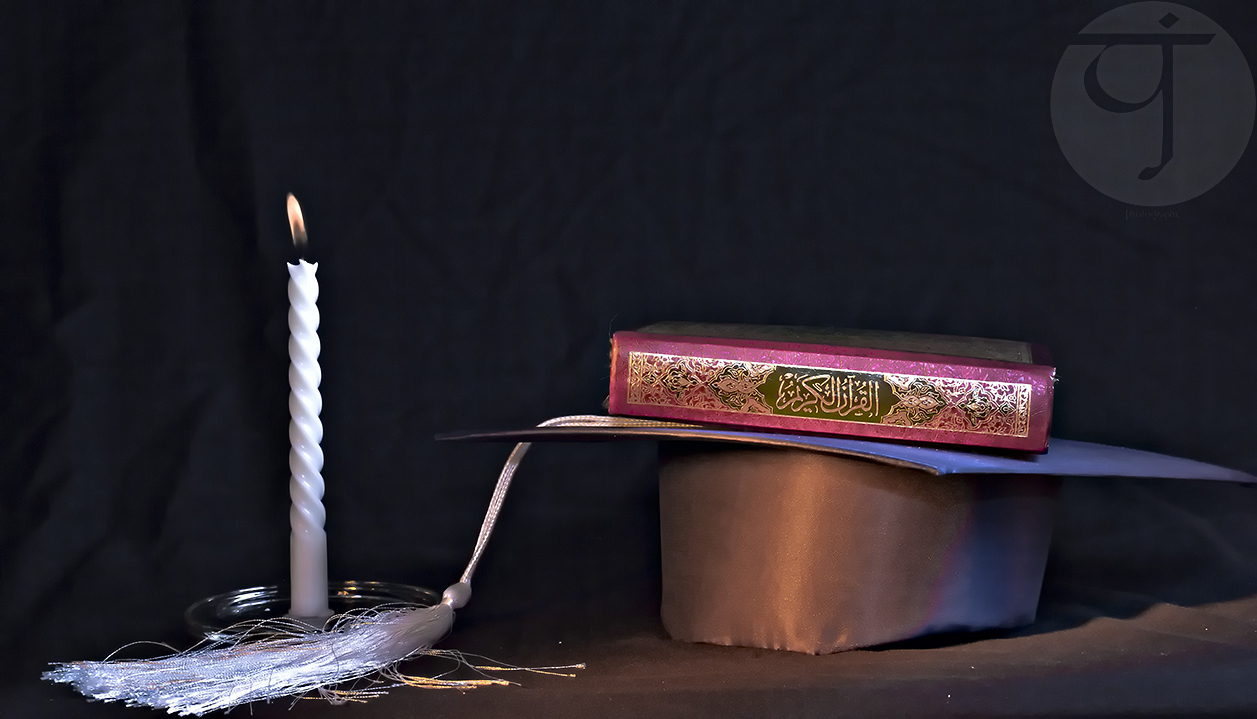
Canon EF 50mm, f/11, 1000-1, ISO250.

The legend says: At the time when Muslims ruled Andalusia, pupils who studied various arts and crafts come to the end of their studies with some ceremony or oath-taking, for which they invented the graduation cap as we know it today with a flat top, to place the holy book (Quran) on top while taking the oath and to apply the verse (and over every lord of knowledge He is more knowing: 12/76) from Quran. Anyway, I'm not sure about this story, but it was a spark in my mind to do this image.
Since I needed to kill the ambient light, as well as for the candle's light, I had to go on with the HSS mode (High-speed) to do this shot and compromise with the aperture a bit. Even though f/11 has a good depth of field for such small scene, but I like to always keep it on the safe side and push the f-number a bit further. However, I had to step back here and stop at f/11. One more reason to increase the f-number here is the desire to create a spark or a burst around the candle's flame, but that didn't happen! The real setback though was the need to place a dark yellow gel on the speedlite, and that alone takes 2.5 stops away from the power (as noted on the gel itself). Thus, even with full power, there was a need for some extra light, and at that point I've decided to use two other speedlites with no gels; that explains that mix in colors in the image above. Moreover, I've resorted to use the flash extender which I didn't put to practical use before this time in hope that I would give some strength to the pulse; which it did but slightly. I had to get my speedlite as close as possible to the set. It is evident from all these setbacks and problems that there is no escape but to raise the ISO as minimum as it could be (and I did have my struggle with the noise when processing the image above).
On the other hand, my brother had some remarks about the image and suggested some changes which I'm willing to try out as soon as possible (already did before typing this but the results weren't good). Here are some of his suggestions:
  1. Wait for the candle to melt down further, which is something I've done already.
  2. Shoot the set with the light from the candle alone. Tried that, but didn't really work, and the candle itself has a weak flame. 
  3. Get things closer together.
  4. Change perspective and move up further (i.e. shooting looking down to the set).
These are the major notes he made and I'm still trying to apply them (using Voigtländer 20mm lens instead of Canon EF 50mm) but still it didn't work out in a good way. Probably changing the lens was not a good idea after all and I would have to get back to 50mm. I'm envisioning the usage of my pinhole cover to shoot this set as well but I'll keep that for later.

Finale

As these words are going on, I'm pushing my way alone this time trying to get or grant a permission to shoot at a special place: A theater where a mural for the deceased artist was painted there with the opening of this theater after renovation (which now bears his name in gratitude to his services to the comedy and arts in general in this country). So far, official channels seem blocked and no one is giving a listening ear, so I'm resorting to some connections in hope that I will get this grant to shoot some ideas there. I'm doing this work solely alone without any help from anyone, as I'm trying to find a name for me somewhere out there rather than being dependent on my group.
Meanwhile, it seems that I'm giving myself a break from the group again and this time it might be for good indeed. I'll try to keep my activities minimum. There are more important things that still bug my mind, e.g. travel and creating ideas. I'm working on the latter, but not sure about the former. I'm getting nervous here... panic attacks had been frequent lately with insomnia. I need some good relaxation time before I lose my mind, and myself as well.


Stock photography by Taher AlShemaly at Alamy

Thursday, August 10, 2017

Mí Lúnasa…

August is in, and the heat is in surplus combined with humidity. Well, the good part is, my birthday is coming and I'm planning ahead for this day to... sleep some more. If I'm lucky enough I might as well get the chance to have free lunch with friends! Let's pray…
I've been busy the past few weeks doing many things (and skipping many things), but mainly finished a whole post/article for my Arabic blog explaining how I shoot through my old microscope, in hope someone out there find it beneficial anyway. I was also busy working on July's project: motion and splashes. But since I've done splashes before (and they require a messy set-up) I've decided to confine myself to do motion images as much as possible. I think I've posted some trials in the previous post, and some of them were a great fail.

Waiting


As I've mentioned before that the lines from songs of Sabah Fakhri [صباح فخري] are still inspiring me for these shots. My first trials with stroboscopic function didn't go well majorly because of the nature of the clocks or watches I've been using as it seems, so it was inevitable to do some Photoshop work out of the context of photography a bit as in Waiting. However, because of the depth of field, which was not shallow enough, and the irregular gaps between the ghosts of the minutes hands, all that made me think of re-doing the shot again with some fixes.

Waiting II


As shown here in Waiting II, I've pulled the rose closer to the table edge toward the camera to increase the distance and hence enhance the look of the shallow depth of field. However, it seems that I've done it with a bit of extra spices since I doubt that movement of the clock's hands are obvious at this level, but I'll leave that to the viewers. This is not the end of the story as I will be back to this project in a bit.
In my trials to depict motion I arrived at an idea which I've encountered some time ago in fact. A method of merging various channels of various similar-looking images (mainly those containing a sort of motion in them). The method was described by Yuga Kurita, a Japanese photographer. Though his method is a bit different but the final result is essentially the same almost. It's about merging one channel from each shot, in a series. I was set to go and try this new method with some spin-tops!

Chromamotion
Voigtländer 20mm, f/11, 1s, ISO100

Unfortunately, I didn't take a shot for the set, but it was a simple set with camera dangling vertically over the set with a lateral arm. I used my Voigtländer 20mm lens here for its sharpness and quality, and to have more freedom in the field of view as I was planning to crop later on. I've set my Speedlite (580EX II) on second-sync on the camera and directed it to a white cardboard on the side of the set. With some angle it was possible to make elongated shadows for the spinners. All these measures later on, however, proved to be kind of useless! Anyway, the main task was to have a proper image for the motion and that was kind of possible at 1 second exposure. After spinning and shooting several shots, it was time to combine some of them. In Chromamotion, three images were merged by channels. Later on, I've decided to merge all of the shots in sets of threes (made about 6 groups).

Quarks
The sprinkling colors across the white space here reminded me of the quarks so I named it after them. However, despite the colorful look, the motion blur in the original shots is not quite obvious here so I was doubting about the ability of such work to deliver the idea of motion to the viewer; any viewer. Things, however, got into perspective with my next move when I thought about the first shots I've made for Waiting above. Why didn't I think of that before? I can merge those in the same way instead of stacking them together in a regular manner!

Waiting III

I think in Waiting III, the allusion of motion is better and more obvious than Waiting I and Waiting II because of the colors on an almost-black-and-white image in general. This beings me to a conclusion as to why Waiting III is depicting motion better than Quarks or Chromamotion, and I think this is mainly because the image itself has mixed elements of stable objects and those in motion, and in fact those stable objects are, somehow, more general than those in motion. In Waiting III, also, we have a center (the clock's center), something which the motion is going about or around - since it's hard to depict the motion blur in this method it would be better to have the moving object in some periodic motion (visually at least) or attached to a static object (e.g. waves and beach, or moving branches in the wind). This is just my observation for now, and we'll see what to do about it later!

Finale

Well, there had been so much on my table lately, whether it's photography-related or domestic. I've been learning new stuff about Anaglyph making and 3D illusions, specifically for videos. I've posted a video last time which was not very concrete in terms of its 3D effect, but it was a trial and now after learning new things, I might try to record a new video; However, it does require some work on prepping my gear first just a bit.

Source: Amazon
I've stopped my ongoing reading list to read and finish my 2 new books from Amazon, and I've already finished one by Syl Arena (which I've read books of his before) This book is quite easy to digest and the beginning bulk of this book is for beginners, but nevertheless what comes then is quite useful, specially when it comes to discussions about his projects and situations. He describes exactly the mental process as needed to follow on with creating the needed light (even though some professionals might disagree with his methods).

Source: Amazon
Now I've started reading the second book, Schaum's Outlines: Optics, which is supposedly and introductory to the world of optics. However, the book kind of looking weird, because I feel as if it is in fact an answering-model for another major book (or let's say a solution manual). Nevertheless, it gives good information still with some good explanations in paragraphs before giving questions and their solutions. It is in fact a good refresher for me so far because what I've been reading so far is what I've studied long ago in my physics classes and completely forgot about right now!

There are other stuff I need to test and examine too, but waiting for the right time as I'm pressed (and can barely type this blog even!). I have the focusing pyramid (to calibrate the focusing system for lenses) as well as the H-alpha Night Sky filter which I didn't examine properly for the night sky yet, except lately for shooting the lunar eclipse (image at the end of the post). It is a regular job (and imaging) with such a filter and when I ordered it, I was really aiming at using it to shoot at the sun, but seems I have to wait till summer is over or I will simply be a fried egg! As for now, I need to get myself involved in August project with the group, which is about "Books." So far, I have no idea what I'm supposed to do, but only glimpses and visions in my head waiting to get out to reality.
When it comes to travel, it seems that I have to delay my plans a bit further and probably skip this year as well. I guess things are going crazy in this world, too much that a travel itself is a stress that needs a stress-relief. Needless to say, I don't quite have any idea as where I should be going. Sometimes though I wish if I can meet some of those amazing people I knew online… Well, till that time comes, I better get back to my Irish lessons and learning, and maybe add another language to the list.

Lunar Chain


Stock photography by Taher AlShemaly at Alamy

Thursday, August 6, 2015

Toys Toys Toys!

Here are they! My new toys and gear! Well, forgot to mention anything about them in previous posts but I will dedicate this post to them. Up until this moment I'm trying to find some time to test what I got here and write a review for them on B&H website. However, this week has been hectic for many things (and believe it or not some of that because of work despite the dormant summer season). Add to that, a turmoil at home because of renovation work that I just can't swallow.

Toys!

Now, to the business. All in all, beside the toys there is a side order of 2 books but I'll keep those for later down. Most of the items were actually from the wish list I've stored on B&H website and I've just realized that I was just "window shopping" for more than a year without thinking of upgrading anything in my arsenal of "toys!" Most probably it is all related to the downgrading financial situation worldwide.

Source: B&H
Anyway, first things first. A camera and lenses case or bag, from Think Tank. This item was on my wishlist for 2 years or even more! Now it is the time to get I thought, specially with the deteriorating conditions of my own bag right now. It has lot of pockets and the main inner body can adjusted to many positions to fit even a bazooka lens (sarcastic term for telephoto lenses; sorry photographers' joke). I can even fit my Rokinon barrel (mirror) 800mm lens in it instead of leaving out as I used to do before. The bag is supposedly made to accelerate your airport experience (a hassle every photographer might have encountered already). However, with many metallic stuff and batteries inside, I'm not quite sure if this will work with the increased security issues worldwide now. The best thing here even is that I could attach my tripod and I don't have carry it by hand... finally!

Source: B&H
One of the interesting items here, and I mean "very" interesting, is what I've discovered on B&H as I was surfing looking for some other items. A UV filter. Usually when "UV filter" is mentioned, people would think of that yellowish filter that enhances the colors of the scene by blocking the bluish UV haze. This one is completely different and acts like a cold mirror in the case of infrared: allows UV and blocks visible light. This is a completely new field to me and I still need to discover and try. One thing for sure though, Long Exposure. It does require film or converted sensor as well just like in the case of infrared photography, but the sources here can be different. One of the interesting facts here is that flash tubes (e.g. speedlites) can be used for UV photography but some protective layers must be removed (hence it would be a good idea to get a cheap flash and adjust it). Till the moment of writing this, I've tried the filter only once in the outside in my workplace just to test the length of the exposure and I have to say... it's long!

Source: B&H
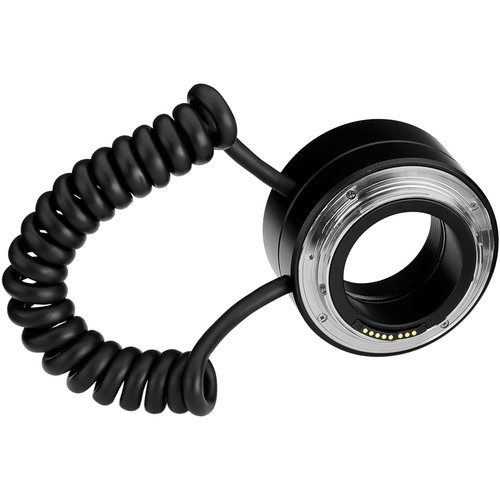
Then we arrive at the next major toy! The Microfier from Vello. It is relatively cheaper than reversing rings from other brands and it offers the essential control over the lens when it is reversed and mounted on the camera for macro photography. It does offer somehow a greater magnification level more than extension tubes (by calculations) specially when used with 18-55mm kit lens (the smaller the length, the greater the magnification). There is still the issue of the closest focusing distance which I didn't experience or read about yet. However, I did take a simple shot for my fingerprint which does look good (with high ISO here though). Left to say that it comes with several mounting rings to accommodate for the various diameters for lenses.

My fingerprint taken with Microfier.


Now, the rest of the toys are simple accessories, and some of them are really needed though, specially as a replacement!
Source: B&H
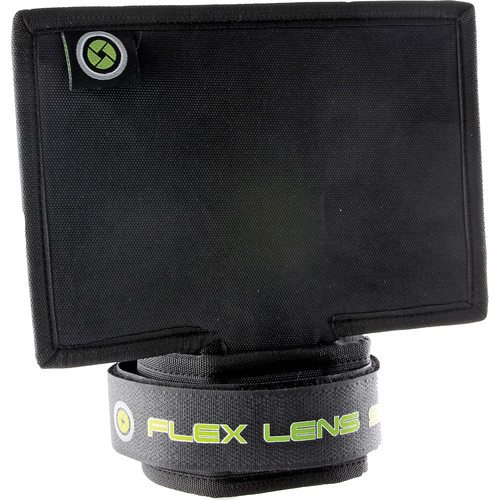
First, we have here the Flex Lens Shade I guess the name says it all. Anyway, one can also argue that even lens hoods don't do the job perfectly in blocking the light flare (in the description of this item by the manufacturer, they state it can be attached to hoods themselves!). Anyway, this is not only for daytime photography, but also for nighttime to block the remnants of street lights. However, the real test would be with fisheye lenses and their excessive field of view (specially the Rokinon 8mm that I own). Seems a night shooting session is due, despite the horrible weather!

Source: B&H
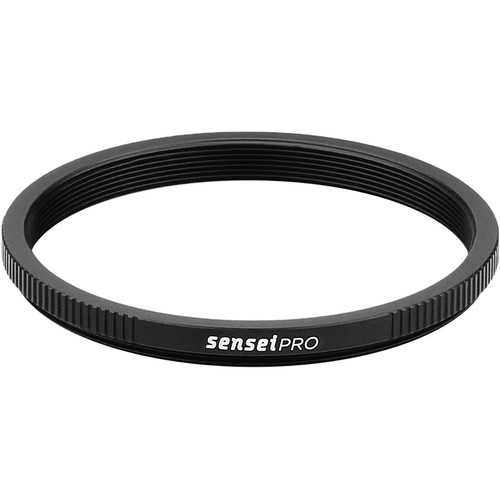
The next in line is something I needed as a replacement. A step-down ring to fit a small filter on a large lens diameter (58mm onto 62mm). The comedy here is in the fact that I've only found one store which sells those here in Kuwait, and for my fantastic luck, they don't have this particular size. Please note the sarcasm when I said "fantastic." This ring though is better than the one I've lost already since it is made from aluminum alloy and not plastic. I've ordered 2 rings just in case!

Source: B&H
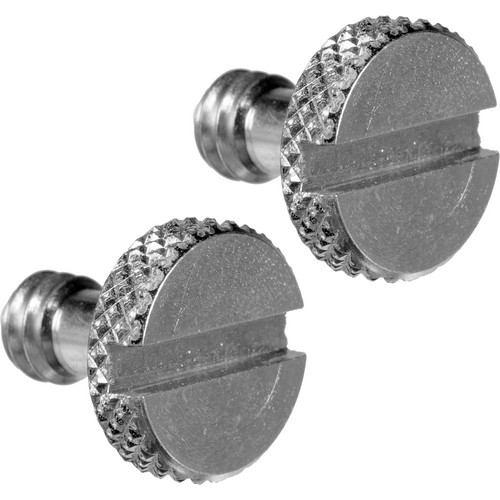
The last item in this list is just some Manfrotto 1/4' screws to keep as spare parts. I've kept this time in my wishlist for a long time, specifically when I noticed one of the screws in my Manfrotto VR-head was missing (and during that time I was using a spare screw from Manfrotto macro rail head). However, I did find that missing screw later on! But nevertheless, it would be a good idea to keep some of those available whenever needed for such "disasters!"

Büche

I don't know why I used a German subtitle for this section, but oh well. I didn't read photography books in such a long time I guess, and still I do have a queue of Arabic books that I need to go through still. I'm planning to stop reading a novel in Arabic in bedtime and replace it with one of the photography books I've recently ordered.

Source: Amazon
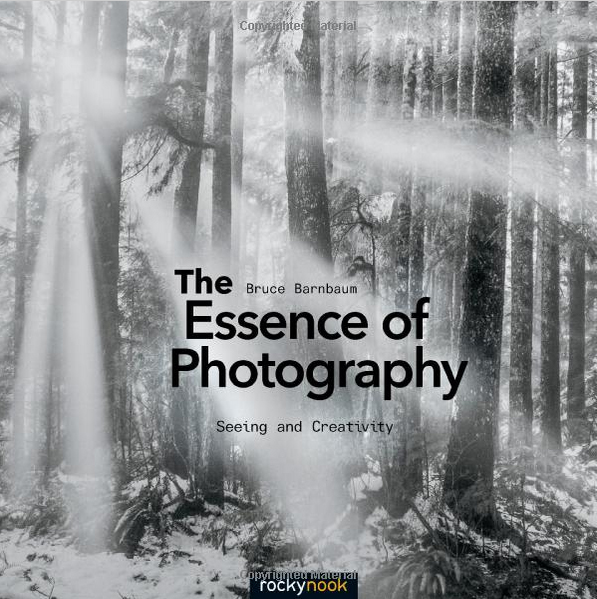
The first book on the list is by Bruce Barnbaum. This is the second book I have from him. The previous one was The Art of Photography; a very intellectual approach beside a long and detailed technical description for the chemical processes done for films development. It was/is such an amazing book and I thought this is the time to rejuvenate my eyes and vision in photography after such a dormant period. Thus, I'm hoping that The Essence of Photography would be like its predecessor. It is not only about the information in a book that one would stick to it, but also to the style of writing and the order and organization of the book itself that one might lose him- or herself reading it.

Source: Amazon
 The second book is supposedly about the art of using flashes (speedlites) in a creative way. I had other books about flash photography, specifically those by Syl Arena, but this one seems different in essence, since it discusses ways and methods instead of the technical aspects as it was in Syl's books. I will keep this book for later reading. I think I will be taking one of them anyway with me when I travel... I need something to pass the time with from time to time.

Finale

Things are done and ready, almost, for my travel. All what is left is... the visa! After completing my papers, I've set an appointment to "submit" the papers and complete the procedures - I heard an interview is involved. So, we'll see by next Monday, August 10th. Good thing that Mom has no dialysis session on this day. Because of all this hassle my ongoing Geltani documents are on hold, again. I just can't wait till I start my vacation and off the country. One thing though I do wish for... a specific someone to be with me on the way…

Thursday, August 7, 2014

How do you see it?

It's Idle time here. I gave myself a "vacation" from blogging last week for the Eid holiday. Not much has been going on except for some shots done in the family gathering - and they were not as vibrant as the years before. I, in fact, spent many days in the holiday sleeping for long hours (8 to 10 hours a day!). I guess I'm compensating for all the sleeping problems I've faced during Ramadhan. Meanwhile, I decided to do a little study on some aspect of tone-splitting technique. This study is not scientific in any way, but it is mainly observational to take some notes. I wonder though if there is a way to "scientify" this process after all.

Vergleichung

Since I've been working in Tone-splitting techniques for some time, I wanted to test some matters related to it. Yet, I'm not sure how to make a scientific and bold approach to such matter, since they are artistic in the first place. Thus, the sole reasoning in this experiment is done by heart and feelings initiated by eyes vision. The task here is to investigate the relation between luminance colors and their usage in tone-splitting process; how would they appear and feel when used as one of the tones in the process. But before going through rummaging, I will talk a bit about the process.

Concept
In the beginning, the general idea here is to use 2 colors: a specific chosen color from part of the image, and its complimentary color. Now, these two colors can be bright and dull sometimes, according to how we see it, but the main question was, how to specify this? What makes a color lustrous more than the other? If we have two complimentary colors, they are just opposites on color circle, and the difference between the two is barely in the Hue value, while Saturation and Brightness (or Lightness) have the same value. After searching around and with the help of the colors websites I have at hand, I've found out that the most adequate tool to compare these two is by checking their CIE-LAB values (LAB for short) - and more specifically, the "L" value (which stands for Luminance).

Portion from ColorHexa website showing the LAB values (in Red). The Luminance value which I've used for comparison between colors marked in blue.

After doing some experiments and comparing various colors, seems my guessing was right: The "L" value is indeed responsible for how "bright" the color is as we see it. So, what now?

Work
The work now was to choose a specific color. In the beginning, I was kind of in dilemma for what color should I choose in each image, as I didn't want to make the whole set is based on two complimentary colors alone - but it should be something of general concept. In the beginning, I tried to use the Average Blur command which makes an average of all the pixels in the image into one color. Sounded a good idea, but unfortunately, the colors resulting from this process were mostly dull and with low L-value, and their complimentary colors have the same characteristics. Thus, I had to do it in the usual manner as I usually do the tone splitting process for some of my images; by picking a lighted area in the image itself and analyze its color, and then pick the complimentary for that color. The two are used then to do the usual job of tone-splitting for the image.
I won't go on with the manual procedure of tone-splitting with the images, but to make things standard as much as possible, the random-picked images were turned into Black and White and using Maximum White preset (which can be found in the menu of the command in Photoshop). This preset sets all values for all tones to 100. Usually in my regular work in tone splitting I would play around with these values to pronounce specific details more than the others, but since I'm going to test several random images here, it is better to make something as a basic procedure.
Now according to these procedures and after picking a color and its complimentary color from the available colors in the image itself, we are in front of two cases, which I called "AB" and "BA" for easiness and affluence, where:
  •  AB: The color of the higher luminance is assigned to the highlights, and the colors of the low luminance is assigned to the shadows.
  •  BA: The opposite of the above; the low luminance color is assigned to the highlights of the image, while the color of high luminance is assigned to the shadows.
Thus, for each image picked here, we have two cases; one for AB and one for BA.

The Images
The images for the test are picked randomly, from various folders and years. Nothing specific was set to be looking for; simply random. The images are below and they are minimized. You can click any for a bit larger view. The total is 12 images.


Observation
After checking for myself with these twelve images (which is not enough in fact), I've made a simple statistical count:
AB preferred:  58.3%
BA preferred: 16.6%
Undecided: 25%

I can't surely say that having a luminance color to be taking the place of highlights is a sure thing, but I would say that with the abundance of highlights in some image, and placing a luminous color when splitting the tones in place of the highlights, that would make pretty much a bright image to the extent that, sometimes, it eclipses the complimentary color given for the shadows - thus, probably in such instances of abundant highlight, the AB type is not advisable. On the other hand, the colors chosen would play a great role, but in this instance it is all the role of taste. Those 25% of the undecided, might be so for compositional factors I presume, or ought to a balance in the overall highlights and shadows in the image, making the eye sight torn in between elements of the image without really residing on a specific element. This is all I could think of in the time being, but sure it doesn't end here. I'm wondering what would the next step be? More experimenting? Notice that all of this experiment, from A to Z, is based on color and complimentary color relation - there are other schemes to be investigated as well. Anyway, for the time being maybe I can put a guide line for myself in the matter of tone-splitting which might go like:
In tone-splitting process, the color of the highest luminance, or "L" value in LAB system, is to be assigned to the highlights, and its complimentary would be assigned to the shadows, providing that highlights do not overwhelm shadows in the image. And that is a starting point for creating and contrasty and easy-to-notice image.
And more testing should be coming on the way.

Finale

I was supposed to have some rest in this month, regarding my workplace which made it easy with the fingerprint attendance process. However, on Wednesday, I've received some letter asking that I should be doing the fingerprint attendance again after being told that I do have a exclusion permit till the end of the month. Such news really rose my blood pressure levels and added 10 more points to the scale of how much I do hate administrators and this workplace specifically. This, specifically, is an addition for really disrespecting this place even more. I just wish it is September already and I'm ready to go away from this trash just to smell some fresh air in Ireland.

On the other hand, I've checked out for another appointment for my eyes examination instead of the one which was during Ramadhan and I didn't attend. Even though it could have been in the next week but I told the nurse to put it some time in November. The appointment is supposed to take place on November 16th. A special date if you ask me!

Source: Amazon
Book-wise, I've finally finished the optics book, which was small and old, but HUGE in its content of information. Of course most of the techniques mentioned in this book are, probably, obsolete by now, but the information mentioned here are nevertheless pretty much valuable. The book is direct and highly technical without much theory. I like such books. That doesn't mean I don't encourage reading theoretical books as well, but too much theory without a real scope on how to use such a theory in a proper and physical manner to be beneficial can almost be in vain.
Source: Amazon
Now, I've moved to the next book on the queue line, Archaeology Essentials. According to the introduction, it seems to be a "student" edition, or the type taught in colleges. Sounds good. I've gone through few pages so far and I like it. It is indeed concerned about Archaeology rather than sociological issues like the last book I've read. That book was somewhat a disappointment. I don't think I can finish this book in just a month, thus I think it will be my companion when I head to Ireland hopefully.

For now, I've stopped my extreme macro experiments. I still do have problems in lighting opaque subjects from the front, and I couldn't come up with a proper solution specially with my slow progress and my lessened attention to this matter. For this reason I've decided to stop it for now and think of some real photography to do in the few coming days, when possible.

My life looks like been punched with one big vacuum in the middle. Missing out some elements which are hard to be found any where, any time soon. All what I'm hoping for for the time being is to have one nice vacation. If someone doesn't feel bright about work, and doesn't feel at home in home, where would one go? I wonder...


Thursday, May 1, 2014

Nacht der Langzeitbelichtungen...

Well, now we are back to the rhythm after two posts about my trip to Failaka; despite the fact that I'm still processing some of the images taken there. But probably the bulk of the images that I really enjoyed taking were already done... till I discover something new though. The B&W processing and tone-splitting sound promising but I do need more time with my images. In the meantime, I'm trying to settle down with time ripples as I'm torn in between two blogs, both of which would require an early preparation to be posted in time. Probably my future posts in this blog would be short (be happy!).

Nacht der Langzeitbelichtungen

I hope dear reader won't consider the title offensive*. It's just a title that reflects what I've been doing since I got back from Failaka island two weeks ago. I'm trying to do the best I can before the weather gets warmer (than this already); long exposures at night time.

Sky and Earth
Rokinon 8mm fisheye, f/8(?), 3.5m, ISO100.

My beginnings were shaky. Despite the fact that the low tide timing was perfect for me, because I wanted to go deeper into the sea shelf (the area which is covered in high tide time), yet, the tide was not low enough. To add to my problems, the beach area was not "silent" at 3:30 a.m.!
My first exposure, Sky and Earth, which was for around 4 minutes, came out blank. Not literally blank but out of features. I was hoping to go deeper into the sea shelf specifically to capture more rocks in the foreground, but it wasn't the case here.

Luminatus
Rokinon 8mm fisheye,
f/8(?), HDR, ISO100.
As you can see, because of the time that lapsed when these images, Sky and Earth and Luminatus, were taken, I've completely forgot what was the aperture used back then in this manual lens; but I doubt I've gone further than f/8 (hence "f/8(?)" in the caption). Luminatus, in particular, was shot about 180 degrees to the other side on the shore, away from the first shot Sky and Earth. Now, I have to admit I don't like both shots, but I did shoot after all. I didn't want to go back with empty hands after struggling to the beach at 3 a.m. that day! Some people commented that they like the transition in the horizon line in Sky and Earth, and I might like it a bit because of its minimalistic approach to the seascape, yet, it's not much more than a play of colors; in fact this is all what I depended on here to make this image work a bit. Otherwise, it is one big fail. Luminatus on the other hand was a fail still but with some liking from my side because of the spot-like effect that surrounds the buildings. This is mainly caused by the lights of the buildings themselves which caused a halo effect somehow. The HDR technique (gathered from long exposures) helped a lot here in controlling the range of the halo, but then some work in Photoshop was required. My night was over then and I had to go back to my car on the soft sands, carrying the load!

Extraterrestrial
Rokinon 8mm fisheye, f/8(?), 8m, ISO100.

The night after was a bit more promising but I have to admit here as well, I didn't expect the results. One of the major differences between an amateur and a professional photographer is the expectation of the final outcome before the work is done. The timing isn't really what I was hoping for because it was close to dawn, and the exposure time, when calculated in the regular way as I usually do, must be shortened than the real calculations; This is because the sun is on rising even though slowly, but it does affect the outcome significantly (in some trials before, the exposure time would be one minute short than calculated to get a proper exposure, or at least a proper histogram distribution).
In theory, when doing long exposure for moving clouds, a cloudy day in fact is not good - this is because the movement would not be so obvious in the sky. The movement won't be noticeable unless there is some spacing in between the clouds. In the meantime, I was thinking: Is it possible to record the movement of a hole in the clouds when a cloudy day? I think I got the answer in Extraterrestrial. I'm not a meteorologist, but it seemed that this place in the sky specifically was like a barrier for the clouds passing through it and hence the lines formed around this specific vacancy. The bright spot in the sky was probably the sun disk which, on location, was completely invisible to the naked eye. Probably this is one of the beauties of doing long exposures: to see the unseen!

Blauentraum
Rokinon 8mm fisheye,
f/8(?), HDR, ISO100.
Just before leaving the place, after observing how much light is shining on the land, I decided to do one last trial, this time for HDR bracketing (and if I remember correctly it was also a series of long exposures). As you may have noticed  in Blauentraum and Extraterrestrial already, I've been using the Fluorescent WB excessively for such time of the day (along with dusk time too). In processing the HDR, I didn't try to do any magic here, but simply eliminate as much as possible the ground of the beach while darkening the sky a bit. The guide line here is not strong, and the only thing I would rely on in this image is the hues and blend of colors. Otherwise, I wouldn't submit this to be judged in a contest!
The coming weeks after that did (and will) witness more long exposure trials but I'll keep these images for later...

* In case the reader is not aware what it means; the title means "night of long exposures"; parallel to the Night of Long Knives (Nacht der Langen Messer), which was a name given to a  series of political murders in the beginnings of the Nazi regime.


Finale

Source: Amazon
 New books now arrived, and I've already started reading it. The new book is a contemplative book somewhat (just like another book I had before) but in a different style somewhat. I do have some list of books that I'm reading already for bedtime (an Agatha Christie novel in Arabic in fact) and at work I'm somewhat busy doing work related to this blog and the other blog, thus reading this book is a challenge for me now. The best I could do for now is to read in between when taking breaks, or when I wait for my fingerprint time before leaving work. The other books are related to Archaeology and principles of optics which I'm also dying to read. The latter specifically looks an old edition; I really didn't check it out! But it doesn't matter as long it gives some basics.

Source: Amazon
On the other hand, I've ordered another flash cable instead of my Vello cord which got broken after some accident. This one (from Pixel) though is cheaper than Vello's. I'm not sure why though, but it works fine and tested it for High-Speed mode on my 580EXII. If it is about the make, then I have to say the Vello is higher in price and yet couldn't stand the fall of a tripod; hence, it wouldn't make a difference for me I guess if I get a cheaper one. After all, I'm not using it excessively for the time being - but that doesn't mean it's not necessary!

This is it for now I guess. I'm not sure I want to talk about work here, because I'm trying to keep myself busy as much as possible just to forget the insults that I see daily in that place. The summer is coming, and the hell is starting to cook my body already. My only condolence is to see students finish off their semester as soon as possible to release some of the jam in this place.
Meanwhile, I do feel guilty though for not doing much work with my Geltani conlang. Two weeks of vacation and yet, I didn't touch it at all and concentrated all my time for photography; it's unfair I guess. Too many things to do, and one body to do them all...

Thursday, January 9, 2014

Sonnenaktivität

Here we are; a new year. I won't be talking about resolutions here as, in fact, the new year thing is not widely separated and the concept of New Year's resolutions is just something weird for most of the people here - needless to say that we grow up without really considering it something special that a solar year passed and a new one began.
I can't say my beginnings of this year were good, but I really couldn't care lesser about my bad luck, or the troublesome conflicts with other people around me, specifically at work. This, by now, became like a daily dish for me.
One of my great sorrows for the past week is that I wasn't able to go out at night during the long "weekend" which consisted of 4 days and shoot at night. Mainly because not much scenes were available, and some of the locations that I've used to visit for some solitude and silences, were bugged by annoying people and their trash. Luckily, I did some of my homework the week before and did shoot something at night.

Blaue Nacht

From the early beginning of that night, it was a helpless endeavor trying to find out something to do and not to sleep that early in a such winter night. My first pick was a location that I used to visit years back, and specifically at such time of the year (and even did a panorama there deep in low tide time). This time, however, the situation had changed. People (specifically the annoying type) were still roaming the place. I tried my best to stay away from the rest and do my own business.

Ausstrahl
Rokinon 8mm fisheye, f/11, HDR.

I have to say that the main reason for visiting old location is some inspiring kick that got to me when I viewed some old images (specially those I've made into 3D anaglyph images) of a broken shade on the beach. Back then, I didn't have the fisheye lenses that I do have now, specially the Rokinon 8mm. Thus, I've decided to re-discover the area and this shade specifically with my Rokinon because, simply, the geometrical patterns were inspiring as they are.
As I settled down in the place, over the soft sand, I was faced with two main problems: a) setting up the tripod on a soft ground, and b) the flare from the harsh lights of the restaurant at my back. In the final image, Ausstrahl you can still see some traces of the flare even after the crop. One of the problems with fisheye lenses like Rokinon, with a large field of view, it is the hardship to use a flag to block other light sources that cause the flare; simply because there is a big chance that the flag would get into the frame, and when moved out of the frame it does not technically block anything!
On the soft sands it took me some time to settle and to take some test shots with ISO12800 to judge my composition. I've decided then to go with long exposure brackets; something that became a favorite activity at night exposures. Can't remember the exact timing but it ranged from about 8 minutes down to around 30 seconds. Almost at the end of the exposures, some guy was peeking from the top of the concrete wall behind me and started to make comments. His comments weren't bad or vulgar, but they were simply nosy. Thus, when I felt the situation being like that, I didn't stay longer and picked my stuff and left the place.

Altar
Rokinon 8mm fisheye, f/8, 4m, ISO100.

Leaving the first location, I still had the urge to work a bit more, thus I've visited Soog Sharg dock place where I made some shots several times previously. This time, it was relatively quite (as the time was nearing dawn by then). Even though I did take several shots with different times thinking of bracketing and merging into HDR when I finish, but at the end I only picked the first shot that took me 4 minutes. The rest was a play in the RAW editor (DxO in this case) to fix the shadows and highlights as much as possible, along with the distortion but not to the extreme flattened look. That night, however, wasn't the last activity for me in 2013!

Pajero

As I've mentioned before, I've got a new car just before the end of 2013. A Pajero. I really like driving it and it was a great help with the rains that hammered over Kuwait this week. I'm grateful.

Pajero 2014

The day I picked to shoot my new car was cloudy and prior to some light rains back then, but with HDR rendering I was able to show details in the clouds above. For such an elevated car, it was hard to pick up a proper angle to shoot form a lower level, unlike my previous car, Seat.
I've taken several shots as well from various angles. However, no need to put them here as they are just regular ones. The main interest for me now is to do a panorama from inside like I did with Seat. I've managed to check the rear and I've almost settled with my mental process on how to setup the gear inside - but I do need a proper place to work (for some long time) and it should have proper light level. Let's not forget that I must wash the car prior to my work!
There is one old panorama taken from inside of Seat, which I've done in the parking lot of my work place, but now with my sickness of this place, I've neglected the idea of heading there and shoot a panorama.

Sonne

In the past 2 weeks I've picked up a new hobby. Shooting at the sun. Well, it can be classified as astrophotography, but the case with me is that I'm not completely within the reach of astrophotography; but my main interest is the sun, and the moon of course.
This main interest was sparked (again) in fact when I was surfing B&H website to find what was new for me back then, the mirror lenses. With some little research and study, it seems that those lenses are in fact just small telescopes to be attached to the camera (with the help of some adapters too). This even sparked in me the desire to, maybe one day, get my own telescope and try some astrophotography - but we would need REAL good locations for such hobby, and the urban areas where I live and roam are, of course, not suitable for such task.

Sonne I
Red arrows point to noise bits from the system itself.
Blue arrows point to features on the sun itself.

My first trial to shoot at the sun was with my relatively-new Sigma 70-300mm. As I used to do with the moon, with my Tamron back then, I've attached two x2 teleconverters to raise the focal length to 1200mm. Using the two teleconverters can be awkward in normal conditions because the light quality becomes lower, but with the sun, we would still need some filters to block the harsh light, and here comes the welding glass (green) to do the role.
The welding glass provides around 11.7 stops which was enough to look at the sun thru the LiveView LCD at the back. They say, usually, if it is safe for your eyes, then it is safe for your camera when it comes to shooting at the sun, and this is what I've done in fact. Focusing, however, was a bit troublesome; typical for such a long focal length and a shaky system. I think I do need a collar to hold the lenses to the tripod like how it is done with typical large telephoto lenses.

Sonne II

I did another trial few days later but this time the harsh spots from the system itself did vanish, and I'm not sure why! Maybe it has something to do with the focus itself. When focusing at a subject like this I usually zoom the LiveView to the edge of the sun disk and try to make it out as sharp as possible visually (which is not always a good solution). With two teleconverters (and f-number exceeding f/2.8 in multitudes!), the AF function is simply idle. Just to note here that the image were corrected for colors later of course. In Sonne II, the spots (or flare?) are more obvious than in Sonne I. The best has yet to come though...

Sonne III

My third trial with the sun was done differently. I've used the IR filter instead of the welding glass. The thing about the IR filter is that I can't technically measure the number of stops it reduces, because mainly it is intended to block visible spectrum and pass the IR band of the spectrum - this is the main goal for producing it, and using it! Thus, with this uncertainty in my mind, I kept some ND filters at hand just in case I do need to reduce the light even further. Just to notice, my IR filter thread is 58mm and my Sigma's thread is 62mm, thus I had to use a step-down adapter between the two which causes a bit of vignetting at the edges, but here it's not really important.

Sonne III
Original IR shot.
The light level, however, was easily controlled then by the shutter speed and the aperture (which was kept at maximum) and reducing the ISO too (back to 100!). All that was done as I was watching the LiveView. Not so surprising, focusing using the IR filter was much easier and I could achieve a relatively sharper edge focus. This is understandable since the welding glass is bulky and it technically hangs in front of the lens, while is IR filter is screwed in. What I'm not sure of though, does the IR radiation has any part in any of that? Meaning, does the IR radiation come into focus and NOT the harsh disk of the sun itself? Logic says that I've been focusing with the help of the IR band since I'm using an IR filter - but who knows! However, with Sonne III I was even luckier to find several spots at the center of the sun. Adding to that, the original IR shot did have some "halo" around the disk, unlike the dull image done with the welding glass. Seems to me that it is all a good practice for now before, one day, getting my hand on a mirror lens or even a telescope.

The f-Problem
One of the problems that accompany using a teleconverter is the fact that not all information might be recorded in the EXIF of the image file, or even communicated with the camera itself. In my case, my Bower x2 teleconverter would communicate such information, but the Vivitar x2 teleconverter does not communicate any of such information with the camera. Thus, the camera would show f/22 for example, but in reality the f-number is supposedly larger than f/22; after all, the f-number is a ratio.
When shooting at the sun with my two x2 teleconverters, the recorded f-number was f/64. I thought, if someone would try to track the information of the shot to try and do something similar, the consequences might be not "pleasant". Also, I have to think about the future use if I want to mention such information with my images, like in this blog for example, and definitely such information would be misleading. All in all, there must be some accuracy in the information represented with the images. Sigma's maximum f-number is f/22, and it is recorded as f/64 when using the two x2 teleconverter, and this value comes from the Bower teleconverter alone.
Hitting mathematics, let's see what does that mean. That is, having f/64 with two x2 teleconverters and the lens zoomed to 300mm. First of all, let's get the diameter of the aperture here without teleconverters:

N=f/D;
Where N is the f-number, f is the focal length, and D is the diameter. Simple algebra, and we get the equation of the diameter as:

D=f/N;
Thus, in normal conditions with 300mm focal length and maximum f-number of f/22 (as in the Sigma 70-300mm lens), the diameter should be: 300/22 = 13.636mm. 
Now, the teleconverters are just magnifiers and do not have any aperture control. In return, then, the diameter doesn't change with the addition of teleconverters, but the focal length does. With two x2 converters, the focal length is theoretically expanded to 1200mm! (300 x2 x2). Now, if we supposed that the f-number is indeed f/64, and the diameter of the aperture is not changed, what would the focal length be in that case? Again, simple algebra would give the equation as: f=ND. Meaning, the focal length is: 64x13.636 =872.727mm. A wrong answer of course.
Using the above equations again to find the correct f-number, it would be: 1200/13.636 = 88. It is worthy to note that in the specs of such teleconverters, it is mentioned already that they double the f-number, but the problem here lies a bit in the mathematics involved, because f-numbers are not based on the rule of stops of 2n, but rather on 2n/2. I find the method of finding the diameter is more "direct" if I can call it so!
This item of info, though simple, I believe it would play some role in critical times when calculating the required exposure becomes essential and finding the correct f-number would be a must at such times, along with other uses.

Finale

Gaston Bachelard
The Aesthetics of The Image
Ghada Al-Imam, PhD.
Husain Ali, PhD.
The Philosophy of Art
A New Vision
My arsenal of books is about to finish, but that's going slowly for the time being. Two interesting books (somewhat) are on the list for now. The first is a discussion of Gaston Bachelard's (1884-1962) philosophy. In fact, despite the title of the book, I thought it would be a direct impact on the matter of the arts, but it turned out to be a highly deep and sophisticated discussion for various themes, and generally for the relation between science and art. I had to stop when I reached around quarter of the book or even lesser than that because, simply, I could not comprehend a single word from the text. Thus, I've just decided to put it aside for later and start reading the second book on the list. The second book, The Philosophy of Art, is more clear in its aspects about art and the philosophy related to it. I've just began reading it though and I need to see what comes next; at least the talk is clearer and I'm able to follow the ideas so far. I'm not expected though some tips about how to criticize a work of art or the likeness of that, but at least I might develop my own sense and evaluation of art in order to see future work with a philosophical eye, and not simply with the visual attraction.

Aside from the cultural venue, I've been suffering a lot of downs with no ups. Mom's condition is not getting any better (though stable), and in my work place things are getting on my nerves more and more. In fact, my work right now is the last thing I do care about. The mediocre, if not poor, treatment from the administrative people in my work place makes me question the value of my dignity and respect relative to those people. It's not the first time to think of seriously leaving that work place and be on my own doing my own job and the things I like - but it is better to be with moonlighting; that is working with a stable job and a side job until the situation becomes concrete on the side job. I didn't start this yet even and makes me wonder what to do next. What angers me the most is to realize that I've spent 6 years in this college to get a scientific degree, to be controlled then by a bunch of monkeys that barely know how to do algebra and simply got no considerations for our simplest rights.

The situation is vague. I'm simply living each day to its extent and trying hard not to think of tomorrow. It's hard to neglect that because of the hammered mind, an expectation for a new trouble arises with every morning I turn my opened for the daylight. My heart is tired.