Showing posts with label sound. Show all posts

Thursday, May 2, 2013

Free Fall...

Struggling struggles and fighting fights, all of that to keep coming out with new ideas for photography and other aspects of conlangs, amid the increasing responsibilities concerning the house. Well, I guess I'm glad I'm not married at such moments.
At least in this week, I got to test the trigger partially, and under the light of the new book I'm reading (and almost finished) I've got more insight about my mistakes. More to come below.

Source: Amazon
As I've mentioned in my previous post, I've ordered 3 books, and they are here already. Instead of reading 2 at a time as I usually do, I decided to concentrate better on one book at a time. The first one to pick was the Tabletop Photography book by rockynook. I would classify the book as general (because under tabletop photography, you can enroll product photography or food photography... etc) but it has some nice tips about the lighting and how to do some stuff with emphasis on low costs. It is really an encouraging book despite the lack of some technical data when dealing with the light but, anyway, I think the depth of such topics is out of the scope of this book. I've already almost finished the book!
While reading the fore mentioned book, I was working on my own experiment which is also my first real trial for the new trigger since I got it back in March. I've pointed some of the lacking points in my previous post and some of them (if not all) were very true. From my side, I had my own problem too with my own tools already (other than the trigger that is) and also, I didn't learn quite enough about such type of photography.

The setting I've worked with in my experiment. Sorry about the bad quality but this is what you get when you ask a non-photographer to take a photo with his iPhone. I think my brother never heard of the word "focus" before!

As you can see from the blurry image above, my brother never heard of the word "focus" before as it seems. My setting was simple (and the trigger is placed on camera) while I needed a long cord to connect the sound sensor to the trigger. The sensor was placed on the surface of the black sweep (if you can notice, it is a small tiny black box on the left side of the sweep, which is your right side). Luckily, I had such cord long time ago when I used to record some music for a friend!
I've used my both speedlites here on both sides but I think this is a wrong step. I will explain further below in form of points for easy reading. My target was to freeze the falling moment of some marbles.

Free Fall
Canon EF 50mm, f/7.1, 2500-1sec, ISO100.

Many trials went on to check for position and light levels as well as the depth and the shutter speed required to freeze the moment. Believe it or not, a 800-1sec shutter speed was not enough to completely freeze the moment, and some marbles kept on showing motion blur. Yes, I'm a physicist (or so my B.Sc. announces) but I don't have the time to count for the falling acceleration and velocity and check it out with my camera's shutter speed; besides, I really hated mechanical physics! However, let's move on to the points:

  • I've used some marbles randomly here and with different sizes. The problem with Free Fall above is that two big marbles dominate the scene in the foreground and this is a bit distracting. It is a trial and error job after all but it might be better to use only one large marble or leave them all at the same size, I think.
  • The positioning of the speedlites on two sides (but pointing in different directions) was a mistake I believe. Under the light of my new reading, I think the best method to conceive the feeling of glass in the air is to have a reflector on one side and reflecting the light off it. I think a narrow strip of some white board would do. I think this way would also help me on concentrating the power of the light in one direction to get an intensified effect from both speedlites under the operation of High-Speed mode, which reduces the brightness severely. This is way much better than scattering the power of the two speedlites in different directions.
  • The prop or sweep I've used was not completely black, or let's say it reflects bright tones when light strikes it. Besides that, simple cleaning from dust particles was not enough for clearing the view. Anyway, I do recognize the importance of capturing a glimpse of the ground to emphasize the sense of falling, but this ground such as the one in Free Fall is not a favorite.
  • With trials, it was evident that there is a time gap between capturing the sound and then sending the signal and triggering the camera - this is natural of course, but with time and trials, it seemed the time gap between these processes is getting bigger (bigger in terms of micro or milliseconds).
  • Maybe it is not very clear in this situation, but probably I should start using a black board over my lens when I shoot up close to avoid any reflections from the camera onto the glass.
  • The low level of the settings in general is not helpful and I think they better be up a bit. 

These were some of the points that crossed my mind so far and bearing them in my mind, I might work it out again some time later. I'm just glad that I've tried the trigger at least and I'm ready to write a review about it on B&H website. This is like a duty for me. In the mean time I have to think of something to do about the increasing number of tools and how to organize my room!

Linguae Artificiales:

In the course of developing some thoughts about the future of some of these conlangs I've created, I've decided to keep a regular notebook. Probably, a notebook for every conlang I'm trying to work on from now on. I've had this idea since I've been looking at my scattered leaflets on my desk at work with all scribbles for Geltani and figured it is really easy to lose track of ideas made before! For example, I'm still not sure of the possessive articles that I've made already nor I'm sure about the grammatical cases! I have to organize my stuff.
On the other hand I was thinking if it is possible to work on 3 conlangs altogether? Seems huge step but who knows! Geltani, Bulughman and Betenic; and probably Caqobian as well - an artificial language spoken hypothetically by Alexander, and the plan is to make it go along with Greek somehow. Ideas, ideas, ideas. This is all what I can promise of. If only I can get my brain to organize itself as well...

Thursday, August 11, 2011

Ouch, My Head...

Seems that in Ramadhan and despite the fact that people are fasting, I'm the one to be buzzing like someone struck with ADHD. I'ts not all bad but when it comes to sleeping at night before going to work in the morning, this is the real headache. With all this fuss and sleepless nights, I've decided to go ahead and finally record something for my Ayvarith: the story of Alexander. The recording is still going on and I can't believe it is that much fun even though it is a headache to edit the sound files and correct them and remove these parts where I cracked up laughing! The progress is just beginning, and the real heavy work is left for chapter 6!
You can check Chapter 1 in Ayvarith transliteration, and you can listen the text. Hopefully it is a good quality (MP3 files): Chapter 1 (Ayvarith). It might be a good idea though to read the Preface before checking Chapter 1. The whole story in English can be checked out here.
The process of adding these sound recording is going slowly though, but at least I'm pushing myself now and trying to overcome my mood when I see my papers scattered around me without working on them. However, I had different stories to tell for this week!

I. Kackerlacka in The House!
Done it! Finally, it's here! Well, not so perfectly done in fact but still the best I could achieve with some minor errors. I had to plan for this procedure and I have to admit that it is impractical, but after all it is still the best I could do.
The panorama that made me sleepless is finally done. A low-level panorama in the bathroom, mimicking a view of a cockroach! Well, the first thing that would give you a headache in such panoramas is the narrow space that you have to work in...

General setting in the bathroom

This time though, the tripod legs were pulled back a bit and shortened but the camera level is almost the same. I didn't go further as to elevate the camera upward for 45 degrees, but it was enough to test the theory I've planned on paper to achieve a 360 panorama on a low-level. I'll make an analysis in a form of points to make it easier a bit to understand what we are working with here.
  • Target: Low-level panorama in a narrow space (my bathroom) using my new tripod, whose central column can be flipped upside down to fit the camera downward closer to the ground. An impressive perspective if you ask me!
  • Problem: Tripod legs must show. The whole planning is to eliminate these legs in the final stitch of the panorama. To add to my misery, there are shadows (but I didn't bother much about them) and there is no lock on the central column of the tripod; meaning, if I want to rotate the tripod by lifting it from the hook on the top, the legs will definitely flip back and won't be kept steady in their places to rotate them. This recalls for another treatment: using both hands to keep the legs as they are.


The first and the main part of the problem is the legs of the tripod. I knew a solution to this is to actually take the panorama twice; each time with the tripod legs in different positions. This is natural thinking I believe, as the goal here is to get specific angles with the legs showing once, and then another time with the legs not showing then, and overlapping the two to eliminate the legs completely. This requires a VERY measured workflow. Another solution would be to simply hang the whole thing from the ceiling without the help of a tripod and we wouldn't have to bother about the legs at all! Simple, isn't it?!

The Workflow

1. In the beginning, and to make it easier to align things perfectly, I've decided to align the camera forward to one of the legs. But first, I had to rotate the VR-head disk (which clicks every specific angular amount as you specify) and fix it on Zero, and then I've loosened the base to rotate the whole base freely and aligned it to one of the legs. This can serve as a starting point and will help us to align the angles as perfectly as possible later on.

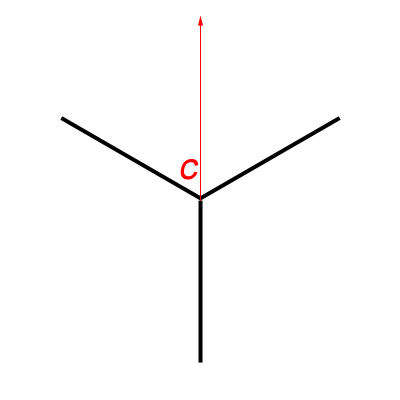
The camera (C) pointing to one of the legs directly

2. This alignment, means that we can start from exactly the same point, when the tripod is rotated for 180 degrees. All what we have to do is rotate the camera (and the VR-head) 180 degrees as well and we can start from the same point to do the second panorama. This angle of rotation, 180 degrees, is best in this situation because it guarantees that in the two panoramas, the 3 legs of the tripod will NOT fall in the same place or angle between the two panoramas. If any of the legs in the first panorama falls in a certain angle and another leg, in the second panorama, falls on that same angle, then our overlapping goal fails and the tripod leg in that specific angle can't be removed! (Make a mental image and rotate the triangle in the figure above to 90 degrees around its center).

The camera (C) starts for the second panorama from the same point as before after rotating the tripod 180 degrees (half a circle), and also rotating the camera 180 degrees to make it point to the starting point.

3. As stated before, it is hard to rotate the tripod from the hook on the top, because the legs would close down and I would have to stretch them back as they were before, and in doing so I will definitely loose coordination. Hence, I needed a method to align the center of the tripod in the same point after I rotate it with my hands. Unfortunately, this was impossible to do because the VR-head occupies the space and it was hard to align the center to the ground and put a mark there. I had to resolve the problem in another way, away from its center! Simply by noticing that a two overlapping triangles can form a circle, we can sort something out!

The two positions for the tripod for each panorama. The tips can be connected to form a circle.

4. Instead of aligning the center, we can then use the concept of the circle to point and predict the position of one of the legs when it is rotated. The best leg to be rotated here is the one aligned with the camera (this is the reason in the first place to align the camera to one of the legs). To predict its place after rotation, we measure the the distance between the leg tip to the center of the tripod (radius: r) and then count as much on the other side, and put marks on both positions (mine yielded a radius of 49.5cm).

The radius on both sides: the original starting point for the first panorama, and the predicted place after rotating the tripod for the second panorama.


5. That's it! After doing the first panorama (360 panorama) with one orientation for the tripod, I carried the tripod with both hands and aligned the leg+camera alignment with the second mark. At this point, I've rotated the camera 180 degrees to the back to start from the same point as the first panorama. This order is critical when files are managed by PTGui later on.

The whole process took around 45 minutes, excluding the time spent to adjust the tripod out of the bathroom, and adjusting the camera and lens settings as well. I tried here to use the hyperfocal concept to ensure that the whole range is in proper sharpness, because setting the fisheye lens to infinity here (as I usually do with normal panoramas) will make the floor closer to the camera blurred too much. The camera was finally adjusted to a hyperfocal at f/8. Simply set the camera to f/8 and manually rotate the focusing disk to fix the infinity symbol over "8" on the right side of the middle point. 

Canon 15mm f/2.8 Fisheye lens
Source: B&H

Then after, the struggle of PTGui begins. In fact, the stitch was not at all perfectly good but it was way far better than my previous trials! I'm happy for this despite the broken lines and the weird exposure spots and noise (say, even a normal panorama has those!!). The HDR images were prepared in Photomatix 3 instead of 4 to spare myself some headache. But later on I used version 4 for tone-mapping only.
As a beginning, I've decided to make use of the Blending Priority in PTGui before I begin aligning the images in the very beginning, and this option is supposedly only a numerical value that bears priority but nothing else, i.e. the number you put there is not entered in any calculations but PTGui uses this number to order the importance of the images and which to blend the most and the least (However, I tend to think of it as how much radius of the image is taken into). By default all images are given a value of 100, and as a starter for me, I've reduced this number to 50 for every image that has a leg from the tripod. The initial result was astonishing, and some tuning was done later on to some images to hide more from the legs or broken lines around the toilet seat, which worked as well (but not for the tripod leg which I had to clone later on).

Kackerlacka

In case you wonder about the name, Kackerlacka, it means "cockroach" in Swedish (yes, again). I just liked how it sounds, so I've changed the name from Cockroach to Kackerlacka!
The major fixes were done in HDR mode to hide the remnant of a tripod leg (above the bath tub) which is something I couldn't hide using Blending Priority option. I had to cut a piece from the adjacent walls and stick them there over the remnant of the leg. Also, some spots of colors were there, in HDR mode, under the washing basin and I had to clone these out too. The other fixes were done after tone-mapping the HDR panorama and majorly they were broken lines on the floor and else where, but I didn't fix them all. I was happy enough that my plan worked already and decided to give myself a rest from all the headache of fixes! Taking a row at 45 degrees upward was an idea, but I've neglected that for the time being because I do need to raise the camera a bit more from the ground. In my first trials with this panorama, the camera rotation when it was tilted, caused the setting's center to shift from its place causing more chaos when it comes to stitching! For the time being, this is enough, and might even fit a simple QTVR!

II. Moon on The Roof:
Spent Monday night on the roof trying to test some long exposure procedures. It was a hasty work really and no intention to make some art work out of it. I barely metered and settled everything on the roof (and forgot that the WB was set to K3000). However, with my fisheye lens not much can be done and lengthen the exposure time because I don't have the proper filters that fit to it. I wanted to use this lens specifically for the distortion and the wide view, but I might try to test my 18-55mm lens since I have a filter adapter to this one.
Anyway, this experiment was useful in some aspects. I've realized some problems and aspects that might be helpful for me in the future.
The longest exposure I could get was for 8 minutes, and for some reason I was not able to automate the whole process. I had to come back and forth to the tripod to do the exposure again, as I had some overlapping layers in my mind. To make sure that the breeze won't move the camera I've hung the camera back on the hook on the central column.

Night Photography: Finding your way in the dark

Lance Keimig in his book mentions a lot about the histogram and doing tests before doing the long exposure, but I have to admit I didn't do any of that. I was working in a haste. One thing though was proved as Lance mentioned: the heat produces more noise. The temperature was around 40C (~104F) and that definitely produces not only luminance noise, but also chromatic ones like if the ISO was not set to 100. However, the results were interesting indeed...

Falling Moon

In the beginning I've decided to work with DPP (Canon's software) because as, again, I read in Lance's book, the software of the camera manufacturer is best suited to deal with the noise recorded into the RAW file, while third-party editors, like Photoshop or Lightroom, do not identify this data (but they do give a way to clean the noise and sharpen the image). Long story short, it didn't work. It didn't fit my workflow and I made some mistakes (converting the RAWs to TIFFs in sRGB space) and DPP do not provide ProPhoto space (the highest space I guess was Wide Gamut RGB, which is still lesser than ProPhoto space). One thing though surprised me, sort of, and that was the "Linear" option in DPP. In fact, the Linear option, when turned on, did change the image into the "real" atmosphere that I was looking at on the roof!

One RAW slide before ticking Linear option.

The same RAW slide after ticking the Linear option. This how the sky was in real.

Anyway, I didn't want things to go the normal way, so I followed my old routine with Photoshop. Fixing the WB made an interesting blue sky, the only thing that was missing is a long line made by the moon. However, since I had shot several exposures, I wanted to overlap them. It was not an easy task and the auto-blending in Photoshop didn't help me much so I had to do things manually, and that was awkward! All in All, it was a struggle against the noise and I tried to make a trade between details and the noise...

Luna Cadit (Falling Moon)

Another surprise was waiting for me in this scene though. This little surprise was a delicate one, that with some noise cleaning it just disappears. My place is in the middle of a urban area and of course in such places, it is hard to see stars. Seems, however, this is not the case always...

Click for enlargement to see more clearly.

I think I can learn now for sure that the longer the exposure, the more lights from the stars can be in even in a busy area with so much light pollution like the city. But, this is not an excuse for not going to the desert or any isolate place to take some star trails. I'd love to do this one day, if only I got the means. Hmm, maybe light painting is my next target? Who knows...

III. My Busy Schedule:
After managing some aspect of panoramas in the past 2 weeks, specifically in the Kackerlacka and Asylum panoramas, and looking at the knowledge gained in the past weeks specially about what is related to the Blending Priority in PTGui, I've decided to go for another round and do a panorama that was done some long time ago (and probably in a time when I didn't have even a VR-head). That is a panorama in my office, including myself in it.
I've learned my lessons already from the previous trial, but I never thought I would be doing it again. One of the critical things in such panoramas, and because I have no one to help me out as it should be, the scene must be STATIC. Yes, in bold. A slight movement can screw the whole scene for you. In my case now and with my new trial with this, I did face further problems, as I do with any panorama, yet, I did fix some aspects that did make troubles for me before. I learned new lessons as well this time too!

I'm Busy

I won't go and talk about the nadir point this time. I guess, if you were following the past posts, you know already what kind of headaches involved here and that's why this one is cropped from the bottom (yet, a QTVR can be done later, and this is what I'm thinking of).
The panorama was done completely in the beginning (including taking the nadir and zenith points) and then, carefully without moving the tripod, I've tilted the camera down 45 degrees (because on the couch, my feet won't be showing if the camera was not tilted down). After putting the camera down, I've decided carefully for my places to sit (or lay) and I had to do this VERY slowly to avoid moving any object (and holding the wireless remote of course). I've added myself three times in three close positions on the couch and this was a mistake. The couch stretches and changes its shape when you sit on it, and this is not good for the stitching process and I had to sacrifice this appearance and drop down two slides for me sitting on the left and right. Attention to such details is a MUST.

Playing around with Blending Priority (raising and lowering) was fine in the beginning until I discovered after the FIRST stitches (I made already 3 projections of this panorama) that there was some "blending errors". Some portions of me disappeared (knees of me sitting disappeared and the elbow too, and in other places). Trying to fix these errors in Photoshop was not a good idea. Hence, I've went on and tried to change the blending priority again for several slides and here, I had to do some trade off: when I increase the blending priority for really important slides (mainly those I'm in) I will be ending up with broken lines. I've decided to do it that way since broken lines are, relatively, easy to fix in Photoshop.


The settings for shooting this panorama were critical, mainly the White Balance (WB). In many occasions and many times, whenever I go around my work place shooting under various lights, I always end up with a problem deciding what WB I should use, and henceforth, what color temperature to put when I tone-map my HDR images. This time though, I've decided to go on with a simple test. Since the wall in my office is supposedly called "white" then, why not use it as a Custom WB? Simply, I've took a picture of the wall under the current lighting conditions and configured this image as a custom WB. They say though that it is more accurate to set the WB using a 18% gray card in the location but I think I've made the right decision here, and when it was the time to tone-map the whole thing (after heavy editing in Photoshop) the picture was majorly neutral and natural, and all what was needed is a bit of blue hue to be added (by putting the color temperature in Photomatix down little bit). Although you can set the WB manually later on when you edit a RAW file, but you always see in books some advises about the importance of doing the right WB in place. I think after this experiment I can say it is completely true. Many times when I take pictures from my work place, the WB was hard to be decided for, and usually I would end up with too much bluish images or with purplish ones. Here though, I made use of the Av mode and not the (M)anual mode, since it was so hard to decided for an intermediate shutter speed between highlights and shadows. The difference was vast.
Beside the corrections in Photoshop for the stitching errors, there was also a minor edit to put up the exposure value for the whole scene while putting down the Exposure for the light sources and window. This is my usual way for emphasizing the details in these areas (although the light sources, when blown out, can be attractive as well).
____
After all of this fuss this week, I'm really wondering where am I going? Seems that the more I work with my camera, the more I get isolated, somehow. I still have some ideas to do with my camera but I didn't have time to do them this week, and probably will work on them soon by next week, and until the time comes, my mind will keep being busy with daydreaming, keeping me a dead with open eyes, and imagining how things would evolve around me in a reality that will never happen. I can hear it now going... tick... tock... tick... tock... ... ... tick ... ... ... ... ...


Tuesday, July 6, 2010

Alexander 6, V95.

This will be one busy day!! I got my babies from the DHL, and just right after 12:00 p.m. . I believe the temperature out there was something exceeding 50C (~122F maybe). I'm pretty sure of that. I wanted to get these stuff and get back to my work place as fast as I can. I virtually did eat the books when I got into my office. I was flipping the pages gazing into the pictures in a fast rhythm. Not only that, but even one of the books got a chapter on HDR imaging, which is something I didn't know of!

Photographic Multishot Techniques: High Dynamic Range, Super-Resolution, Extended Depth of Field, StitchingMastering Photographic Composition, Creativity, and Personal Style 

And of course let's not forget the beloved monopod that might, just might, solve lot of my problems!

BENRO MA-96M8 Aluminum Monopod 

I do really need to settle down at home and work with all of these stuff for a really long time. I still remember the first time I got my book about Architectural Photography. I finished reading it in something around 5 days. I always had a problem keeping on reading something for a long time, and this is a problem I had all my life, but with these books, the only thing that makes me drop it is a tiresome eyes and falling asleep!

Architectural Photography: Composition, Capture, and Digital Image Processing 

In my office today I made one serious trial to put a layout for my coming webpage, and I was surfing the net for some tips about adding a sound into a webpage without using the usual Flash, but seems after all I have to use some kind of scripting, and this time with Java. I'm not sure how it is all done, but things will come slowly I guess.


The basic layout so far...

I wanted to add a translation for each word of those into Ayvarith, but I'm reluctant to do so, and possibly, I won't add a sound along with these. The idea I had in my mind was to put a "MouseOver" action to each word, and a sound would be played with the Ayvarith writing showing beside it or underneath each word of those accordingly. Realizing my weaknesses in the field of HTML and my desire to leave out the Flash composition, I have to lower down my ambitions!

An item of good news came in today, when I got a message on my www.writing.com account, saying that I gained an honorable mention (with some extra gift points as a reward). The reward went for my poem, Queen, which was submitted for one of the contests in the website. An honorable mention is just like being placed on the 4th place or so, right after the three main winners. However, from the comments I've seen, people seem to like it!

Now, it is time to put this down and go on reading some books until it is time for me to get the hell outta here!
__________
2257. but amid the work on the wall some beasts approached
2258. they realized with their low minds that it is not good
2259. thus they desired to attack Alexander and his men
2260. and the noise had been made all over the valley
2261. thus, other beasts were warned and came to help
2262. and Alexander had no choice but to release the Cadid
2263. thus the Cadid attacked them like a fierce dog
2264. but the beasts kept on coming to Alexander
2265. yet he found no escape from drawing his sword
2266. and started to slash it through them fiercely
2267. then, amid the battle and the blood flushing over
2268. Alexander noticed a rapid moving object beside him
2269. and then he looked upon heads of beasts flying away
2270. he did not know what was going on in the battle field
2271. he thought it was one of the farmers fighting with him
2272. but he forgot this idea since farmers are not good with it
2273. he took a look to the back and saw the men working
2274. so fast they were doing the job and so afraid of the beasts
2275. thus he forgot the idea of a farmer being a warrior
2276. with this thread of thoughts in his mind going on
2277. he kept on watching something amid the beasts
2278. a warrior was walking with him and with his Cadid
2279. it was but moments when Alexander saw the shadow
2280. and with a surprise he shouted: Birbuár?!!!


Wednesday, May 5, 2010

Alexander 6, V51.

So, so, so. Here I am starting my first day of fasting. It's not Ramadhan, but I felt the need to do this. I need to reduce my food consumption since I felt many stomach upsets lately.
I didn't post anything yesterday, well, I was kind of busy with transliteration, that I'm trying to boost up little bit, and also I didn't have any images to put on or anything new.

However, today was a sort of a busy day despite the fact that I'm fasting and barely got strength to do anything, but this is what fasting is about; to challenge your own self. I had to check for myself with the garage to see if my car is ready after that damn accident, since no one answers the phone. Yet, the car is not ready yet! Blah!
I'm writing this after having a little nap for 45 minutes before noon. This is supposebut d to be a charger. I'm going to spend the rest of the day working on this transliteration as much as possible as long as my head can remain still on my shoulders. I'm getting to the end and reaching the limits of line #2700. The work won't finish of course by simply finishing this transliteration, but this part will be done for good and it would be like the weight of a mountain been moved out away from my back. On the other hand there would be, after all this is over, changes to some grammatical features and accordingly, some changes in the Ayvarith text of all of the 6 parts all together. Also, sounds that I must record again the Ayvaric (I coined this) narration to get along with such changes, and that means, it is the time to install some good software to manage my sound files. The hard part of this process is to have a strong memory for the words and for the flow. One of the major changes or check-ups that await for me is, the present verb and its suffices (that require short vowels). There had been some ambiguity in this area.

I've been working again with the topic of posting an HDR image on the web and being able to see all exposures manually via a plugin. I've downloaded PTConvert, a software that converts Radiance files (.hdr) into Floating-point JPG (.fjpg) format, and with the help of Java, people should be able to see the image and ramp up or down the exposure to see most of the bright and dark areas of the image as they like. I've done most of this correctly by now and as I checked by the tutorial given by Christian Bloch in his website www.hdrlabs.com, but until this very moment, the thing did not work properly. Java loads, but no image shows except of a red rectangle! Before this time, I already had a problem with the software itself because it was crashing and closing down. The problem was fixed by replacing the desired file for convert in the folder of the software itself! Thanks Blochi!

Planning for some big day tomorrow. Well, not much of a big day but it is a day for me. Planning to capture 3 labs or rooms in our center and make them into QTVR. Hopefully, these QTVRs will be used in the website of our center as an interactive material. For the time being, I've settled my mind on 2 rooms so far, but no idea what the third one should be. And just for the fun of it, I've taken some pictures of myself yesterday and started to play around in Photoshop with them, trying to make out some diabolic. Well, not going to post the image here anyway!

Literature-wise now. After doing my last one, One Day in May, I've started to write some words for another one. The problem is, I lost interest so fast that I always prefer to do my homework all at once instead of gathering the words from here and there and writing them down, and this is what is happening now. I left my Notepad window open in my PC at home with six lines only, and the flow stopped for some reason which I can't remember. I hope I would be able to push myself to write more to it and not just close it down and forget about it. It has been, and still, a weird time that I'm not sure if it is related to some aspect of my life or it is a natural consequence for my age by now. It is a strong desire to live back my teenage. I do believe that I didn't get much out of this age for myself back then, and it all comes in some passion for the old songs, but I don't mean the so-old ones, but those that I used to listen to when I was at that age and up until my early 20s.
__________
1201. then Birbuár continued his talk with Alexander
1202. and this he said: O good king things here are different,
1203. I do not know what is the summer or winter, or spring or autumn!
1204. we plant here and harvest all the time,
1205. and time is counted by the passing of light and darkness,
1206. while months are counted by the moons of the sky
1207. some people have shadow here, and some do not,
1208. it all depends on how much dark side they have,
1209. did you not see that I have a dark black shadow?
1210. it is all because I was once a wicked man,
1211. and it is time to clean my soul and take a rest,
1212. and I hope the Khaznútím will not be severe with me,
1213. as for your question about the light and darkness,
1214. the light is the light! when darkness is not there, it is here!
1215. then Alexander went silent for few moments to think
1216. he verily knows now that it is a different world than his
1217. where the laws of nature does not sound natural in this
1218. thus he expected to see more abnormal things
1219. all of these thoughts raced in his mind all at once
1220. then he raised his head and asked Birbuár
1221. "and now my friend, what are you going to do,
1222. and what am I going to do in this world?"
1223. Birbuár replied: as for me, I shall do whatever Khaznútím orders,
1224. as for you, I advise you to see Shdáyur by the morning

Sunday, April 19, 2009

The Machine is ON...

Continuing the work with Alexander's story. I finally fixed the recording problem, and seems I have to record in a 16bit resolution which makes the file larger. Seems all the roads lead me to be using Flash capabilities for the myth section in the webpage. I am almost ready for making the first part of the "Alexander Chornicles". The chronicles will be divided into 6 "books" (i.e. 6 parts or stories).
1. the book of Beginning (Bshíthá)
2. the book of Geltan (Géltán)
3. the book of Bulughman (Bulughman)
4. the book of Zimura (Zimúrá)
5. the book of Hoshea (Hosha'a)
6. the book of Ayvar (Ayvár)

and as I promised before, here is a sample of the Ayvarith, after applying some effects of course.

I worked out a simple schematic diagrams for the classifications of conlangs in the world of Daynur...

The first group is the Ayvaric languages (click to enlarge):


The second group is the Galaic (click to enlarge):


The third group is the Bulghaic (click to enlarge):


The fourth group is the Zimuraic (clik to enlarge):


The fifth and final group is the Barbaric (click to enlarge):

Saturday, April 18, 2009

A visit to Failaka

2 days ago I had been to Failaka island, finally. Although I didn't visit much of it in fact but I had the chance at least. The island is deserted. We heard of some places there but we didn't see anything, actually we need more time next time to visit everything we can there. I started my photography there with making out a panoramic view. Panoramic photos are usually taken with wide lens, but in most cases we can take several photos and then stick them up together to make one complete wide photo. The panoramic image I made had a real size of 6.5 meters in width (that is around 18ft maybe).


I really don't know what are these buildings behind but they seem governmental from the looks. The building at the far left behind the bush is drilled with bullet holes. I had the chance as well to test my HDR capabilities (with a software help).


We went insid this building and of course it was nothing but ruins. The good thing is, you can hear sounds of some birds that sounded like, exotic if I should say. They had this place for nesting.
I took some other photos but I didn't prepare them yet to be published on the net. Some clearing for the images must be done because the weather was dusty and not clear as you can see it in the photos.
During the trip to the island I had to cope with seasickness, and thank God I didn't have anything for breakfast but still my stomach played tricks and I felt sluggish and couldn't move out of my car. As for coming back from there, I had lil bit dizziness but I was mostly struck down by the headache.

Because of this trip and being busy with the photos I had, I didn't have the time to record (again) something from the text, nor write something down in the story of Alexander. But today, Saturday, I already starting to write the story. But I think I will leave that for tomorrow or some other time... I think I have to concentrate more on recording since I have lot of problems with the sound quality and playback.

Yesterday it was my niece's birthday! Happy Birthday to Noor!